Politics & Government
Workforce Housing Bill Moves Forward, Black Leaders Make Statement to County Council
Those living in workforce housing are not required to have jobs in Anne Arundel County. Another bill introduced will allow new townhomes to be only 16 feet wide.
An official county policy for workforce housing has moved one step closer to adoption, but faced a litany of changes at Monday’s meeting of the Anne Arundel County Council.
For the past three months, District 1 Councilman Daryl Jones has been drafting a bill that would give developers incentives to build more workforce housing units in Anne Arundel County. For example, developers could take a property zoned as R5 (dense residential), agree to provide some workforce housing units, and receive what’s called a density bonus to build that property up to R22 (multifamily residential) standards, making it a much more profitable venture.
On Monday night, Jones’ measure underwent nearly a dozen changes, but came out the same bill in spirit.
Find out what's happening in Broadneckfor free with the latest updates from Patch.
Most of the amendments were made at the request of Alan Friedman, the county’s director of government relations. Friedman led an impassioned speech advising the council to steer clear of what he described as a volatile housing market. His argument across the past three months has been that the market in Anne Arundel County was saturated with homes for sale.
What the county needs now are empowered buyers—not more housing, he said.
Find out what's happening in Broadneckfor free with the latest updates from Patch.
“The problem we’re trying to address is not with supply,” Friedman said. “The best approach is a buyer-driven approach, not builder-driven.”
Friedman talked about working with local banks to loosen the hurdles new homebuyers face.
Jones retorted that his bill was addressing workforce housing issues across the next decade, and it was not targeting merely today’s housing issues.
“I don’t think we’re just dealing with today, but 10 years from today,” Jones said.
Jones and Friedman squared off for nearly an hour before coming to some consensus. When the dust settled, the council approved almost all of Friedman’s amendments—except for one key change.
A sticking point for the council was requiring those living in workforce housing to have jobs in Anne Arundel County. Jones was against it. But Friedman argued that the reason to enforce that was to ensure those workers were contributing to the local workforce, hence the name of the measure. But Jones said that could be a stumbling block for those having difficulties finding a job locally, but wanted to live in their chosen community.
“That, to me, would be a big deterrent,” Jones said.
The council unanimously approved an amendment that exempted that requirement. The final vote for the bill will be put before the council at its next meeting, set for Oct. 3.
Black Leaders Ask for Equal Representation
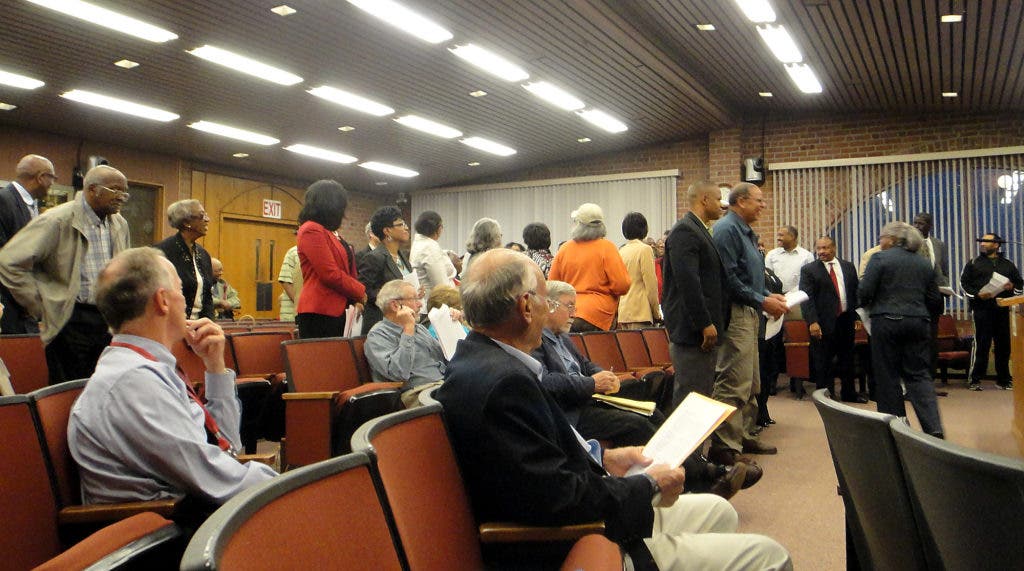
City and county black leaders gathered in the council’s chambers on Monday to voice concern over equal representation in Anne Arundel County.
The crowd of about two dozen included an Annapolis alderman, two school board members and representatives of the National Association for the Advancement of Colored People (NAACP). They did not ask for any specific measure, but a minister read a prepared statement.
The message was directed squarely at County Executive John Leopold and members of the council.
“We want to make sure that all of the departments and agencies that serve the residents of Anne Arundel County reflect the community in which they serve,” said Tywana Tyler, a minister. “We also request the county government make a concerted effort to ensure that minority businesses are included in the procurement process.
“In short, we want to make it clear that we citizens and voters will not tolerate the subsidization of discrimination with our hard-earned tax dollars,” Tyler said.
Tyler then asked members of the audience to stand if they were there on the group’s behalf, and concluded their statement.
Council Cleans Up Zoning Measures
District 5 Councilman and Chairman Dick Ladd forwarded two zoning changes affecting small businesses and townhouses that he said would correct “obvious shortfalls” in the current zoning code.
Under bill 63-11, business complexes of up to 10,000 square feet in size would be allowed under the small business district category. As long as they resembled a house on the outside, they’d be allowed (as one councilman put it). Other uses for small business districts include childcare centers, bookstores and delicatessens.
Ladd said this measure came up during talks of comprehensive rezoning, which is nearing its final round.
With bill 64-11, sponsored by District 3 Councilman Derek Fink, a technical change to the allowable size of townhomes was reduced to 16 feet wide. Fink said this was a cost-savings measure that would allow builders to provide homes at more than $30,000 less. Before the bill, for every 16-foot-wide townhome, builders must also build a 20-foot-wide home to meet a required average width. Under the new code, that average is not necessary.