Community Corner
Charlestown's Polly White Thanked by Everyman Theatre for Her WWII Aviation Service
She flew Hundreds of Missions
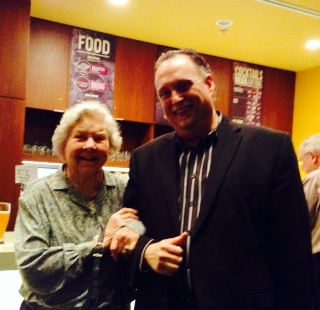
CATONSVILLE, MD (November 7, 2014) -- Charlestown retirement community resident Polly White last night was honored by Everyman Theatre in Baltimore City for having been an aviation pioneer during WWII.
White, who flew hundreds of missions in the war as a Women’s Airforce Service Pilot, was thanked at the performance of “Grounded,” a play about a current female fighter pilot who is switched to a desk job to fight the enemy with drones.
White was met by Everyman Theatre Founder and Artistic Director Vince Lancisi (seen with her in above photo, courtesy Everyman Theatre). She held discussions with Nora Stillman Burke, the theatre’s Education Director, and she was greeted from the stage and introduced to the applauding audience by Megan Anderson, the star of the one-woman show.
Find out what's happening in Catonsvillefor free with the latest updates from Patch.
White today is among a small group of unsung women heroes whose aviation skills helped the United States win WWII. She served as a flight instructor and a tow-target pilot for gunnery training. She was also an engineering flight test pilot and she flew radio-controlled planes. Less than 100 of the nearly 1,100 original Women’s Airforce Service Pilots (WASP) remain.
White flew ATG training aircraft and P40 fighter planes along the west coast of Texas. She averaged four flights daily from 1943-1944. Her dedication to mission paralleled her resolve to serve her country at a time when women were normally far removed from direct combat support operations.
White, a native of Boston who worked as a secretary in Washington, D.C., in 1942, found out about the WASP program at a luncheon in New Hampshire with her mother and an editor of Flying Magazine. She immediately arranged for a meeting in the nation’s capital with Jacqueline Cochrane, who headed the WASP program.
“I didn’t let any grass grow under my feet,” she said. So much so that she quickly learned to fly at Lacoma Airport in New Hampshire after being told by Cohrane that she would need 35 hours of flying experience in order to qualify for the WASP program.
“We were treated as officers,” she said, proudly displaying her uniform ‘Wings’ and her Congressional Gold Medal – the highest honor a civilian can receive from the U.S. Government. ‘I did whatever I could to help my country.”
As a WASP she earned $150 per month while in training, and $250 per month after graduation. She paid for her own uniform, lodging, and personal travel to and from home. She was hired under the U.S. Civil Service.
Her piloting skills were severely tested when a hurricane hit during the time she was stationed in Victoria, Texas, and she had to move aircraft out of the storm’s path. “I flew planes in a hurry to Dallas,” she said, “without any charts to follow. That was rough.”
In 1944, just as the bill to militarize the WASP went before Congress, the need for pilots decreased. The decision was made to deactivate the WASP, and the program formally ended on December 20, 1944
This amazing experiment using women pilots during wartime seemed destined to be forgotten. Then, in the mid-1970s, the U.S. Navy announced that, for the first time in history, women would be permitted to fly military planes. The WASP finally gained their belated militarization from Congress in 1977.
In 2010, the surviving WASP – including White -- were awarded the Congressional Gold Medal by the United States Congress.
“I did my job well,” she said.