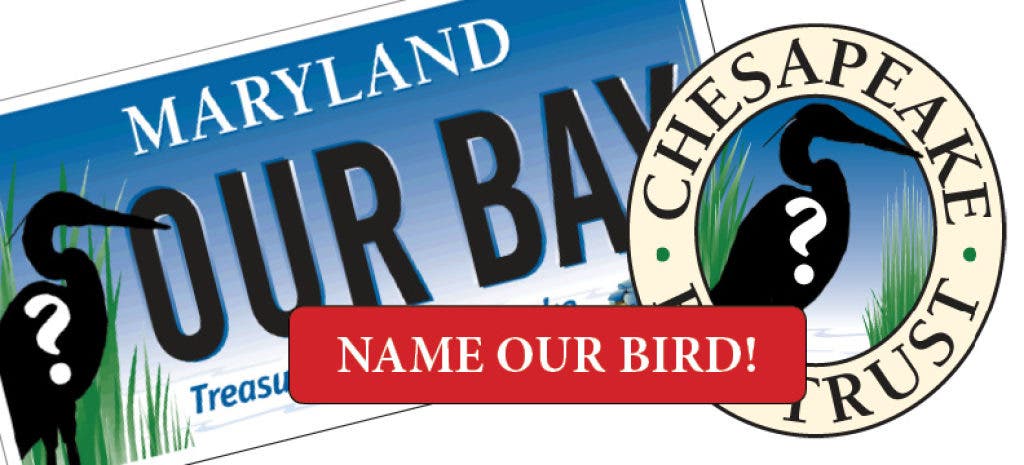
(Annapolis, MD) April 19, 2013 – The quest for a name for the Chesapeake Bay’s iconic blue heron has begun. Over the past two weeks, the Chesapeake Bay Trust, a non-profit grantmaking organization dedicated to restoring the Chesapeake Bay and its rivers, has been accepting suggestions to name the famous blue heron used on the organization’s official logo and Treasure the Chesapeake license plates. More than 550 names were submitted for consideration in the Trust’s “Name Our Bird” competition, and the field has been narrowed down to three wonderful possibilities: Hattie the Heron, Seemore D. Bay and Wade.
“We are thrilled to see so many creative ideas to name the beautiful blue heron found on Maryland’s Treasure the Chesapeake license plates,” said Molly Alton Mullins, director of communications at the Chesapeake Bay Trust. “Submissions ranged from names that rhymed with heron, to ones that represented famous Marylanders, to others that held a personal story or connection the submitter had with the Bay. It was incredibly hard to narrow it down, but we think we found three great name ideas for the public to choose from.”
Find out what's happening in Elkridgefor free with the latest updates from Patch.
Hattie the Heron was submitted by Janet Dimalanta of Jessup, Md., who when asked why she liked the name, said “Hattie was my 4 Greats back Grandmother's name. I looked at your picture of the Heron and Hattie just popped into my head. She was a strong woman and so is our beautiful bird. It just seemed to fit to me.” For Seemore D. Bay, submitted by Lesley Ann of Chester, Md., her reason was, [this name is] “A reminder to all to 'see more of the bay' and protect our treasure each day!” The third naming option is Wade, submitted by Megan Flickinger of Frederick, Md. She thought this name was fitting for the iconic symbol because “"It's simple and descriptive, as herons wade in the water to fish."
Find out what's happening in Elkridgefor free with the latest updates from Patch.
The three names will be voted on by the public from April 19 until April 26 at www.bayplate.org. The winning name will be chosen on April 29 and there will be two grand prize winners; one for whose name is chosen to represent the blue heron and the other a randomly selected voter who chose the winning name. These winners will receive fantastic prizes including Southwest airline ticket vouchers, a free Bay Plate, tickets to the Trust’s Treasure the Chesapeake Celebration gala and other gifts. There are also fantastic giveaways for the runner-ups and randomly chosen participants daily throughout the contest. Visit www.bayplate.org to see the official rules and prizes.
“Our region’s famous blue heron means more to Marylanders than just being a resident of the Chesapeake; it is a symbol of the Bay’s health and resiliency,” continued Mullins. “We hope that through this contest we can remind residents of the Chesapeake Bay Trust’s mission to improve the Bay. Each of us can make a difference by simply purchasing a Treasure the Chesapeake license plate, which supports environmental education and restoration work in local communities and throughout the Bay watershed. And now, that heron on that license plate will have a name!”
For more information on the Chesapeake Bay Trust and how you can support Bay restoration, visit www.cbtrust.org. To enter the contest and for its official rules, visit www.bayplate.org.
About the Chesapeake Bay Trust:
The Chesapeake Bay Trust is a nonprofit grant-making organization dedicated to improving the Chesapeake Bay and its rivers through environmental education, community outreach, and local watershed restoration. Since its inception in 1985, the Trust has awarded $50 million in grants and engaged hundreds of thousands of citizen stewards in projects that have a measurable impact on the Chesapeake Bay and its tributaries. The Trust is supported by the sale of the Maryland Treasure the Chesapeake license plate, donations to the Chesapeake Bay and Endangered Species Fund on the Maryland State income tax form, donations from individuals and corporations, and partnerships with private foundations and federal and state agencies. Ninety percent of the Trust’s expenditures are directed to its Chesapeake Bay restoration and education programs.