Community Corner
Elkridge Icon Honored on National Civil Engineering Stage
The Thomas Viaduct, built in 1835, was recently declared a National Historic Civil Engineering Landmark.
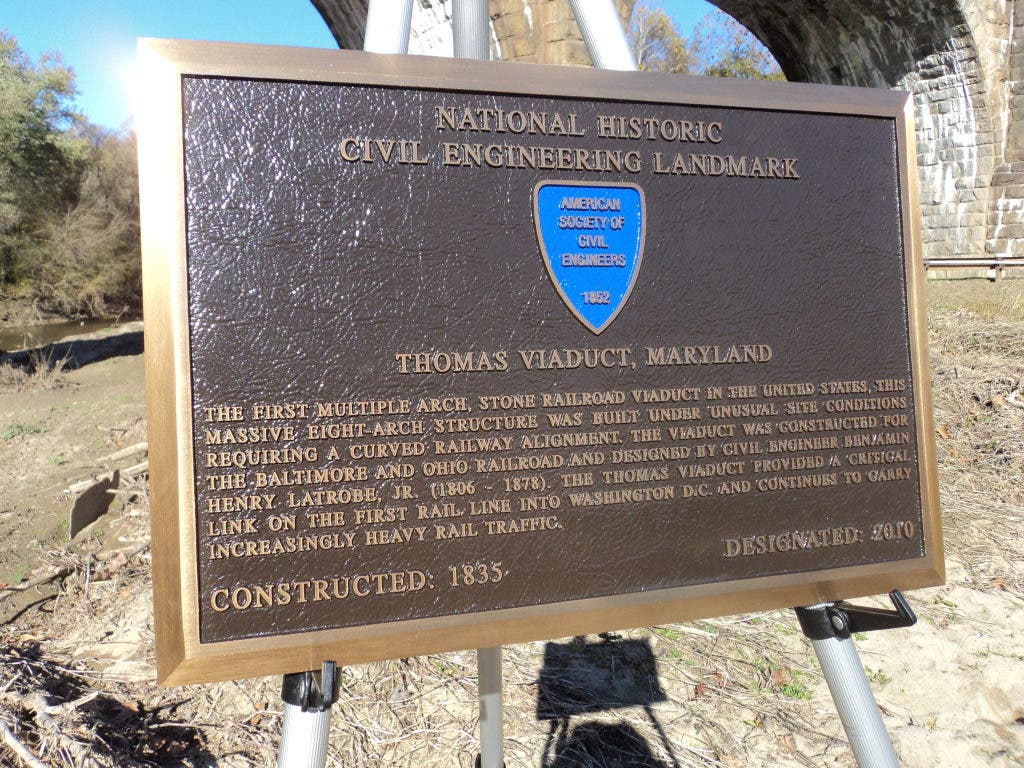
For 25 years before the Civil War and nearly every day since, the Thomas Viaduct in Elkridge has, without much fanfare, dutifully ferried freight and passenger trains across the Patapsco River Valley.
The viaduct, one of the oldest large stone-arch railroad bridges in the world, was recently named a National Historic Civil Engineering Landmark by the American Society of Civil Engineers (ASCE).
The honor was the culmination of efforts by local advocates over many years to cast a national spotlight on the structure.
Find out what's happening in Elkridgefor free with the latest updates from Patch.
“This was the first time a bridge like this was built on a curve. It was a very innovative design for its time,” said John Slater, vice president of the Friends of Patapsco Valley and Heritage Greenway, a nonprofit dedicated to preserving and protecting the Patapsco River Valley.
“You have to remember that the Patapsco was a raging torrent in those days,” said Slater. "Benjamin H. Latrobe, Jr., the viaduct’s designer who went on to become the B&O’s long-serving chief engineer, faced difficult site conditions and solved them with numerous design innovations."
Find out what's happening in Elkridgefor free with the latest updates from Patch.
The viaduct’s 4.5-degree, 1,273-foot radius curve made the upstream side of the bridge longer than the downstream side. To account for the difference and simplify construction, Latrobe maintained a uniform size for both sides of the bridge’s eight arches, but made the piers that they rested on wedge-shaped, according to Slater.
“This served as a precedent for other multiple-arch stone viaducts constructed in the years that followed,” wrote Raymond E. Streib, a member of ASCE, in a message to local community leaders about the viaduct's designation as a National Historic Civil Engineering Landmark.
Named for Philip E. Thomas, B&O’s first president, the viaduct was constructed of Ellicott City granite and is 66 feet above water level.
The successful completion of the Thomas Viaduct in 1835 allowed the B&O to be the first railroad to serve the nation’s capital. It has been in continuous service for without any significant repairs or enhancements, according to Matthew Fenton, a civil engineer and painter who serves as history and heritage chair of ASCE’s Maryland section.
Thomas Viaduct also has these credits to its name:
- Designated National Historic Landmark by the Department of the Interior in 1964
- Recognized as a State Historic Civil Engineering Landmark by the Maryland section of ASCE in 1999
- Listed in the Historic American Engineering Record
Andrew W. Herrmann, national president of ASCE, unveiled a bronze plaque designating the viaduct as a National Historic Civil Engineering Landmark before a gathering of 100 people, including several politicians, at the Avalon Area of on Nov. 5. The viaduct itself, silhouetted by a brilliant blue sky, served as a backdrop for the ceremony.
Next week on Patch: Future plans for Thomas Viaduct