

Pearl
A pearl is not a stone at all. It is the organic product of a few types of shellfish. The pearl is the only gem that does not have to be cut and polished. It is ready to wear when taken from the shell in which it has grown.
The Egyptians, Persians and Hindus held the pearl in great esteem and the Romans learned of it from them. Julius Caesar was a great fancier of pearls. The couches and trappings of the Romans literally glowed with pearls. Roman women wore them in their sleep to remind themselves of their wealth.
Find out what's happening in Elkridgefor free with the latest updates from Patch.
The pearls brought back from the Orient by the Crusaders probably spread the appreciation of these gems to Europe, where they were worn as personal ornaments by men and women of high rank. In fact, pearls were so much in vogue that a subsequent period in European history was called the Pearl Age.
Not only was the pearl sacred to the Greek goddess of love, Aphrodite, and to her Roman counterpart, Venus, (who also came from the sea). The white radiance of the gem made it a favorite of Diana, the chaste moon goddess.
Find out what's happening in Elkridgefor free with the latest updates from Patch.
Pearls were dedicated to the Angel Gabriel and adorned the gates of the New Jerusalem, probably the original "pearly gates." They were fundamental in the Table of the Koran and the Hindus thought them the divine creation of Vishna.
The pearl has always been the gem of modesty and purity and has been believed to have a power for the good: to bring succor in troubled times, to cement friendships and to strengthen weak hearts and memory. The pearl supposedly gives its wearers the courage to resist and overcome evil, eases irritability, wards off pestilence, increases the fruitfulness of oxen and cures blood disorders!
As the birthstone for June, the pearl brings a promise of health and longevity.
There are two more birthstones for June.
One is the alexandrite, the other the moonstone.
Alexandrite Beads
The alexandrite has the remarkable property of displaying two colors: green by day and red at night. Poets have spoken of this variety of the mineral chrysoberyl as "an emerald by day and a ruby by night."
Alexandrite is an uncommon stone, and therefore very expensive. Sri Lanka is the main source of alexandrite today, and the stones have also been found in Brazil, Madagascar, Zimbabwe, Tanzania, and Myanmar (Burma). Synthetic alexandrite, resembling a reddish-hued amethyst with a tinge of green, has been manufactured but the color change seen from natural to artificial lighting cannot be reproduced. Such stones have met with only marginal market success in the United States.
The stone is named after Prince Alexander of Russia, who was to become Czar Alexander II in 1855. Discovered in 1839 on the prince’s birthday, alexandrite was found in an emerald mine in the Ural Mountains of Russia.
Because it is a relatively recent discovery, there has been little time for myth and superstition to build around this unusual stone. In Russia, the stone was also popular because it reflected the Russian national colors, green and red, and was believed to bring good luck.
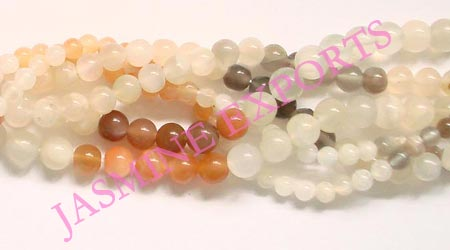
Moonstone Beads
The moonstone gemstone bead is named for the bluish-white internal reflections that seem to have a silvery play of color like the moon. The more of this silvery light a stone has and the more translucent it is, the greater its value. Not all moonstones have this pearl-blue hue; some have a green, blue or yellow tint. When the gem is turned back and forth, its shows silver rays that have been compared to moonbeams dancing over the water.
The moonstone has no sharp edges and is sometimes liked to a raindrop or tear. The Asians, steep in gem lore, point out that when there is a moon there is no rain and so the name, moonstone, means "no tears." The moonstone is believed to arouse tender passions in lovers. According to legend, a moonstone placed in the mouth while the moon is full gives lovers the power to read their futures together.
Moonstones have been found in Switzerland, Sri Lanka and more recently in India. Small stones are found relatively often; larger stones of unflawed quality are more rare.
The moonstone has always been regarded as bringing luck and is held in high esteem in the Orient where it is believed that it has a live spirit that moves as the stone is turned. Superstition says it has the power to hypnotize the person who gazes at it as it moves back and forth.
In India, the moonstone is considered a sacred stone and often displayed on a yellow cloth – yellow being considered a sacred color. The stone is believed to bring good fortune, brought on by a spirit that lives within the stone.
As a June birthstone, the moonstone is a lucky gem that stands for friendship.