Politics & Government
Sanctuary Bill a 'Symbol' for Howard County, Community Members Say
Approximately 80 who testified were split on whether to make Howard a sanctuary county for undocumented immigrants.


ELLICOTT CITY, MD - The word symbol was woven throughout testimony before the county council Tuesday night regarding a proposal to make Howard County a sanctuary for undocumented immigrants.
More than 80 people testified about the "sanctuary bill" during a public hearing that continued from Tuesday night to the early hours of Wednesday morning and will resume Wednesday evening. The proposed legislation would declare Howard a place where county employees may not inquire about a person's immigration status.
Approximately 40 people testified in support of the bill, 37 opposed it, four proposed amending it and one sardonically supported the proposal so Howard could help shoulder the pressures she said her jurisdiction - Montgomery County - was experiencing since it became a sanctuary.
Find out what's happening in Ellicott Cityfor free with the latest updates from Patch.
Some appeared before the council for the first time, compelled by the issue and the state of the nation.
"I don't protest. I don't march. I don't agitate," said Daniel Newberger of River Hill. "I stay on the sidelines." However, he continued: "These are not ordinary times," speaking in a packed room that had to be cleared repeatedly by the county council because of cheering and clapping, which were prohibited, to restore order.
Find out what's happening in Ellicott Cityfor free with the latest updates from Patch.
"Symbols matter. Words matter," Newberger said. Juxtaposing the sanctuary bill with the election of President-elect Donald Trump, who has spoken about building a wall to secure the U.S.-Mexican border, Newberger said that 71 percent of Howard County voters cast their ballots for candidates other than Trump. To the council, he said: "The people of Howard County have told you which way to choose."
Howard County Police Chief Gary Gardner testified against the bill, saying it was codifying something his officers did not need in writing and which could hamstring public safety efforts.
"When it comes to immigration status, we don’t ask," Gardner said. "We treat everyone the same regardless of their status."
Becoming a sanctuary county "could tie our hands" with regards to funding and agency cooperation, he said.
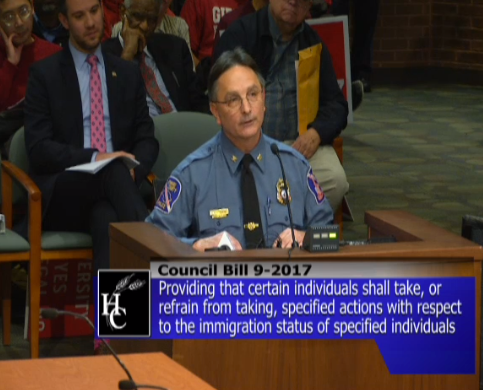
The Inspector General put police departments across the country on notice last summer that sanctuary status could preclude a jurisdiction from receiving federal funding. Howard County received a $50,000 grant for crime suppression this year, Gardner said, and has secured as much as $1.2 million before.
On the flip side, immigration attorney Jonathan Greene said that he believed the bill would not violate federal law.
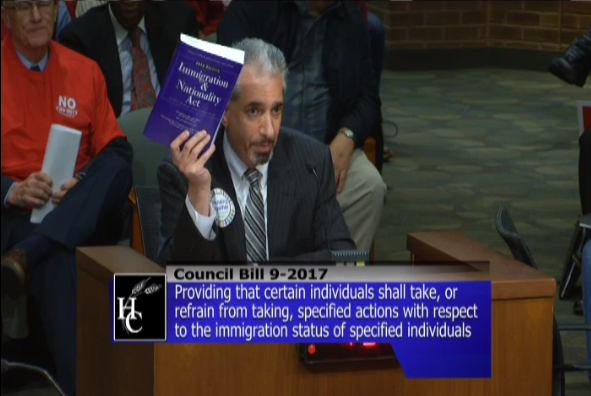
Greene referenced Trump's proposal to create a registry of Muslims as a demonstration of the need for the sanctuary bill as a counterforce. "Imagine rounding up children, seniors..." Greene said.
"These people are in danger because of the things Trump has said," testified Pooja Singh, who identified herself as a documented immigrant advocating for sanctuary status for her undocumented counterparts.
Supporters of the sanctuary bill said that it was essential to ensure Howard County remains inclusive.
"Just because it has been an open, welcoming place doesn't guarantee that it always will be," Howard County Register of Wills Byron Macfarlane, a Democrat, said.
"This bill is about anti harassment and civil rights protection," Marcia White said in support of the proposal, on behalf of the Howard County Democratic Central Committee.
- 'Sanctuary County' Bill Divides, Confuses Constituents in Howard
- Kittleman to Veto 'Sanctuary County' Bill
- 'We are Disappointed' by Kittleman's Response: Sanctuary Bill Sponsors
Howard County Council Vice Chair Calvin Ball and Councilwoman Jen Terrasa said they introduced the bill because the "recent national political climate has galvanized support for xenophobic, Islamophobic, and racist sentiments within certain portions of the population, resulting in increased incidents of hate speech and violence," according to the proposed legislation.
Some said the language in the bill was "offensive" to the citizens of Howard County.
"It has polarized this community unnecessarily," according to Jean Xu. "...if we don't agree with your bill, then we must be xenophobic, Islamophobic..."
Patrick Dornan of Glenwood echoed this sentiment, telling the council: "I demand that you stop calling me a racist."
Noting the buttons and t-shirts that various citizens were wearing around the room, Susan Garber said: "If this legislation is intended to unite us, it has had quite the opposite effect." Garber is the director of the Howard County Citizens Association.
Many of those demonstrating their opposition to the sanctuary bill were those who had legally immigrated to the U.S. Among them was Tae Kim, a Columbia attorney speaking on behalf of Koreans in Howard County.
"We are against this bill," said Kim. The sanctuary status would "do nothing but cast a pall over the hard-working" immigrants who come to the U.S. legally, he said, stating: "We don't need your pity, your sympathy, your protection as if we as an immigrant community can't succeed on our own."
When asked whether his children felt unsafe in school, Kim said they had not, although his son was "ridiculed" for wearing a Trump t-shirt the day after the election.
Several people testified that they would feel fear should the county not be designated as a sanctuary.
"If this bill isn’t passed, [undocumented immigrants] will be afraid to go to the hospital," a Long Reach High School student said.
"Communities are safer when victims or witnesses of crime feel they can come forward," Dawn Pop of Elkridge said. "This is a defining moment for our community."
Many lived in fear that if they ran a red light, they could be pulled over and sent back to their country, according to Celebration Church Pastor V. Lawrence Walker Sr. "Our nation is a nation of immigrants," Walker said. "People shouldn't have to live that way, not in Howard County."
Others said that a sanctuary bill would signify laws were not going to be enforced in Howard County.
"When you ask police to look the other way, what message are you sending?" Matt Mancuso of Sykesville said. The bill could "endanger our police, promote crime and jeopardize the safety of our citizens."
Robert Gillette, who spent eight years in the Navy, said that he, too, disagreed with the message the "symbolic gesture" would send.
Some of his comrades joined the military as a pathway to citizenship. The bill "says to them that their sacrifice and their service doesn't matter," Gillette testified. "I just think that's wrong, particularly to those that serve in combat...I am worried about the message you're sending to my fellow veterans."
Another citizen said that he saw Howard as part of a "growing chorus" chiming into the national discourse that the country does have an issue with immigration.
"We can't solve the immigration problem in Howard County," T.J. Mayotte of Elkridge said. "We can stand up and say, 'Let's treat our neighbors as people and not problems.'" Federal officials and other communities, he said, were taking note.
"It is symbolic," Nigel Tzeng of Columbia said of the bill. "Children are watching what we say and what we do."
A public hearing on Council Bill 9 will resume at 7 p.m. on Wednesday, Jan. 18, for those who were on the list to testify and had yet to be called. There will be a council work session on the proposed legislation at 4:30 p.m. on Monday, Jan. 23.
Still from Howard County government video.
Get more local news delivered straight to your inbox. Sign up for free Patch newsletters and alerts.