Kids & Family
Button Farm: Germantown's Antebellum Flashback
Renovation plans for Germantown farmstead includes historical immersion workshops that depict plantation life in Montgomery County.


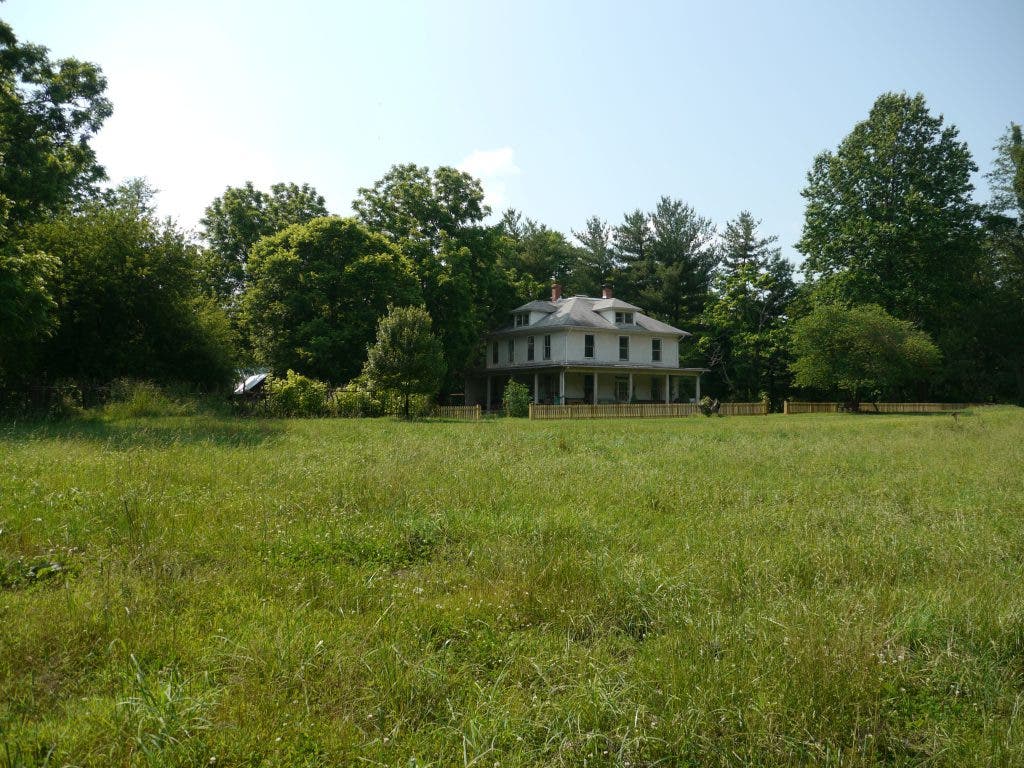


Tucked away at the edge of Germantown, Button Farm simulates 19th century plantation life. But instead of what you’d expect at a historical site — historic buildings, docents in period attire — the farmstead proposes extending the “living history” experience to the visitors.
A nearly half-million dollar makeover expected to wrap up by next season includes plans for an “immersion experience” in which visitors could live out what it was like to be a slave in Montgomery County, according to the farm’s founder Anthony Cohen.
“When you walk into that field you will be walking back in time,” Cohen told Patch.
Find out what's happening in Germantownfor free with the latest updates from Patch.
To get a sense of what this means, Patch caught up with Cohen and toured the property with the CSA manager Cara Light, ahead of the farm’s open house Saturday, June 2, from noon to 4 p.m.
The farmstead plans to spend $600,000 on renovations, with $80,000 coming from the county, $300,000 from a state bond bill and $220,000 from in-kind donations, county records state.
Find out what's happening in Germantownfor free with the latest updates from Patch.
While the bulk of the funds would go toward fixing the farm’s Civil War-era barn and updating the farmhouse, Cohen said there were also plans to relocate and reconstruct a salvaged 19th century log cabin and transform the 17 acre field that surrounds it into a mini 1850s-style farm.
Cohen said visitors could sleep at the farm — shorter four-hour workshops would be arranged for large groups — and re-create some of the day-to-day experiences of plantation life.
In its early days, Button Farm was used for agriculture. Montgomery County farmers would have grown corn and grains. The region’s earliest settlers would have grown tobacco.
To be clear, Button Farm bears the name of the family that owned in 1971, before the Department of Natural Resources leased the site to Button Farm’s fundraising arm, the Menare Foundation, through the state’s resident-curatorship program.
But Cohen said the first family to live at Button farm owned 18 slaves.
A man named William D. Hughes bought the land in 1878 and built a house there in 1882, Germantown Historical Society President Susan Soderberg . Her column on Button Farm continues:
“This first house is long gone, but the Hughes family barn is still on the farm. William and Elizabeth Hughes mainly grew wheat and raised some livestock. They had eight children.”
During a tour, Light, the CSA manager, led the way to a wooded area near a Seneca Creek bike path. Obscured by long blades grass was an array with nondescript stones — though one had an etching of a cross.
It is believed to be a slave cemetery.
“This is probably one of my favorite places on the property,” Light said. “People who bike past this probably have no idea it is here.”
This sort of spin on "living history" is something Cohen has become known for.
In 1997, he helped Oprah prepare for her lead role as Sethe in the film adaptation of Toni Morrison’s “Beloved” by re-creating the experience of a runaway in Maryland’s Eastern Shore. Under Cohen’s watchful eye, Oprah spent 48 hours sleeping in caves, trekking through the woods along streams.
In fact, what caught Oprah’s attention in the first place was something else Cohen had done the sake of re-living the past — shipping himself in a box via Amtrak in order to channel the experience of a real-life Virginia runaway named Boxcar Brown.
Cohen said the immersion experiences proposed for Button Farm would be a lighter version of the “Oprah experience.”
Get more local news delivered straight to your inbox. Sign up for free Patch newsletters and alerts.