Schools
Ulysses Scholars Showcase Projects at Northwest
High school students present findings on technology, science, music and astrology.
In November, Sarah Agate asked a friend to run into her house, snatch a purse from the couch and run out screaming while her sister and friends were in the home.
Sarah’s no criminal mastermind. She’s a Ulysses Scholar. The senior staged this act for the sake of science: a research project investigating the reliability of eyewitness recognition, especially for criminal proceedings.
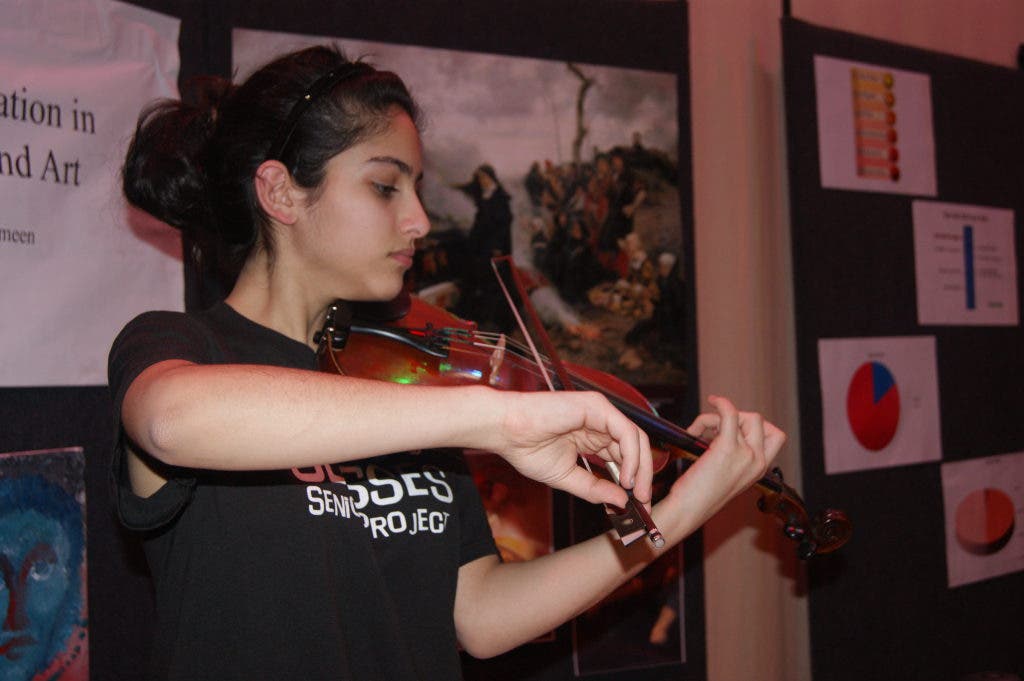
On Thursday and Friday, she and 41 other students involved with the Ulysses Signature Program exhibited the fruits of their research during a fair inside Northwest’s auditorium, where topics ranged from science, fashion, design, music, weather and health.
Find out what's happening in Germantownfor free with the latest updates from Patch.
The Ulysses Signature Program is an academic module in which students carry out a full-scale research project. What was presented on Thursday and Friday was the culmination of four years’ worth research, according to Suzanne Borenzweig, the program’s coordinator. Borenzweig said students often get help from experts.
“One of my students this year was mentored by a neighbor who is an astrologist,” Borenzweig said.
Find out what's happening in Germantownfor free with the latest updates from Patch.
Sarah, the senior who had a friend pretend to steal a purse from her house, said she was surprised by her friends and sister’s eyewitness accounts.
“They could not agree on what he was wearing or what he looked like,” she said. “A girl who went to summer camp with the ‘suspect’ could not even identify him.”
Another student, history fan Carson Fehner, explored how terrain might have impacted the outcome of the Battle of Antietam on Sept. 17, 1862, the Civil War battle considered to be the bloodiest day of battle in American history.
Carson concluded that Union Army’s Maj. Gen. George B. McClellan was at a disadvantage when it came to the terrain.
“The truth of the matter is, when you look at the terrain you notice that the Confederates have numerous terrain advantages,” Carson said. “They have a very highly defensible position and McClellan did not have a good intelligence network.”
Katie Nerud did not have to go back hundreds of years to find an area of study that captured her interest — how the brain manages pain. While in the seventh grade, Katie injured her ankle. However, she noticed that after the physical injury healed, having spent more than a year in a wheel chair and in crutches, Katie said she was still experiencing pain.
The doctor later explained she had reflex sympathetic dystrophy, a condition in which the brain remembers pain long after the physical trauma was experienced.
Borenzweig said the Ulysses Fairs are a way for the public to see what the students have spent so much time working on.
Nancy Painter, a mom whose son will be showcasing his project in spring, has been coming to the Ulysses Fairs for three years.
“It is good to pick up information for use in our daily lives,” Painter said. “Like the research study on the violence of video games, that is a running debate in our house and the one dealing with concussions on student athletes, I have an active son and such information will help us.”
The next Ulysses Fair is scheduled for May.