Schools
Student Scholars Dissect Pop Culture During Ulysses Signature Program Fair at Northwest
Reality television, film and beauty industries, artificial intelligence and others get the critical eye from students
Northwest High School senior Kalkidan Ejamo has two loves after her heart: books and film.
The Ulysses scholar and a self-described bibliophile said she has never seen a good film adaptation that did any book justice and she wants to change that.
“I had always judged the movies really harshly without understanding why some parts had been cut out or what the trouble really was,” said Ejamo, who presented a her research paper about the process of adapting books to film Wednesday at Northwest’s auditorium.
Find out what's happening in Germantownfor free with the latest updates from Patch.
“But after researching I realized the directors really had no choice,” she said. “If they are to give the movie some flavor they have to cut or the story would be too long.”
Ulysses is a signature honors program for juniors and seniors, concentrating in areas of arts and humanities, public policy and public service or science and technology. Graduating seniors carry out independent research and make presentations of their findings in 30-minute presentations to specific classes, hold demonstrations and answer questions.
Find out what's happening in Germantownfor free with the latest updates from Patch.
The program has been running for eight years.
Projects on display run the gamut from zombies, modern dance, Egyptology and the outsourcing American culture to India. Principal Lance Dempsey said the extensive research students undertake serves them well in their college years and some students write back to say what an easy time they are having with college research papers. In total since the program began Northwest has had a total of 252 Ulysses research projects.
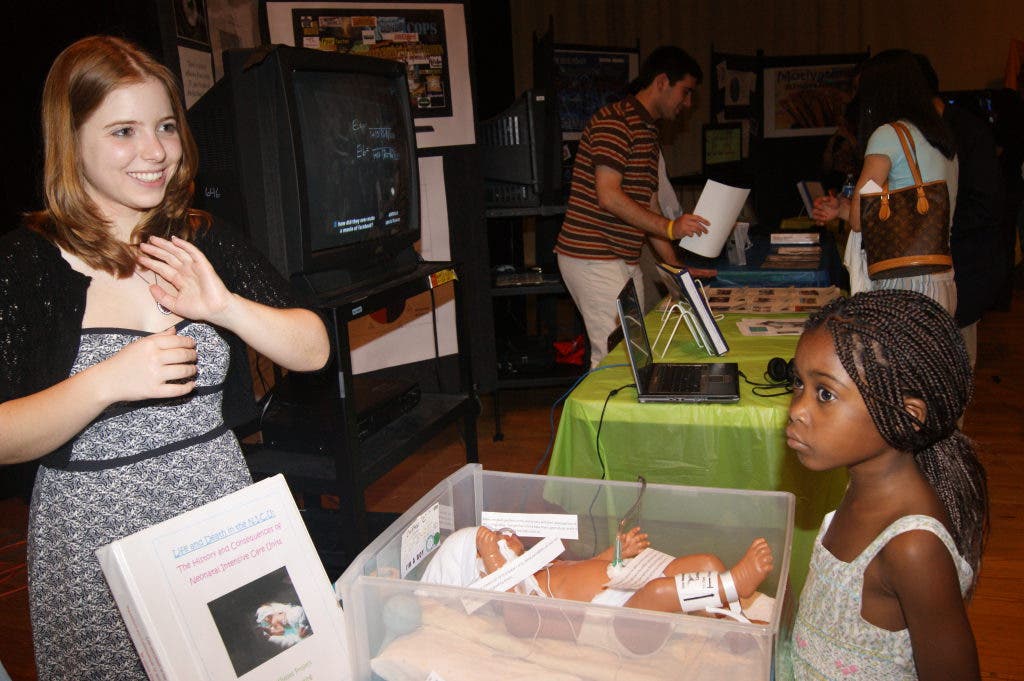
Projects like Giselle Keating’s exploration of the history, technology and ethics of neonatal intensive care. At her table, she displayed a plastic baby in a real incubator. On the table, there was a diaper so tiny that it fit in the palm of her hand. Keating, who volunteers at a local hospital, said she had always been fascinated by medicine. She said she was surprised to learn that across America in the early 1940s, babies in incubators were a circus attraction.
“They were kind of part of a freak show and you would pay to see incubator babies,” she said. “They had nurses with five or six tiny babies that they are holding up and I was thinking this is so unethical. I was completely shocked by this.”
Ejamo, the budding movie director, said she is dreaming big. She wants to bring her version of F. Scott Fitzgerald’s “The Great Gatsby” that she has created in her head to the silver screen. In her research, she said she found directors adapted classic books with popular actors and actresses because both people and books have a good following. She is already making casting plans for what she anticipates will be the most challenging book to film adaptation. Ejamo wants Reese Witherspoon as Daisy and Leonardo DiCaprio as Gatsby.
John Borg, a fan of the MTV reality series Jersey Shore, chose to look into the cultural, social and psychological influences of reality shows. He concluded that while most of us can get over the vulgar language and see reality TV shows as harmless fun, there is more going on in our brains that we realize.
“When you watch TV the left hemisphere is completely handicapped like only your right hemisphere is active,” he said. “When this happens you lose your ability to form your own unique logical thoughts and that makes that much easier for the show’s message to have an influence on us if you can’t you know make your own thoughts. It is kind of scary.”