Community Corner
The Mill of the Waters Brothers
Stone ruins near Little Seneca Creek were once part of a system of mills.


Next to the wooded path from Waters Landing to Black Hill Park, just before the bridge over Little Seneca Creek, lie the mossy stone ruins of an old mill.
These weathered stones remind us of old Germantown. The stones stand as a memorial to those who have gone before us, those who cleared the forest, planted crops and made the land their own by mixing their labor with it.
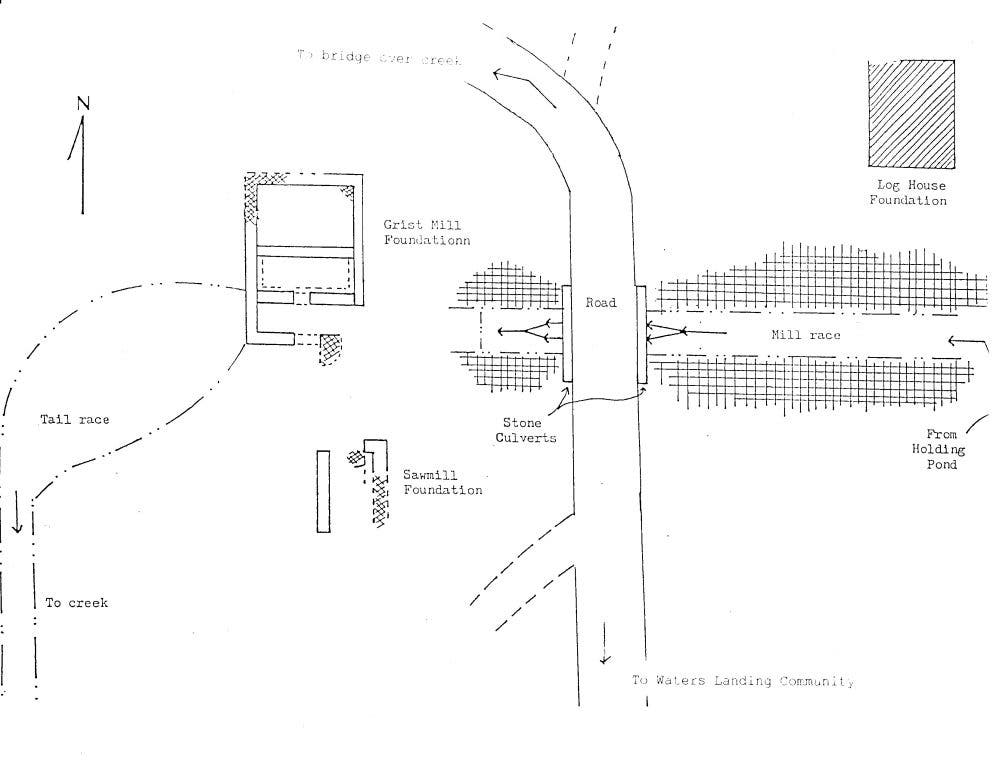
The most prominent ruins are those of the grist (grinding grain into flour) mill. A close observer can discern two rectangular rooms and a smaller three-sided enclosure where the over-shot (water running over the top of the wheel) millwheel was housed. The larger room was the office and the smaller was the cog-pit, where the power of the millwheel was transferred to a vertical shaft by way of wooden cogs. To the south of the grist mill are the remains of a saw mill, which seems to grow from the side of the hill. There was a third mill here, as well — a flax seed mill.
Find out what's happening in Germantownfor free with the latest updates from Patch.
The path crosses over the deep mill race — a huge open pipe that leads the water from Seneca Creek to the millwheel. The creek was dammed to make the water coming down the mill race and over the mill wheel more forceful and able to be controlled by the miller. Remains of this dam can still be seen about 400 feet east of the mill, where the mill race meets the creek. The low open area below the dam was the mill pond that held the water until it was needed. The path crosses the mill race over a stone culvert, and at the openings on the west side of this culvert wooden flumes would have been constructed to direct the water the rest of the way to the three millwheels.
The land where the ruins rest is called "William and Mary" and was first patented as 56 acres in 1752 by William Safford. Safford sold the land to Lawrence Owen in 1754, who passed it on to his son, Robert Owen, in 1761. Robert Owen then sold it to William Waters. None of the owners actually lived on the land until William Waters gave the property to his son Zachariah Waters. Zachariah Waters and his wife Anna Baker Waters moved to what is now called Germantown in 1787. Zachariah was soon joined by two of his brothers, Basil and William Waters Jr., who were given land on either side of Zachariah's by their father and built homes there. The Basil Waters House is the only one surviving today. The three brothers shared the mill for processing their crops.
Find out what's happening in Germantownfor free with the latest updates from Patch.
Zachariah, with the help, no doubt, of his 22 slaves, built the mill and miller's house and his own larger house nearby. Anna and Zachariah had three children: Tilghman, Baker, and Courtney. Tilghman was the only one to marry (Eleanor Magruder), but had no children. All are buried in a family graveyard near the house.
We know that the Waters family grew wheat and flax on the plantation because Zachariah's 1819 will, which gave all of the property to Tilghman, included in the property description: "a Grist Mill, a Saw Mill and an Aill [oil] Mill." Oil was made from flax seed had many popular uses in the 19th century.
having no heirs, Tilghman's will directed that the property be passed to his cousin Dr. Washington Waters and thence to his son, Washington D. Waters. Dr. Washington Waters married Tilghman's widow, Eleanor, and they resided at the Waters' homestead. He advertised the Mill for sale in 1874 and again in 1876, but had no takers. The Mill was finally sold to pay debts in 1895, and has had numerous owners since. By that time the mill was probably no longer in operation, the steam-powered mill next to the train tracks in Germantown (1888) having taken business away from most of the nearby water-powered mills. The mill is shown on the 1869 Martenet and Bond Map as "Mrs. Water's S&G (Saw and Grist) Mill;" and on the 1878 Hopkins Map as "Dr. W. Water's G&S [Grist and Saw] Mill.
On the top of the hill, to the northwest of the mills, are the ruins of the miller's house.
J. B. Jackson says that we in this modern age have a "necessity for ruins" because we don't have a continuous connection with the past as did the people before history was written down. When history was told by a storyteller or keeper of the memory of the tribe there was a personal connection with those who had gone before. When we have lost that personal aspect we need ruins to make the connection between our own lives and the history we read in books.
Your grandparents may not have lived here. Your great-great-grandfather may not have walked down the path through the woods to get his wheat ground into flour. But, looking at these mill ruins you can feel a certain connection with those people who used the mill, ran the mill and built the mill, and consider the great effort it took to haul those huge stones here, to dig that long and deep mill race, and in this way feel a sense of belonging here.