Health & Fitness
BLOG: Limits
"Once limits are placed on almost anything, you will find it much easier to take care of and therefore you will be more comfortable with it and enjoy it more."—Mel Bartholomew on raised beds.



“Once limits are placed on almost anything, you will find it much easier to take care of and therefore you will be more comfortable with it and enjoy it more.”— Mel Bartholomew on raised beds.
Americans don’t really like limits, but I guarantee that in this case limits are a good thing. You will find that when you contain a perfect soil-less growing medium (called Mel’s Mix), taking care of your garden will be much easier.
We’ve talked about raised beds (a.k.a. boxes) a few times already—how the most common size will be 4’ x 4’ because that’s how far you can comfortably reach in to work on that bed and because lumber is sold in 8’ lengths making it easy to make just a single cut to form the beds. We’ve noted that you can make the beds as long as you want but shouldn’t be longer than 16’ as you will be tempted to try to jump over it and risk stepping on, thus compacting, your soil.
Find out what's happening in Glen Burniefor free with the latest updates from Patch.
Mel says the best wood is FREE—castoff 2’ x 6’s found at a construction site are ideal, but PLEASE ask permission before you remove anything. When purchasing wood, pine and fir cost the least, but of course cedar or redwood will last longer. If you would like your raised beds to last longer you may paint or stain the OUTSIDE ONLY of the boxes. To protect the inside, you may use an oil that is food-safe. A list can be found on the following wood working web site: finewoodworking.com/SkillsAndTechniques/SkillsAndTechniquesArticle.aspx?id=26893
Although “pressure treated” lumber is made of “safer” chemicals nowadays, I still wouldn’t use ANY pressure treated lumber for growing edible items. This goes for pressure treated plywood if you are building a raised bed with a bottom. Here’s an article you should read: pubs.cas.psu.edu/freepubs/pdfs/uc173.pdf. There are hints to reducing the impact if you choose to use treated wood on page 4.
Find out what's happening in Glen Burniefor free with the latest updates from Patch.
There are a few types of “raised beds." One has an open bottom that goes directly on the ground. A box with a plywood bottom (and of course drainage holes) can be used on a deck or patio. You can even make a 6” wide box that will go on your deck rail or hook onto a chain-link fence.
Does that mean you have to use wood for your raised bed? Certainly NOT! You can build raised beds using stone, brick, bamboo, cinder blocks, vinyl, composite deck material (there are some like Trex which do not use harmful chemicals—but they are VERY heavy) or other materials. Just make sure that whatever you use does not contain harmful chemicals.
Since you’re using raised beds, you don’t have to worry about compacting your soil, you won’t be walking on it as you would in a traditional row garden.
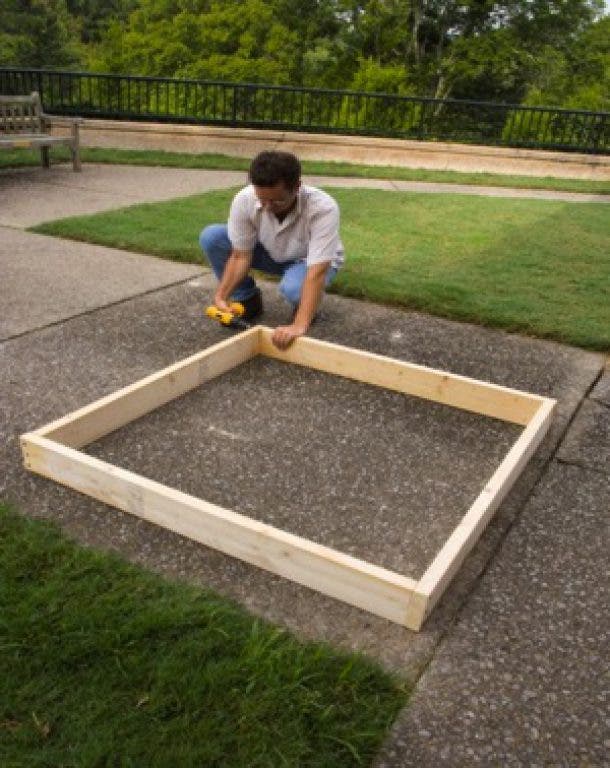
Let’s look at constructing a very simple wood raised bed.
Materials:
Four 2” x 6” x 4’ boards
Twelve deck or galvanized screws
Power drill
Philips head screwdriver OR screwdriver bit for your drill
Pre-drill three holes in one end of each board using a drill bit that is slightly smaller than the screws you will use (as shown in the first picture). The side of the board into which you are drilling is called the face of the board. It is best to construct the bed on a firm, flat surface like a driveway.
Make a simple butt joint by holding the first pre-drilled board against the end of a second board (NOT the same side that you drilled on the face of the second board). Because the end of the second board will easily split, you will use the holes of the first board as a guide to pre-drill holes into the end of the second board. Using a screwdriver or a screwdriver bit for your power drill, drive in the screws through the pre-drilled holes of the face of the first board into the pre-drilled holes in the end of the second board (second picture).
Continue attaching the four boards end-to-end until you make a square bed (third picture).
The next two Fridays we will discuss making the soil-less mix that is the heart of the Square Foot Gardening method.
FYI—I’ll be giving a short seminar on Square Foot Gardening at the Maryland Home & Garden Show Saturday, March 3, at 2 p.m. and again on Sunday, March 11, at noon at the Timonium Fair Grounds. If you’re there, please stop by and say HI!