Health & Fitness
BLOG: Location! Location! Location!
Unlike a large row garden that's usually far from the house, your Square Foot Garden is so attractive you'll want it close to your back door.


Where are you going to put your new Square Foot Garden (SFG)? Unlike a large row garden that’s usually far from your house, your SFG is so attractive you’ll want it close to your back door.
Of course the optimal conditions for ANY garden are about the same:
- Select an area that gets an average of 6-8 hours of sunlight a day.
- Make sure your garden is not located near trees and bushes—the roots will compete for the nutrients and water.
- Choose a location where the water does not puddle after it rains.
In addition to those three “givens," with the Square Foot Gardening method, you’ll want to add one more ... put it close to your house! Mel Bartholomew, the creator of the SFG method, suggests you “Keep in mind foot traffic and sites where you will often notice and enjoy your garden. If your SFG is near traffic paths, you’ll walk past the garden more often, hence take better care of it. This means it will always look nice and the end result will be that you’ll enjoy it more as will every other member of the family.”
Find out what's happening in Glen Burniefor free with the latest updates from Patch.
Another advantage to a SFG is you don’t have to put your entire garden in one space. For instance, I have a 2’ x 23’ SFG along the fence line with my next-door neighbor. Two 2’ x 6’ raised beds are located on the side of my house and I will be building one or two 2’ x 6’ beds on legs along the back of my house. Remember last week we said that raised beds up against a fence or house should not be wider than 2’ so that you can easily reach in to work on it? You can see a picture of my 2’ x 23’ garden in the second photo of my February 3 blog.
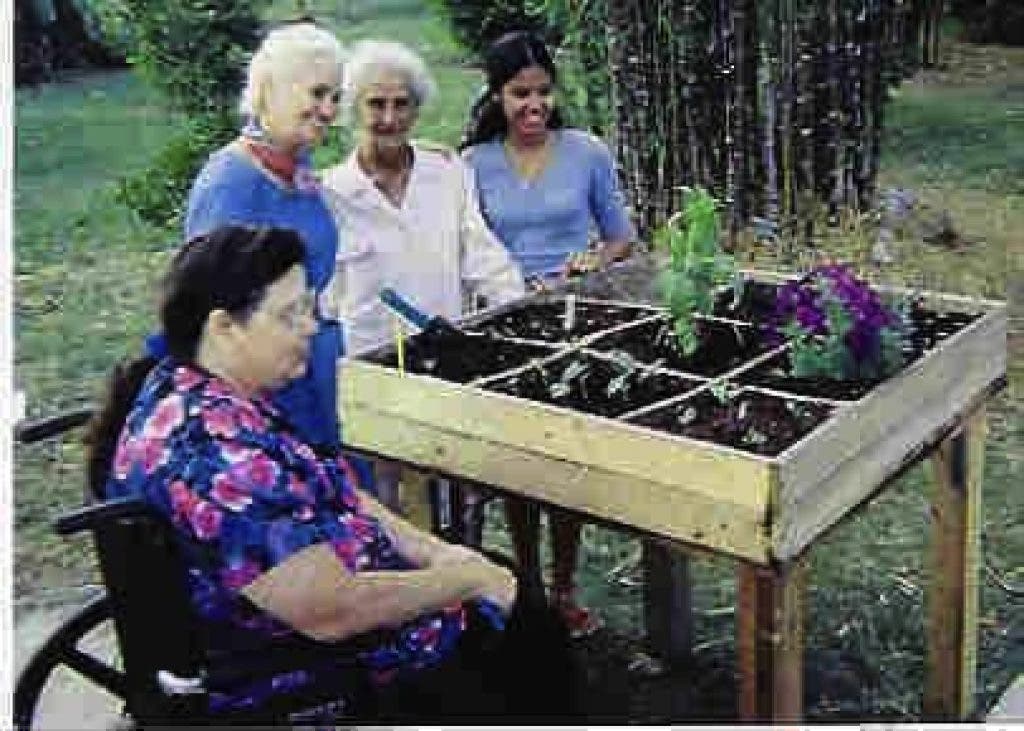
There are a few reasons I am putting legs on my SFG along the back of my house is two-fold. I teach Square Foot Gardening at my home and I try to have different types of beds as a “demonstration garden” to show people the various ways they can have a SFG that suits their needs. The bed on legs (a.k.a. a table top garden or an adaptive garden) can be used for those who have trouble bending over or who are confined to a wheel chair. Another reason is this bed will sit under the window of my office and I want to plant that bed with flowers and be able to enjoy them as I’m working.
Find out what's happening in Glen Burniefor free with the latest updates from Patch.
One of the photos above shows a rough sketch of my yard. You will want to make a similar sketch of your yard so you can find places that will be good to put your raised beds. The sketch doesn’t need to be to scale—at this stage you just want an idea of where you will locate your garden(s). Some important things to consider are the orientation of the sun, obstructions or structures such as sheds, decks, any shade you will get from your neighbor’s trees, solid fences, etc.
How many “squares” will you need? As a rule-of-thumb you will want 16 squares per adult for salad fixings for a season—this would equal a 4’ x 4’ raised bed (or a 2’ x 8’, etc.). For supper vegetables, you will want an additional 16 squares per adult. If you want to grow extra for canning, freezing, etc.—that would be another 16 squares per adult. Small children need 9 squares for each of the above (salad, supper & preserving) or 3’ x 3’ beds. Since children will grow why not just make 4’ x 4’ beds for them from the very beginning and fill the extra squares with flowers?
So start your garden plans now. You'll be glad you did.