Arts & Entertainment
Great Escape: Preserve Your Memories
A tour through the National Portrait Gallery and its conjoined twin, the Museum of American Art.


I was going to call this week’s column, “Tiny World: Part 2,” because it, too, focuses on small treasures. But then I received in the mail a boxed CD set of all of Simon and Garfunkel’s Columbia studio albums, including “Bookends.”
The “Bookends Theme” is one of my favorite songs—itself a little treasure—that frames the album with a few short, bittersweet lines, including these: “Long ago it must be; I have a photograph. Preserve your memories; they’re all that’s left you." Indeed, preserved memories is what this column is really all about.
Memories are the subject of two small, but special exhibits at the National Portrait Gallery and its conjoined twin, the Museum of American Art. But really, the entire collection of these two museums is about our nation’s collective memory and how we preserve it.
Find out what's happening in Greenbeltfor free with the latest updates from Patch.
The first gem of a show is “Mementos: Painted and Photographic Miniatures, 1750–1920.” The small, first-floor gallery showcases portrait miniatures of great Americans: naval hero John Paul Jones, Abraham Lincoln, Samuel Clemens, as well as the lesser known Chief Thundercloud and the artist Lucy May Stanton.
The miniature—usually delicate watercolors or gouaches on ivory, but sometimes tin—was an art form that female artists frequently practiced. The vivid portrait of Chief Thundercloud and the miniature of Mark Twain (who, as the exhibit caption explained, was not fond of sitting for his portrait) were the work of accomplished 19th-century miniaturist Eulabee Dix. And Paris-trained Lucy May Stanton’s exquisite watercolor self-portrait pushes the boundaries of its miniature format and exhibits all the artistry of a much larger Impressionist work.
Find out what's happening in Greenbeltfor free with the latest updates from Patch.
Miniatures were painted for many reasons: to commemorate heroes, to exchange tokens of affection, to preserve the image of a departed loved one. The show’s two portrait miniatures of a beardless Abraham Lincoln, however, served a political-messaging purpose, much like the Shepard Fairey collage “Hope” portrait of Barack Obama, also at the Portrait Gallery. The Mathew Brady tintype and the watercolor by John Henry Brown depict a somber and respectable candidate Lincoln with all the gravitas of a born leader for a country in crisis. Like the Obama “Hope” poster, Lincoln’s image sent the right message for his moment in time.
Not far, in a separate gallery, is “Little Pictures, Big Lives,” an exhibit of snapshots and photo albums from the Smithsonian’s archives in American Art. The snapshot is the polar opposite of the portrait miniature—these photographs are taken quickly, the poses impromptu and attitudes casual. Popular from the 1920s through the 1960s and beyond, the snapshot was low-tech photography, much like the photos I took using my point-and-shoot Canon digital camera that accompany this article.
But the snapshots in this exhibit are special. Their subjects are famous artists, architects and musicians, such as Andy Warhol, Dizzy Gillespie, Alexander Archipenko, Walter Gropius and Alexander Calder. As if we were given a little window into the lives of others, we see these artists—not at work and not engaged in the creative process—but at play, home and the beach, on picnics, at birthday parties, with friends, with lovers.
Such faded Polaroid squares and black-and-white crinkle-edged rectangles may not be great art in themselves, nor offer great insights into artistic creation. They do, however, illuminate the private lives, the intimate connections and the domestic arrangements of their brilliant, creative and often exacting subjects. The exhibit invites us to vicariously share in these private moments, and in so doing, it humanizes these great men and women.
Famous artists—really, they are folks just like us.
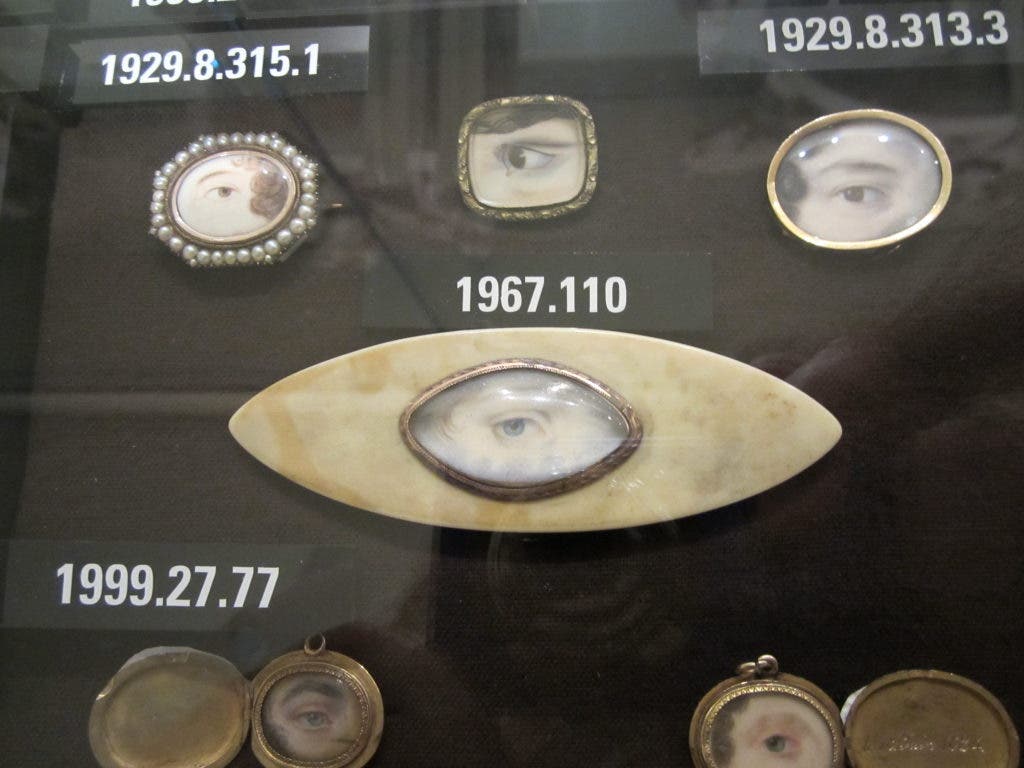
You might think that all of the best stuff is on the first floor, but take the elevators to the third floor and go to the Luce Foundation Center for American Art and the Lunder Conservation Center. The trip is well worth it. On these floors, the preservation—or conservation—of memory is as much on exhibit as the treasures themselves. The Luce Center shows you how art treasures are catalogued and stored.
Learn how an art object obtains a unique identification number and what that number means. See how objects are stored and, because of the unique design of the storage facilities, view the stored objects in special climate controlled glass cases. Walk down the corridor, away from the storage cases, and peek into the conservation labs.
I visited on the weekend, but during the week you can observe the conservators at work, repairing the ravages of time on fragile objects. And there is even a “bookend” to the starting point of our museum tour. More miniatures. Drawers and drawers full of them.
Delight in the portraits of impossibly demure and now obscure 18th-century men and women in powdered wigs! Revel in the 19th-century eye miniatures, exchanged as love tokens! Wonder at the mourning miniatures—some of children—created as remembrances of the departed!
The Portrait Gallery and American Art Museum (Gallery Place Metro) is open seven days a week, from 11:30 a.m. to 7:00 p.m. “Mementos” runs until May 13, 2012. “Little Pictures, Big Lives” runs until October 3, 2011.
Admission is free.