Community Corner
Great Escape: The International Spy Museum
A rainy afternoon at DC's International Spy Museum was full of intrigue.
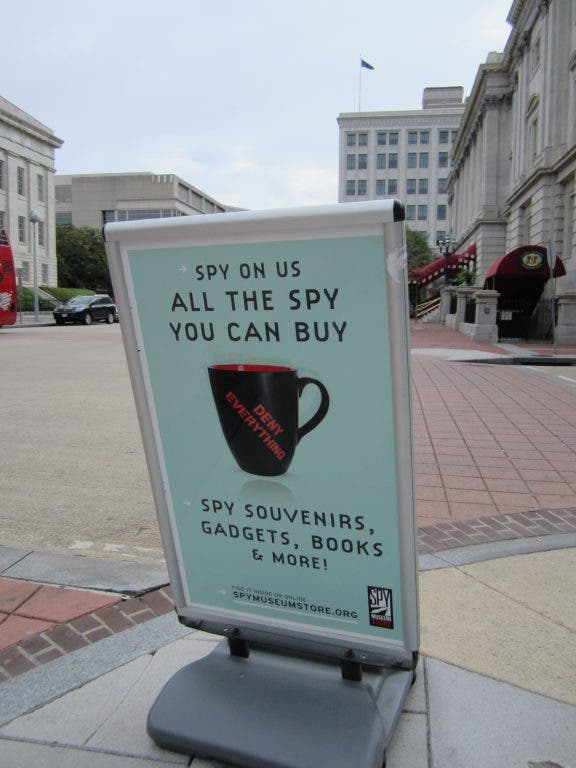


Secret codes, concealed microfilms, ingenious gadgetry, merciless adversaries, and shadowy assignations: the subject of spy thrillers and the International Spy Museum downtown in the District of Columbia.
Immediately upon passing through the entrance scanner—where I overheard a schoolboy exclaim, “They’re scanning people. Awesome!”—I entered an elevator, which transported me to a subterranean room. There, I selected an identity and was entrusted with a covert mission.
At various “checkpoints” throughout, I was updated with new information or tested on my ability to memorize my cover or improvise. I’ll admit that the “game” made my heart race and that I’d make an inept field operative.
Find out what's happening in Greenbeltfor free with the latest updates from Patch.
The museum has multimedia and interactivity down to an art! The exhibits on tools, techniques, and history contained more than objects in a case. Stations allow you to decode secret messages, listen to wireless transmissions, and even crawl “silently” through a heating duct—I declined the latter invitation.
The rooms covering history from ancient Babylon to the fall of the Berlin Wall set the atmosphere: a farmhouse in Nazi-occupied France, the Bletchley Park decoding room, the no man’s land between East and West Berlin.
Find out what's happening in Greenbeltfor free with the latest updates from Patch.
And the collection of objects was rich: umbrella guns, microfilm cameras hidden in coat buttons, a piece of the Berlin Wall, an Enigma machine—and a James Bond Aston Martin sports car with headlight machine guns! The label explained that the Bond movies inspired the CIA and the KGB to replicate some of the technology!
Be warned that the exhibits are text-heavy, but you don’t want to skimp on the fascinating stories of individuals like Virginia Hall, the “woman with a limp,” whom the Gestapo branded “the most dangerous Allied agent;” chanteuse Josephine Baker, who assisted the French Resistance for love of her adopted country; the Navajo code talkers, who stumped the Axis; or sinister Felix Dzerzhinsky, the Bolshevik head of secret police.
The museum’s World War II and Cold War coverage is excellent, but it is less satisfying on the ethical dimensions of intelligence-gathering and the uses to which intelligence is put. There is little about U.S. involvement—and intelligence failures—in Southeast Asia, Latin America, and the Middle East, where documents are classified and morality is murky.
Perhaps not suitable for young children, this definitely is the place for history lovers! I’m already planning a second visit to learn more about the men and women “who live in the shadows.”