Health & Fitness
BLOG: Floods and Havre de Grace's Uneasy Relationship with Its Greatest Resource.
Reflections on how spring floods, power dams, and development have shaped our town.
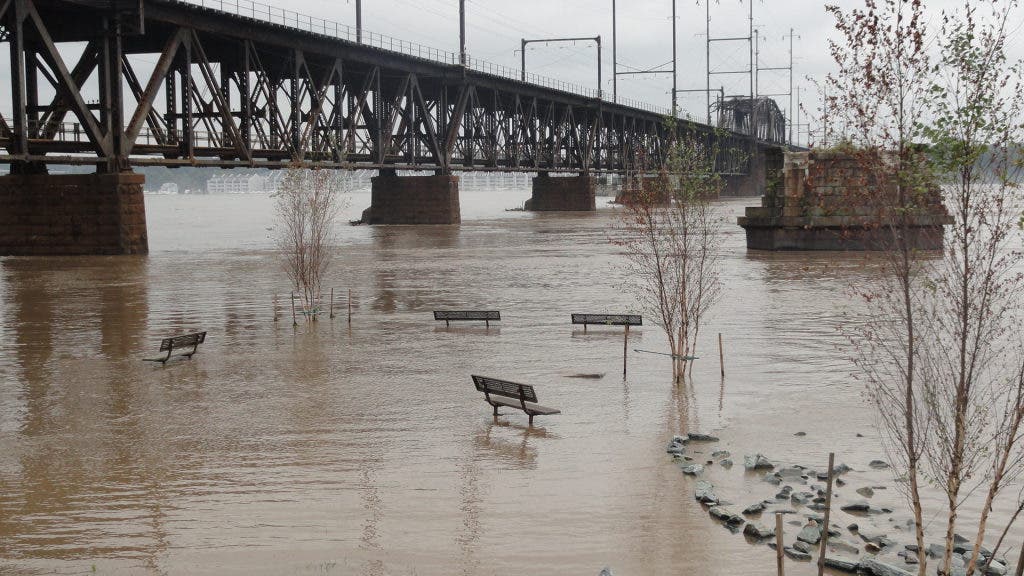
When I first arrived in Havre de Grace back in the late 1980s, there were no condomiums along the waterfront, no new marinas and no Promenade. Other than the new construction going on at the new and projects, the waterfront was pretty much deserted.
There was the Bay Steamer (now the ) and .
But the rest of the waterfront was a collection of junkyards, abandoned cars and old boats. Long time locals knew well that the Susquehanna has a habit of visiting its wrath upon our tiny town, and they had avoided it for generations. The river was where the canneries, iron works, coal yards and warehouses were. Decent folk lived on high ground!
Find out what's happening in Havre de Gracefor free with the latest updates from Patch.
If you’ve been around Havre de Grace for the past couple of days, it isn’t hard to see why!
The Susquehanna rises periodically to remind give us an unpleasant reminder of its power. Luckily, this only happens about once a decade or so. In my time, we had major ice storms in 1996, Hurricane Isabel and the current storm we have today.
Find out what's happening in Havre de Gracefor free with the latest updates from Patch.
These periodic floods have been a part of Havre de Grace life for decades; and for a long time, people didn’t go “down by the River.”
It isn’t as if people weren’t drawn to the water. Take a look at any of the historical maps or aerial photos of Havre de Grace over the years, and it’s obvious that the shoreline today is far different than it was 100 years ago. Over the years, Havre de Grace has filled in major portions of its waterfront, along Green Street, at the foot of Congress Ave (Hutchins Park) and at the foot of Lafayette Street. Much of this fill was for refuse dumps. But they were eventually stabilized, paved and developed. Even was a hill leading down to a wetland before the WPA came in to dredge the City Yacht Basin and build Tydings Island.
So, as flooding became only a periodic threat, and modern regulation forced condo dwellers to live above the 100 year flood plain, the risks seemed tolerable.
It wasn’t always so.
Floods have been a part of Havre de Grace life since before the town existed.
Before the construction of the vast hydroelectric dams, first at Holtwood (1915) and later Conowingo (1928), spring floods were a part of normal life in the towns along the Susquehanna.
The river froze constantly every year along its entire length, from Cooperstown, NY all the way to the Chesapeake. Many locals can clearly remember walking across the river on a regular basis, year after year.
The most famous of these annual freezes was in 1852. Back then, the railroads ended at the banks of the River. Cars were detached from trains and rolled onto a side wheel ferry, and taken across to Perryville where they were pulled off the ferry and hitched to a waiting locomotive. The ferry didn’t run in the intense freezes.
But 1852 was different. The river froze so hard and thick that tracks were laid across the Susquehanna, and the cars were towed by mules across for nearly six weeks in January and February. Passengers had to walk. One enterprising soul actually hacked a cave out of an ice boulder halfway across the River, set a plank between two sawhorses and opened a makeshift bar!
The Spring thaws were dramatic and destructive. Every year, the low lying shore line of Havre de Grace and Port Deposit would flood, as melting ice flowing hundreds of miles would jam together, damming up the river and then break again with the thaw, repeating this deadly process on the journey downstream. Early settlers braved these violent floes in on flat rafts, bringing timber down river to Port Deposit and the Log Pond. One the Susquehanna and Tidewater Canal opened, this trade slowed. But repairing the canal from the spring floods was an annual (and expensive) part of maintaining the canal.
Some years were worse than others.
The storms that produced the Johnstown Flood of 1889, also flooded the Susquehanna and Havre de Grace. That storm so thoroughly damaged the Susquehanna and Tidewater Canal that it was abandoned shortly afterward. The canal continued to service short haul traffic from Flintville, Stafford and Conowingo.
But the last great Ice Gorge of 1904, completely wiped out the town of Stafford (today only foundations of the mills and one kiln remain) and severely damaged Havre de Grace’s waterfront.
The construction of the Holtwood Dam brought flood control to the Susquehanna. When the far larger Conowingo Dam opened in 1928, the annual ritual of spring floods disappeared.
But tropical storms and hurricanes remain.
Many of us remember Hurricane Agnes in 1972. I lived in northern Baltimore County at the time, and that storm wiped out every bridge on the Gunpowder River between Pretty Boy and Loch Raven reservoirs. It also destroyed parts of the North Central Railroad, ending rail service and paving the way for the North Central trail. Agnes would be the catalyst for the restoration of and the restoration of the .
Hurricanes Agnes and Isabel are burned into the collective memories of anyone who has been in this area for any amount of time. Today we have a new storm to add to the list of dramatic floods: Tropical Storm Lee.