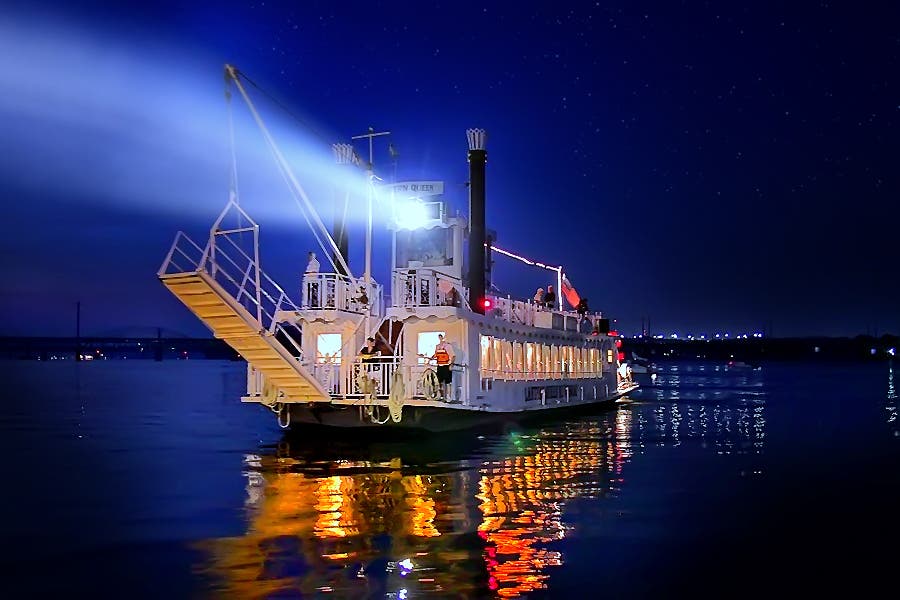
In the wake of the Costa Concordia disaster last week, I’ve been asked to share my thoughts on cruise safety, for passengers or consumers. As many of you know, my husband (Carroll Fitzgerald) and I own the , a Mississippi-style paddlewheeler, based here in Havre de Grace. I can tell you that we’ve been horrified as we’ve read and listened to the news accounts of the Costa Concordia. It’s probably a good time to reassure my readers that in every instance, the Lantern Queen Riverboat exceeds safety requirements and recommendations. Thankfully, most passenger vessels do!
What should you, the occasional cruise guest be looking for when you cruise—whether a sightseeing cruise of a few hours or a week-long big ship cruise
Know something about the boat. Vessels that carry more than six paying customers must be U.S. Coast Guard inspected. In Havre de Grace, both the Lantern Queen Riverboat and the Skipjack Martha Lewis are USCG inspected passenger vessels. That means that the boat receives a thorough above water inspection each year, and a hull inspection (haul out) every five years. It also means that the USCG sets limits as to how many passengers can be aboard at any one time, how many PFDs (lifejackets) are carried aboard, etc.
Find out what's happening in Havre de Gracefor free with the latest updates from Patch.
If you’re cruising on one of the big ships, get your travel agent to look up the safety record for you, particularly if you’re cruising a foreign flagged ship, which most of the big cruise ships are. You can also research a particular ship online.
If you have questions that can’t be adequately answered, or you find that the boat doesn’t meet the above standards, rethink your cruise. Most often, nothing bad will happen. But when it does, it goes bad very quickly.
Find out what's happening in Havre de Gracefor free with the latest updates from Patch.
Be aware and pro-active aboard. You are your own best friend! Know for yourself where the PFDs (lifejackets) and other emergency gear is kept. Pay attention during safety briefings. Don’t put yourself in harm’s way—leaning over rails, etc. If there is an emergency (and they come in all kinds), quickly and quietly follow the crew’s instruction.
And a word about big cruise ships. If you sense there’s an emergency, don’t wait to be told. Go to your cabin, and put on sensible clothing and shoes, particularly long sleeved shirts, long pants, etc. Put your meds, cell phone, and ID in a Ziploc bag in your pocket. And then get your PFD and keep it with you. I believe that I would begin making my way to my assigned lifeboat station, and remain just inside from there so that I could hear loudspeaker announcements. Getting to where you need to be can be a problem once a ship begins listing, or several thousand of your new best friends decide to stampede to their lifeboat stations too. Getting yourself (and your party) to your lifeboat station on your own also removes at least part of the language barrier issue. Most large cruise ships employ 1,000 crew members, hailing from dozens of countries. And frankly, in an emergency, panic causes everyone to revert to their native language—including you.
Going into the water—don’t do it unless it is truly, absolutely, the last resort. First, you don’t want to separate yourself from the easy-to-find cruise ship. It’s much harder to find one bobbing passenger than it is to find hundreds still aboard the cruise ship. And frankly, it’s a numbers game—large groups of people will be rescued first, with singletons getting attention last. Also large cruise ships are like a 17+ story skyscrapers. In order to be completely free of the screws, suction, swirling, etc. you’d have to swim well beyond its reach as it potentially sinks—and you have no way of knowing if it will or not. Water temps are always lower than body temps, so hypothermia is a real threat, even in warm Mediterranean waters. As the Costa Concordia showed so graphically, it is a real possibility that the lifeboats on one side of the ship may not be deployable, so be prepared to move across the ship to a lifeboat station on the opposite side. Given the layout of large cruise ships, this may be quite a hike, since there’s usually an open atrium that would prevent you from just walking across the deck. So once again, be ready to follow direction.
Fire strikes terror in the hearts of mariners. Aboard the Lantern Queen we do not allow any open flame, and limit smokers to a particular, easy to monitor area. Large cruise ships are much harder to monitor, full of passengers with no understanding of the danger a fire at sea can be. Be a real mariner while on your cruise, developing a healthy respect for fire and flame.
Norwalk Virus and its friends—another way to ruin a cruise is to come down with one of the easily transmittable intestinal viruses, like the Norwalk virus. Current cruise lines usually have hand sanitizer at the doors of all dining rooms and restaurants. You must consider that you’re really sailing aboard a giant dorm—the same people (often 4,000 or so) are trading their germs daily. Your job is to break the trading. Keep your hands away from your face, use hand sanitizer and wash hands regularly. Avoiding crowds is another good way to stay well, but harder to accomplish on a cruise.
All this said, cruise vacations, dinner cruises, and the like are still amazingly safe. Large multi-day cruises allow vacationers to unpack once and take their beds from country to country, and enjoy dining and living conditions that rival the best hotels. Customer service is usually impeccable, and entertainment, both onboard and ashore are almost endless. Cruise vacations are a great value.
Likewise, dinner and sightseeing boats offer a number of services, including public cruises and chartering the boats for special family outings, weddings, business meetings, etc. Carroll & I love finding the local tour boat in whatever city we visit—especially paddlewheelers! You usually get great tourist information while aboard, and the cruise is a great way to relax during hectic vacation travel. And of course we’re fortunate in Havre de Grace to have both the Lantern Queen Riverboat and the Skipjack Martha Lewis available for affordable evenings out.
Finally I need to tell you about the men and women who captain and crew passenger vessels. The training and testing is much more rigorous than that of airline pilots. Before sitting for a captain’s license, the candidate must document hundreds and hundreds of hours working on a boat. Then there’s a whole battery of tests, including the “Navigation Rules of the Road” test, where passing is 90 percent. All deck hands and captains on inspected passenger vessels must be enrolled in a USCG approved random drug and alcohol testing program. And once again, airline pilots cannot drink within eight hours of flying. Boat/ship captains cannot drink within 48 hours of taking the helm of a boat/ship. In the last few years I’ve met lots of boat/ship captains, and I’ve got to say that they are, as a group, the most capable, professional, and skilled group of people I know. They also seem to have the BEST senses of humor!
So, as Captain Steve Weisbrod (one of the Lantern Queen Captains) warns, “Don’t drive the boat where birds are walking, and don’t hit anything big, and we’ll be ok.”