Health & Fitness
When Rodgers Ruled The Air: Part II
Part II of the story of how a scion of HdeG's storied Rodgers family became the first man to fly across America.


The story of how a scion of HdeG’s storied Rodgers family became the first man to fly across America
Part II "The Hearst Prize"
William Randolph Hearst had offered a $50,000 cash prize to the first man who could fly across the United States in 30 days or less. There were no airports or highways in early 20th century America. Even crossing by train meant changing trains in Chicago, and took a full week. It had taken an automobile 63 days to cross the US in 2003. Crossing by air meant mounting an expedition. And expeditions required money.
Find out what's happening in Havre de Gracefor free with the latest updates from Patch.
This challenge seemed ready made for 32-year-old Calbraith Perry Rodgers. He had just won an $11,000 prize at an air meet in Chicago when he was approached by a promoter named Stewart Krafft, with the idea of going after the Hearst Prize. Their next stop was to call on J. Ogden Armour.
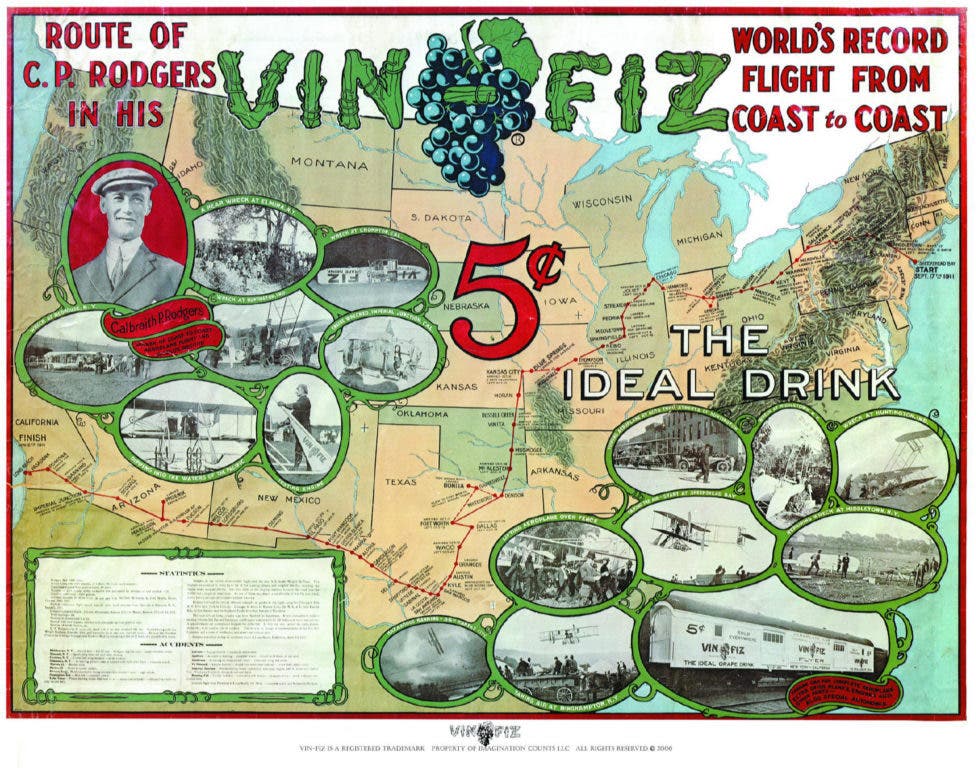
As it happened, Armour had decided to invest some of his meat packing fortune in a new grape soda called Vin Fiz, and he was looking for a spectacular way to promote it. Stuart DeKrafft was the man for the promotion, and Calbraith Perry Rodgers, scion of a family of naval heroes, was ready made for the hero’s part!
Find out what's happening in Havre de Gracefor free with the latest updates from Patch.
Armour agreed to finance the expedition. Rodgers would be paid $5 for every mile flown east of the Mississippi and $4 for every mile west. Cal Rodger’s Wright Flyer was rechristened the Vin Fiz, and the bottom wing had “Vin Fiz, the Ideal Grape Drink” painted on it. Armour chartered a “special” to accompany the plane. A three car train, with two Pullman cars: one for the flyer, his wife and mother. A second Pullman housed three mechanics, a business manager, several Armour employees and a gaggle of reporters. A box car bought up the rear, serving as hanger and machine shop, and as a garage for an automobile that was brought along to find the flyer wherever it landed.
Rodger’s plane was a Wright Flyer, powered by a 35-horsepower engine, turning two propellers via bicycle chains. It could stay in the air for three hours at a time at speeds that averaged 60 to 70 miles per hour.
Dressed in a suit and tie and multiple sweaters, a cigar clinched between his teeth, Rodgers took off from Sheepshead Bay in New York on September 17, 1911. He circled Coney Island, and flew over Manhattan, dropping leaflets along the way. He crossed the Hudson, and soon spotted his train, steaming up the Erie Railroad main line.
The next morning, he crashed on takeoff. He barely cleared the fence the on his next attempt. Crowds of curious onlookers accompanied the plane at every stop. People scrawled their names on the fabric wings and broke pieces of the plane off for souvenirs. Rodgers once landed in a field in Ohio and had to fend off a herd of cows, which surrounded the plane and began trying to chew on the wings.
After six crashes, multiple repairs, and meeting crowds at every stop, the Vin Fiz finally reached Chicago on October 8, 21 days after leaving New York. The Twentieth Century Limited made the same trip along a similar route in 18 hours.
It was clear that the Vin Fiz wouldn’t make the Pacific in 9 more days. What to do now? Rodgers had been through a lot, and he was determined to persevere. He told reporters he was determined to press on, “prize or no prize”
"If canvas, steel and wire hold together with a little brawn, tendon and brain. I mean to get there," he said. "I am going to cross the continent simply to be the first to cross in an aeroplane."
———
Visit Patch on Wednesday afternoon for Part III of Tom's tale of Cal Rodgers.