Politics & Government
Is MV Stuck with Whetstone’s Muck?
Lake's dredging will be Montgomery County's most extensive ever.

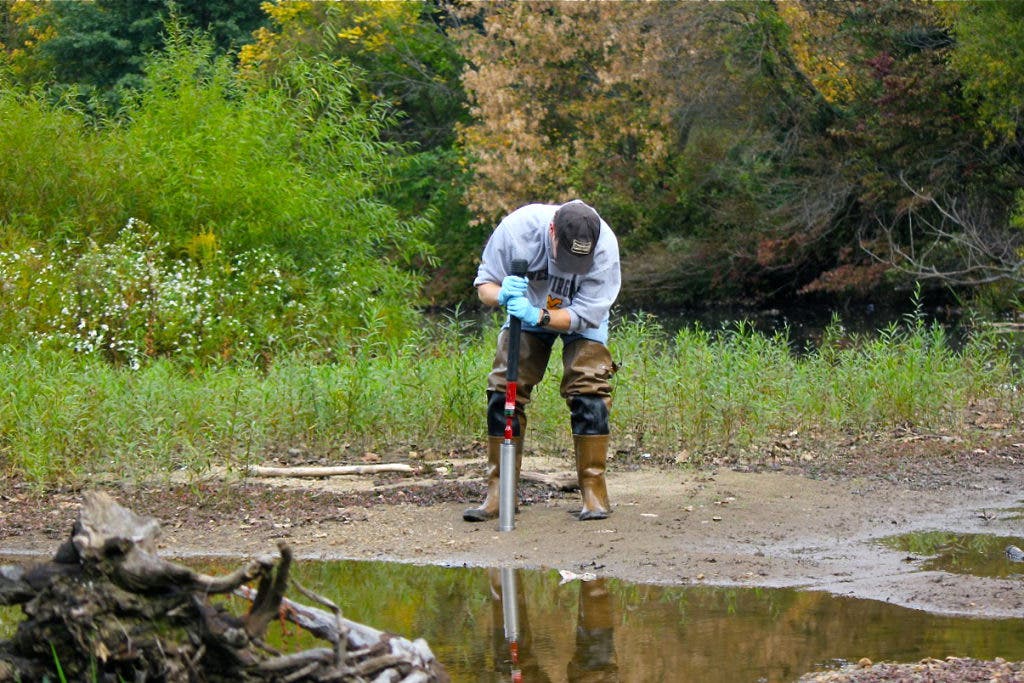


The first answers for the dredging of Lake Whetstoneare less than a month away—what chemicals are in the sediment, where it all might be dumped and when work will begin on what will be the largest and most expensive dredging Montgomery County has ever undertaken.
The dredging project surfaced more than two years ago as Montgomery Village leaders pressed the county for a remedy to the tons of sediment that had built up at the mouth of the lake’s feeder stream. The 45-year-old lake hasn’t been dredged since 1986, and so much silt has piled up that wide stretches of sandbar now rise a foot or more out of the water, carpeted in parts with shrubs and bushes.
Montgomery County’s Department of Environmental Protection has had the results sediment testing for weeks, but the agency is keeping mum on the findings until a forum with residents and stakeholders set for 7 p.m. Dec. 13 at Watkins Mill High School.
Find out what's happening in Montgomery Villagefor free with the latest updates from Patch.
Worry over the dredging didn’t emerge until this summer, when residents realized that county officials are considering three sites in Montgomery Village for disposing the dredged sediment:
- Apple Ridge ballpark
- Apple Ridge recreation area (the soccer field behind Apple Ridge pool),
- The lower of the two fields behind the Montgomery Village Foundation’s office on Apple Ridge Road
The $750,000 price tag includes erosion control, excavation and disposal of as much as 20,000 cubic yards, making this Montgomery County’s most extensive dredging project ever. DEP’s timeline has decisions being made next year on where to dispose the sediment, with the dredging to follow sometime in 2013 or later.
Find out what's happening in Montgomery Villagefor free with the latest updates from Patch.
“There are a lot of factors in play right now, so it could be 2014 before anything happens,” said Amy Stevens, manager of DEP’s stormwater facility maintenance program.
Before the results of the soil sampling came back, Stevens said that DEP had no reason to believe that the contaminants embedded in Whetstone’s sediment vary significantly from chemicals typical to suburban runoff: excess nutrients such as nitrogen and phosphorus, oils, greases and some metals. The results will be measured against standards the U.S. Army Corps of Engineers and the EPA, she said.
Nonetheless, the dumping of tons of possibly contaminated soil has raised fears of health hazards and lesser nuisances among neighbors to the three sites.
“Would you buy a house next to a ball field that was going to have sludge dumped on it? I don’t think so,” resident Brian Burrows posed to County Councilman Craig Rice at a town hall meeting in August.
Rice’s answer: The county needs to explore all alternatives before making a decision to dump so much sediment near anyone’s home.
“The problem is, there aren’t too many places left in Montgomery County where there aren’t people,” he said. “I don’t want to minimize by any means your concern. The challenge is, if it’s not Apple Ridge, then it’s going to be Germantown or it’s going to be Clarksburg or it’s going to be Silver Spring.”
All three are MVF properties, giving the foundation’s board of directors the power to approve or reject any disposal on those sites.
The foundation has asked county officials to dump the sediment outside Montgomery Village, but pointed out last month that the 18-home Poplar Spring neighborhood is built atop sediment from the 1986 dredging with no ill effects to its tenants.
“As far as anybody knows, there hasn’t been anything. And I know people who moved in when they were built.” said board president Bob Hydorn. “Everybody thinks it’s sludge like you have at Blue Plains. It’s not. People are getting all upset over the chemicals and all these types of issues, but nobody knows anything. Don’t cross the bridge until you get to it—we need to know what’s in that soil first.”
Meanwhile, a Wisconsin-based company that turns dredged sediment into potting soil has offered to take Whetstone’s waste off county hands—but county officials have made no moves to pursue that alternative.
Using technology developed in the past year, BioGenesis converts dredged sediment to nutrient-rich potting soil. Their process removes as much as 98 or 99 percent of contamination for more than 200 toxins, said Scott Berggren, a managing partner with Amiran Technologies, LLC, which owns BioGenesis.
“No matter what the contaminations are, we have a process that’ll deal with it,” Berggren said.
While Lake Whetstone’s dredging is Montgomery County’s largest, the 20,000-cubic-yard limit is minor in the scale that BioGenesis has dealt with, which has included the shipping channels in Vienna, Italy, the oil fields of Kuwait and a severely polluted lake in Ohio that needed more than 1 million cubic yards of sediment dredged from it.
DEP would prefer to find a local company that does the same work, but has not found one and has not decided whether to move forward with BioGenesis, Stevens said.
Here are Montgomery County's three most recent dredging projects:
University Blvd Regional Pond
- Where: off Arcola Boulevard in Silver Spring, behind Kemp Mill shopping center
- Whose land: M-NCPPC land
- When: between September 2005 and May 2006
- Cost of dredging: $109,000
- Sediment removed: 4,782 cubic yards
- Disposal: Dredged material placed on M-NCPPC soccer field 2.5 miles away
- Contaminants: Because placed on government property, the county was not required to test the sediment
Quince Orchard Estates Regional
- Where: Off Quince Valley Drive in North Potomac
- When: between January 2009 and August 2009
- Cost of dredging: $172,690
- Sediment removed: 5,519 cubic yards
- Disposal: taken to an undisclosed off-site disposal facility
- Contaminants: The sediment was not tested and was taken to an off-site disposal location
Dufief Local Park
- Where: off Dufief Court in North Potomac
- When: between April 2010 and November 2010
- Cost of dredging: $10,222
- Sediment removed: 891 cubic yards
- Disposal: on-site next to soccer field
- Contaminants: Because placed on government property, the county was not required to test the sediment
Get more local news delivered straight to your inbox. Sign up for free Patch newsletters and alerts.