Politics & Government
SPEAK OUT: Tales of the East Coast Earthquake
Federal and state officials launch campaign to jolt participation in earthquake-readiness drill.

It struck just before 2 p.m., upending an otherwise calm August afternoon with a subterranean spasm of tectonic plates clashing four miles beneath the earth’s surface.
The 5.8-magnitude earthquake of Aug. 23, 2011, lasted more than 30 seconds and radiated thousands of miles from its epicenter beneath Louisa County, VA, according to the U.S. Geological Survey—felt by as much as one-third of the country, from Florida to New England and west nearly to the Mississippi River.
The East Coast’s strongest temblor in more than a century jolted millions of earthquake-uninitiated up and down the eastern seaboard—unnerving some, amusing others, and wreaking upwards of $300 million damage.
Find out what's happening in Montgomery Villagefor free with the latest updates from Patch.
Louisa County, VA, took a $75 million hit. One hundred miles away, came largely in the form of Metro delays and cell phone disruptions, while in Washington, D.C., two of the nation’s still bear the quake's toll.
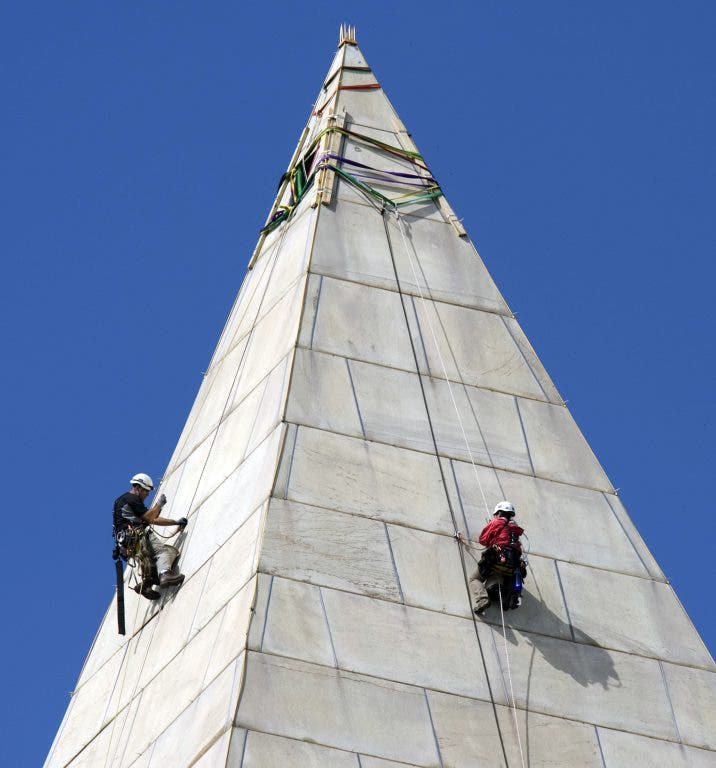
On Thursday, the earthquake’s anniversary, a year’s worth of scientific and disaster-readiness efforts will come to a head as federal scientists and emergency agencies stand alongside officials from Virginia, Maryland and the District at the foot of the Washington Monument, where the quake scattered tourists and forced the monument to shut down for at least two more years.
Find out what's happening in Montgomery Villagefor free with the latest updates from Patch.
Their hope is to leverage interest in the anniversary to stir up participation in what USGS says will be one of the largest earthquake drills ever.
Scientists have already bolstered their efforts to map the country’s eastern fault networks and more meticulously catalogue the more than 450 aftershocks that ensued. The deeper scrutiny is helping scientists understand the character—and volatility—of specific faults and get a better sense of the threat posed by future and possibly larger seismic events.
But as that scientific picture takes shape, government agencies remain puzzled by the human reaction during and after the quake.
"Every large earthquake is a learning experience, but it is particularly the case for this Virginia earthquake because of the rarity of such events in the eastern U.S.," Marcia McNutt, USGS director, said in a statement. "For example, what are we doing so right that a record-setting number of East Coast residents know the value to science of submitting their experiences on 'Did You Feel It?,' and yet not enough appropriately responded with 'duck and cover' during the seconds of most intense ground shaking?"
Officials hope to spur millions of participants to be part of the Great SouthEast ShakeOut, when at 10:18 a.m. on Oct. 18, they will “drop, cover and hold on.” Maryland is one of five states calling for schools, businesses, government agencies and communities to take part. Click here to sign up and pledge your participation.
In the meantime, Patch wants to hear your memories from that unforgettable day last year. So tell us, where were YOU when the East Coast Quake hit? How long until you realized it was no mere train or truck or construction work? Who did you call first? Or did you go straight to Facebook/Twitter?
And be honest: did you, if even for a moment, panic?
Get more local news delivered straight to your inbox. Sign up for free Patch newsletters and alerts.