Health & Fitness
On Feminism and Fairy-Tales
A defense of chivalry as embodied in the tales of childhood.
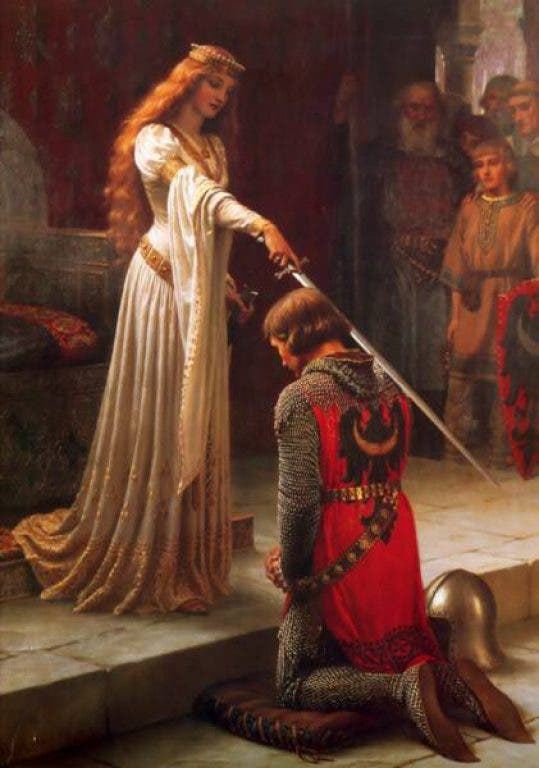
A lot of modern feminists object to chivalry. The adulation of women, they say, is a mask -- or a compensation -- for their notion that women are weaker than men. And it is precisely a reaction to that notion. The West, especially the Christian West, always admired the weak in principle even when it maltreated them in practice; and in fact it maltreated them in practice less often than is generally supposed. But the general objection that feminists make is that women are not weak, and to treat them as if they were is demeaning.
Now, if by "weak" we mean "inferior," I side impenitently with feminism and against the older patriarchal system. Whatever may have been said about it, it is precisely my Christianity which leads me to do this: St Paul tells us that "In Christ there is neither Jew nor Greek, slave nor free, male nor female; for you are all one in Christ Jesus." But even without religious convictions there is no obvious reason to regard women as intrinsically inferior to men, save the sort of reason that Nietzsche might have put forward: women are typically weaker than men physically.
Now, if anyone takes me to be saying that being less physically strong is a case for patriarchy I shall have failed. I do not believe for a second that being physically strong confers any right to rule; believing, as I do, that the soul is the higher and more essential element of human existence than the body (though the body is good also), a romantic appeal to brute strength is at best mere silliness. I am saying only that a difference in strength between men and women does, in broad terms, exist; and that men are, in broad terms, physically stronger.
Given this, it is in fact more possible for men to prey upon women than for women to prey upon men. In moral virtue they are on a level playing field, and everybody knows that a woman can beat a man by argument more often than not. Spiritual and intellectual dominance over women are not genuinely possible to men, because there is no real or final disparity between men and women on those planes. But there is a general disparity of physical strength; and this means that if a man is wicked enough to harm a woman, he usually can.
To me the obvious practical solution is to instill in men a reverence for woman -- or rather, to cultivate that instinctive reverence for women which most men feel in some degree. In other words, the solution to male violence is chivalry: the determination to put male strength at the service of women.
It may be objected that this block cannot work perfectly. I retort that there is no block short of the Second Coming that can work perfectly; and I would hazard that this block is better than the other possibilities. A religious block would be objected to not only by many feminists but by many people in general, and is in any case impracticable as long as there is no one religion typical of our society (which there isn't, though there was a hundred years ago and may be a hundred years hence). A civil block is right enough, but it can only operate when a crime has been committed; the prevention of crime, as much as possible, is a psychological matter that must be dealt with by nourishing the conscience. An educational block is -- well, it is exactly what I am proposing.
What does all this have to do with fairy-tales? Put simply, I believe fairy-tales are one of the best ways of instilling chivalry in young men. If we wanted to educate them in the Platonic style, I suppose we would banish fairy-tales, a la the Republic; and it is a mark of their philosophic profundity that many feminists would like to banish many fairy-tales, even do away with the genre. It is a mark of the feminist intellect; but it is not necessarily a mark of common sense, for it is the usual practice of philosophy to overturn common sense. Common sense tells us that man (whether male or female) is a story-telling animal; and one of the kinds of stories man likes to tell is the fantastic, as everybody knows who has read the Harry Potter series, seen the Lord of the Rings trilogy, or talked with a child of five for ten minutes. Attempting to eradicate them is attempting to stamp out the instinct of primal humility; for the whole delight of fantasy is to be over-awed by something -- that is, to be humble.
Doubtless the form of many fairy-tales is imperfect; doubtless the societies in which they arose have given them a tinge of patriarchy. But, with fairy-tales as with myths, nobody in their senses objects to new versions. Besides, our evaluation of these stories must be empirical, based on what the stories contain, and not upon a fanciful theory about their dark, secret meaning. Trying to make fairy-tales realistic character-studies ruins the fun; it also misses the point. If a person notes that the Prince in Cinderella pursues her with nothing but her slipper, he or she may be impressed by his devotion. But if one insists on demythologizing it -- asking why the Prince was so shallow as to pursue a girl he met for a few hours one night, and about whom he knows nothing except that she is pretty -- he or she will learn nothing about devotion to love or about anything else. For fairy-tales are rarely concerned with such superficialities as deep human psychology.
They are crudely symbolic, and therefore more profound than anyone who tries to be profound for its own sake: the Prince carries with him, not our shallow notion of psychological motivation and psychological complex, but the reverend symbolism of a Jungian archetype: the Royal, suggesting something more than humanity, invading human life as the Prince invades the house of the wicked stepmother, to cast down and destroy, to build and to plant. All of this is a splendid pattern to raise boys on; it says clearly that their job is to be the Prince, to delight in beauty and goodness wherever it is found, and to pursue those twin delights even if they have nothing but a shoe to indicate which road to walk on towards them.
Why not, one might ask, raise children on realistic tales, rather than resorting to romantic symbolism? The chief answer is that this is the perfect way, not only to be dull oneself, but to be the cause of dullness in others. Reality is exciting; but unless we are trained in humility -- that is, trained by something which does what fairy-tales do, to touch the nerve of wonder and happy astonishment -- we shall never appreciate reality. Consequently, trying to get a child to be excited over a realistic story is mere silliness, and will instill neither chivalry nor even the decencies of feminism. Reality is romantic, but reality by itself will not train us to perceive its romance.