Health & Fitness
What Is Faith?
An attempt to distinguish faith from wishful thinking and self-willed blindness.
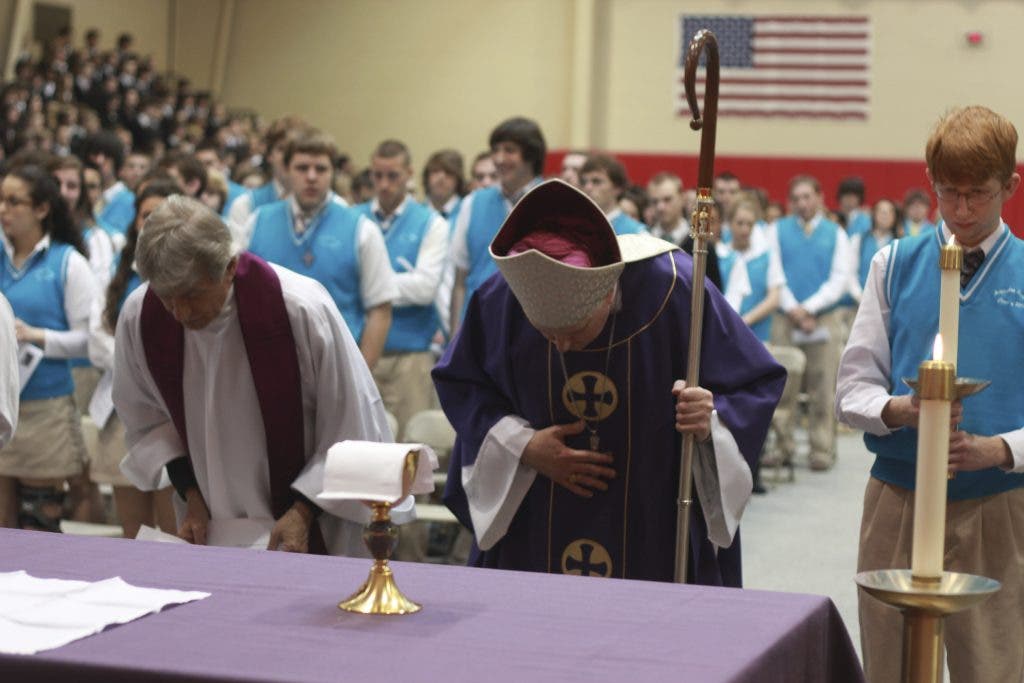
If there is any expression we have all heard a thousand times -- in church services, in movies, in conversation -- it is the phrase 'leap of faith.' Faith is taken by American culture at large, both within and outside the Church, to be a leap; usually understood to mean a leap in the dark.
Interestingly, this is one area mostly agreed upon between believers (of whatever kind) on the one hand, and atheists and agnostics on the other. Whether we feel uncertain about the leap as agnostics, or boldly and even defiantly make it as believers, or pour scorn on it as atheists, a leap in the dark is the action understood to be under consideration.
And it must be admitted quite frankly: if that is what faith means, the contemptuous atheist has a point. Christians call faith one of the three chiefest virtues, together with hope and love. Now, if faith means taking a leap in the dark -- that is, electing to believe something with no grounds whatsoever, or with hints but nothing more -- is there anything virtuous about that? Is it anything but an abdication of the intellect, a symptom of wishful thinking or stupidity?
Find out what's happening in Odenton-Severnfor free with the latest updates from Patch.
The Catholic tradition, however, expresses a quite different understanding of what faith is. Faith is certainly belief, and belief to some extent in things that cannot be proven by unaided reason. But all beliefs are based in the intellect; and, in order to be worthy of respect -- as virtues should be -- that intellectual basis should be intellectually credible, not based on whim or desire. No one should believe anything that seems, to the best of their rational analysis, to be nonsensical.
Some Christians balk at this. The only answer to such balking, to my mind, was put best by an author named Timothy Ware: "Christianity, if true, has nothing to fear from honest inquiry." Anybody who cannot agree with that has a very odd notion of what truth means.
Find out what's happening in Odenton-Severnfor free with the latest updates from Patch.
What, then, distinguishes faith from mere rational analysis? One could, for instance, discover as a mere intellectual exercise the existence of the man Jesus of Nazareth, based on the historical evidence; one could determine more or less what He did and said, and from those, what He thought about Himself and His earthly mission. What separates faith from intellectual discovery is, still, an act of the will; but not, as in the 'leap in the dark,' a fideist act, a decision to trust without considering the evidence. Faith is precisely a decision to trust based on the evidence.
But note that word: trust. To accept something in principle because, as far as you can tell intellectually, it is true or reliable -- that is not so much faith as it is sanity. Faith brings in a relational dimension; it is not so much accepting an idea as trusting a person, and accepting the ideas they set forth on the basis of your trust in that person. (Hence we might accept something, on the basis of trust in a divine authority, that we cannot prove with our intellects alone; but our acceptance of that divine authority must come from our own rational analysis, followed by a decision to trust.)
This helps explain why faith is regarded by Catholics, and Christians in general, as a vritue. Its opposite is not examination of the evidence. Indeed, up until conversion, it is a person's intellectual duty to weigh the evidence quite objectively, for the simple reason that you should learn about a person before deciding to trust them. But when once you have come to know and trust a person, you can still choose to continue or withdraw that trust -- or, alternatively, you can be brought to a point where your trust is clearly warranted, and still refuse it.
In short, you can be suspicious. It is this which Christ rebukes in St. Thomas after the Resurrection, when He says, 'Blessed are they that have not seen and yet believe.' An element of this statement could be rephrased, 'You should have known Me better.' There was no need to shrink from this leap; for it was a leap in the light.