

So, this is a teaching blog, right?
After we settled into our new digs at the luxury hotel in Jintan (great place to vacation, folks! Only 40 bucks per room!), we were told to be ready at 11 to meet our hosts from the Economic Zone and Board of Education. While any of us would spend a few minutes in Jintan and call it a city, everyone there referred to it as a “town”. For what it's worth, it's been declared a city since 1993, and has a population of a half-million people.
China is big.
Find out what's happening in Odenton-Severnfor free with the latest updates from Patch.
We met our new friends at a hotel located in the heart of Jintan, and enjoyed a 20-course meal (that's a blog post within itself) and were taken to set up our classrooms for the following morning.
Objectives, Day & Night
Find out what's happening in Odenton-Severnfor free with the latest updates from Patch.
Our mission was to teach Chinese teachers how implement lessons with more creativity, differentiation, and rigor. Each teacher was also responsible for a specific pedagogy- Erin was tasked with drama, Mike with United States History, Sarah Lynn with Arundel High School's Signature Program & Teaching Dynamics, and myself with Model United Nations (which I've never taught, just co-sponsored with super-teacher Brad Wray).
Mike, Erin, and I were also told that every other night, we would use our same lessons to teach high-school students at another evening school. When we arrived, Sarah Lynn was also informed that she would join us at the evening school. Our experiences at the evening school would end up being a stormy cloud over our trip (another blog post on that, as well).
We had all spent days and weeks preparing our lessons before the trip. The lessons were submitted to Kent, our liaison and host, two weeks before we left. We were also instructed to attach documents that needed printing for our lessons. While all of us submitted our work with mapped lessons, objectives, and print documents, we never received any feedback. This seemed foreboding at the time. It was.
First Impressions and Differences
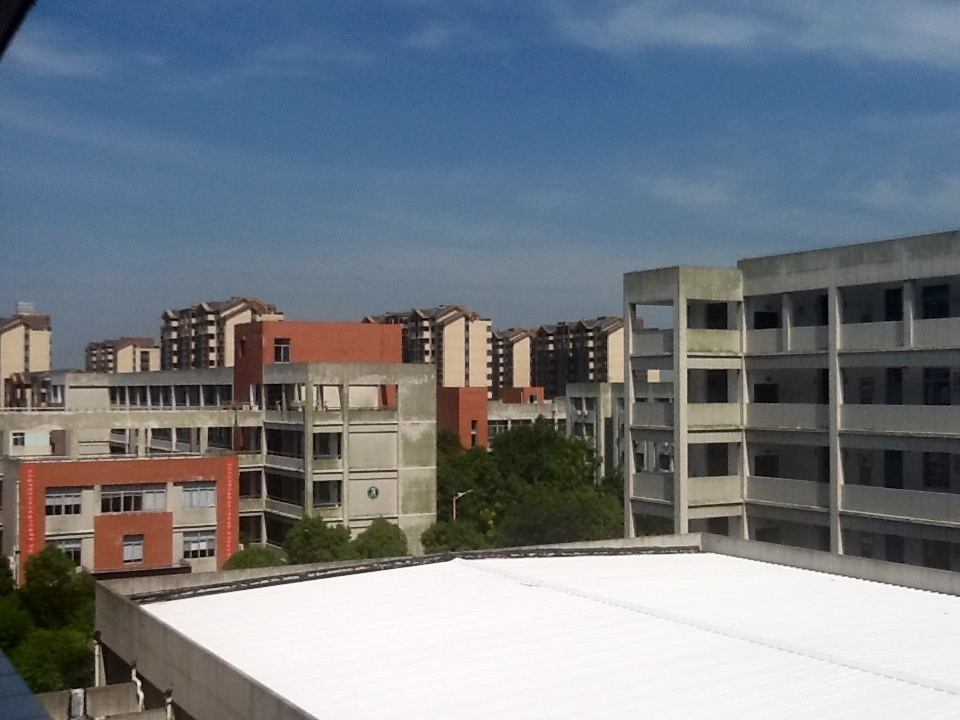
Jintan High School is a massive complex that takes up the equivalent of an entire city block. There are several entrances (I counted three during the week), all of which have security gates. As you enter, it's hard not to marvel at the size of the buildings, each of which are four stories high. Many of these buildings house the students during the year.
The Chinese implement a school year not unlike the classic American model, which include summer “holiday”. Their second longest holiday is built around the Chinese New Year. The students return home for their vacations, but when school is in session, they spend almost all time on campus.
The similarities continue to fade away when looking at the typical school day. Classes begin around 7:30 in the morning, and go until noon, when there is a three hour break for lunch and rest (these same siestas exist at almost all jobs in China-- please pay attention America!). When the students return at 3pm, they will be in class until 8 or 9 pm. Most often, teachers will stay on campus or have housing near the school where they can also rest. However, teachers lounges are equipped with cots for those who wish to stay and work near their classrooms.
Chinese Classroom Aesthetics
We were let into our classrooms, and asked to make sure our technology worked properly on their equipment. There was standing water in a corner of my room, located by the unit air conditioning tower, which ended up working quite effectively during the oppressive heat of July. The classroom has two entrances on the same wall, barely secured by a latch that seemed to be there only to keep the door closed for temperature control, not security. The walls were bare, except for a Chinese flag at the front of the room and an overhead projection screen. My projection screen had a large bug that had been melted into the fabric.
The desks were small, about half the size of a regular high school desk in width. The accompanying stools were even more tiny in comparison with our chairs in American schools. I immediately thought of how much our students would complain about the seating; no backs to lean on. Frankly, some of our more heavy set students would have a hard time fitting their rears on the seat without some comfort issues. Ergonomically, though, it would be hard to argue that students would have to be attentive in such an environment-- unless their heads were down.
I'm sure that our classrooms in America don't look terribly welcoming before a teacher makes it their own space, with personality and flair. However, from the lighting, to the barely-painted drywall, to the smell, these rooms were certainly eye-opening, but unsurprising. Later in the week, we would tour classrooms that were in use for summer school-- the teachers in these rooms do not seem concerned with improving the conditions; there were no posters, student work, or posted objectives.
The dreary buildings and classrooms were, however, surrounded by ponds and gardens, each bragging with gorgeous lilies, gardenias, and trees. If you turned your back away from the school, you'd think you were in a brochure.
I would love to show my students at Arundel the videos and pictures from our tour of Jintan High, but don't want to be the “see how good you have it??” codger who elicits eye rolls and sighs. Arundel has its share of structural issues, as do most public school buildings built in the Eisenhower administration.
Bottom line—the discrepancies in expectations of what the aesthetic of teaching looks, feels, and smells like are very different things.
Larry Lee, Sisyphus of Jintan High
As we absorbed the aesthetic of our new school, all of us took turns having 4 men yelling at each other in their foreign language, making sure that our computers worked. Some of us had more success than others. Throughout the week, there would be computer swapping amongst the four of us-- Erin needed sound in her classroom, Mike's Apple Macbook wasn't compatible, and my computer wouldn't play videos. However, we all left knowing that technology would be fine and compatible for our lessons in the morning.
However, when we inquired about our worksheets for the week, no one had answers for us. Then, we met Mr. Lihua. We'd call him Larry. Sometimes, people would call him Lee. Sometimes, we'd call him Larry Lee. He seemed to answer to all of them.
Larry was a head teacher from the school, and was the facilitator of our instruction for the next two weeks. He visited Arundel High back in the fall, the first to engage in our cultural exchange. He arranged our meals, our rides, our weekend activities, and our overall Jintan experience.
Larry would be the man, our tireless champion, and disaster manager.
Speaking of disasters, Larry was kept out of the loop about what we needed until the last minute (this would be a reoccurring theme for our trip. Last minute is the best two word description for how virtually all plans in China are made) . Our lesson plans, it seemed, never were looked at by anyone, and never forwarded to Larry. He asked us to return home to the hotel, and send him anything that needed printing for the next two days, and he'd have them for us for class tomorrow.
After taking in the dreary setting, the yelling technology dudes, and no sight of our printed lessons, reassurances were not best remedy for our anxieties.
At dinner later that evening, after several adult beverages (more on that later, as well), Debbie told Larry quietly, “you have to return to school to get their papers ready. You'll be there all night”. Larry replied with a reserved, resigned look- “yes, most likely”. He then took a rather large gulp from his beer, and smiled some more.
It seems as if Larry is used to such expectations.
------------
It was a long, exhausting day in Jintan. Unfortunately, our bodies were telling us it was 9am EST, which made for a long night. The night before the first day of school with new students is a jittery one, regardless. Throwing in jet lag made it even more dodgy.
Tomorrow, we'd have a room full of teachers.