Politics & Government
Uncertainty Looms Locally as Congress Battles Over Budget
With the Department of Defense projecting a possible 20 percent cut to its civilian workforce, the area around Fort Meade is bracing itself.



Members of Congress have less than a week to reach an agreement on reducing the federal budget deficit, and there’s a big potential impact locally if they fail.
If a “supercommittee” of lawmakers can’t strike a deal by Nov. 23, there will be automatic cuts to military and civilian programs that could ripple through Odenton, Fort Meade and other communities that have thus far been buoyed by the heavy presence of the federal government.
A potential for $1 trillion in immediate cuts would almost certainly lead to layoffs and furloughs among government agencies and contractors locally, observers said. Contracts may go unsigned. Services to military families will likely be cut.
Find out what's happening in Odenton-Severnfor free with the latest updates from Patch.
“It will definitely affect the Fort, there’s no doubt in my mind, if they can’t come to a resolution,” said Jamie Benoit, the council member for District 4, which includes Odenton, Fort Meade and portions of Severn.
Just as importantly, the uncertainty over future defense spending, regardless of outcome, has left a feeling of anxiety among many contractors, stifling any potential plans for expansion.
Find out what's happening in Odenton-Severnfor free with the latest updates from Patch.
Fort Meade is home to more than 90 tenants, all of whom have some tie to the Department of Defense. Many are expected to be insulated from budget cuts due to the critical nature of their work, but some offices, such as those tied to the Air Force and Navy could be hit.
Defense Secretary Leon Panetta recently warned lawmakers that the lack of a budget deal would force the military to reduce the size of ground troops to the smallest level since 1940. The Air Force would shrink to the smallest size in history, and the Navy would have the smallest number of ships since 1915.
Meanwhile, the civilian workforce tied to Fort Meade is bracing itself for cuts and furloughs. According to Panetta, the automatic cuts to the defense budget would result in a 20 percent reduction in civilian personnel, the smallest civilian workforce since the DOD was created.
“There’s some question as to whether [local agencies] will fall into a carved out piece, but even if they’re not affected, civilian government employees will be affected,” Benoit said.
Garrison staff is also preparing itself to operate with fewer resources.
“Fort Meade is analyzing programs and services to determine which to reinforce and which to discontinue,” Fort Meade spokesman Mary Doyle said. “Our decisions are aimed at reducing costs while maintaining the services our service members, civilians and families deserve.”
Contractors Wait
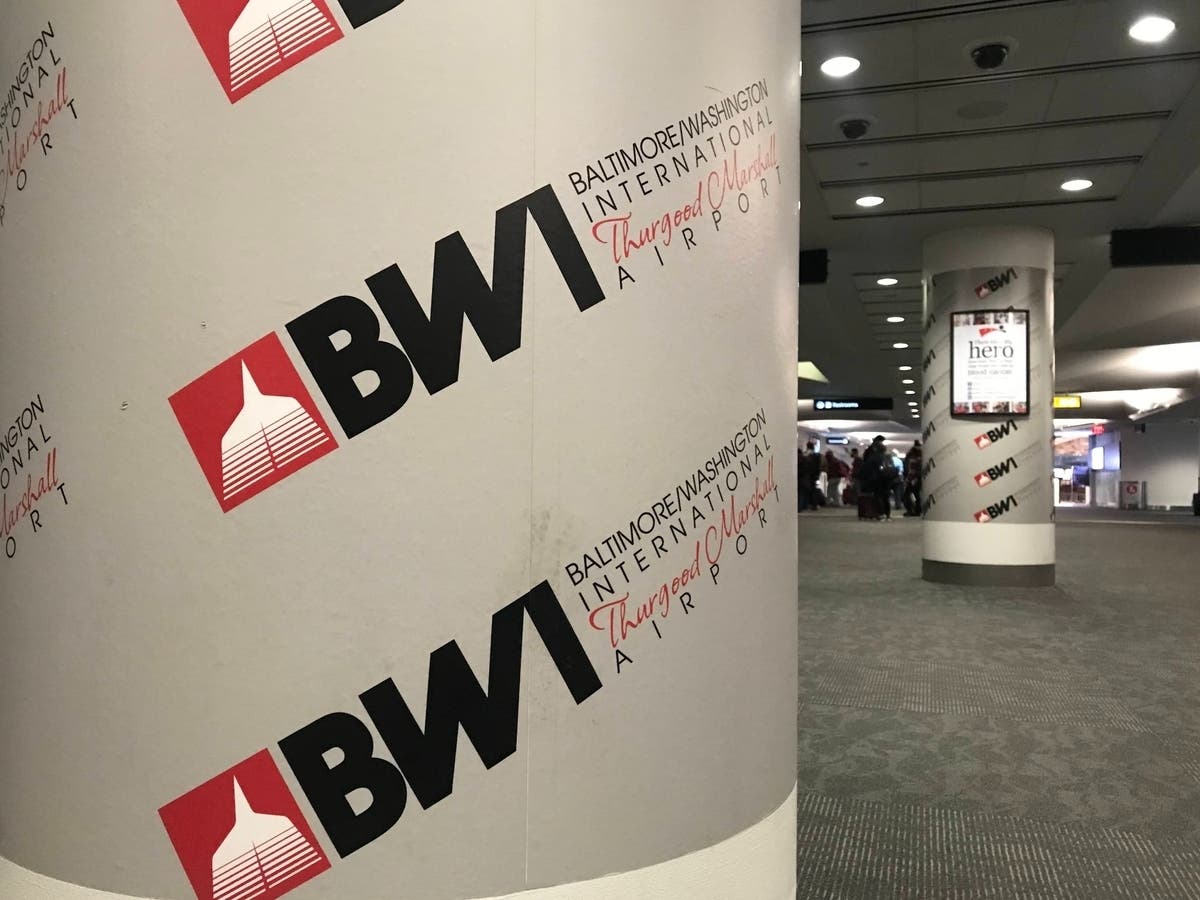
Anne Arundel County, in particular the areas near Fort Meade and BWI/Thurgood Marshall Airport, is a hotbed for companies tied to the defense sector. Major companies including Lockheed Martin and Northrop Grumman have hundreds of employees working in the area, and fill thousands of square feet of office space.
With cuts to the defense budget looming, some contractors have already cut back. Northrop Grumman, the county’s largest private employer, announced in October that it will cut 800 jobs from its Electronic Systems Sector.
Meanwhile, other companies have been loath to expand or make any major business decisions due to the uncertainty over federal spending.
“The current budget environment introduces a great deal of uncertainty into normal business investment decisions,” said Fred Downey, vice president of national security for the Aerospace Industry Association. “This may result in decisions to reduce some current operations or shift assets to more profitable operations. Each company is going to evaluate these decisions according to their specific business plan.”
Brokers of office space in the region have also noticed wariness on the part of contractors to lease new space or move.
Kevin Wilson, a broker for Capitol CREAG who helps negotiate leases for owners of Class A office buildings in the region, said he is always on the lookout for defense firms looking to expand. His latest effort involves leasing more than 68,000 square feet of space at the new Seven Oaks Office Building, across from Fort Meade in Odenton.
Wilson said his job has been made more difficult by the lack of budget clarity. In short, nearly every company he speaks to is enormously hesitant to sign any type of long-term lease, as they have no true sense of what their future revenues will be.
“A lot of people are saying, ‘I’ll just do a one- or two-year extension where I’m at,’” Wilson said. “There’s too much uncertainty. No one knows what’s going to happen.”
While he said talk of major defense cuts is worrisome, he finds the uncertainty of the situation to be even more problematic.
“How do you plan for something if you don’t know what it is?” he said. “If there are cuts, people will adjust. But just tell me how it is.”
Remaining Signs of Strength
Despite some anxiety over the short-term impact of Congress’ actions, local officials remained bullish on the government’s role in propping up the economy.
A glance at office space vacancy rates in the region shows that agencies and contractors haven’t downsized yet. Real estate analysis firm CoStar reported a 12 percent vacancy rate for office space in Anne Arundel County as of the end of September, down from 14.4 percent during the same month last year.
In Annapolis Junction, home to more than 3 million square feet of office space, the vacancy rate is just 1.7 percent, down from 16.2 percent last year. Annapolis Junction includes National Business Park, a major office complex filled almost entirely by government agencies and contractors.
Officials said that any defense cuts will be balanced out locally in the long-term by big growth from other agencies at Fort Meade that aren’t on the budget chopping block—specifically, the National Security Agency and U.S. Cyber Command.
What’s more, Fort Meade has already seen significant growth just this year as a result of Base Realignment and Closure (BRAC) activities, which brought more than 5,000 workers to three new headquarters buildings.
Robert Leib, the chairman of the BRAC task force for Anne Arundel County, said he predicts 26,675 new jobs at and around Fort Meade between 2007 and 2015, as a result of BRAC and other growth on base.
That prediction has actually increased in recent months, even with defense cuts looming. That’s because U.S. Cyber Command and NSA are expected to play a bigger role in the nation’s future defense strategies.
Leib predicted that NSA will add 6,680 jobs by 2015, with Cyber Command representing 2,500 workers. And those figures are likely conservative, he said.
“Cyber will be larger than BRAC by a few,” Leib said.
The leadership at Cyber Command, in particular, suggests it will be a major priority. U.S. Cyber Command is headed by Gen. Keith Alexander, a four-star general who also heads the NSA. Fleet Cyber Command, a division of the Navy, is commanded by Vice Admiral Michael Rogers, a three-star admiral.
“President Obama recognizes the importance of it,” Leib said. “The mission here is very focused and very different from the broader, global mission.”
Contractors said they expect to delve further into the cyber security space once Cyber Command takes hold at Fort Meade.
“Cyber security is a strategic adjacent market for Lockheed Martin,” company spokesman Christopher Williams said. “We see continued opportunities in this area to support our customers in facing these pervasive, ever-changing and increasingly sophisticated threats.”
Get more local news delivered straight to your inbox. Sign up for free Patch newsletters and alerts.