Arts & Entertainment
A Lesson in Non-Melodic Chords
Lesson 3: This is a follow up to my last lesson about making chord progressions using scales and power chords. In this lesson, you will learn other chords that operate just like the power chord.


Non-Melodic Chords
we learned how to base our power chord progressions on the major and minor scale. Before we move on to melodic chords (a chord that is major or minor) we should learn about other non-melodic chords, similar to the power chord. Remember, non-melodic chords are immune to the flow of major and minor within a key–this makes them easy to use and move.
Please Note
Find out what's happening in Owings Mills-Reisterstownfor free with the latest updates from Patch.
This article assumes you know what to do with these chords. If you don’t, read my and postings.
5th (Power Chord) Plus Octave
Find out what's happening in Owings Mills-Reisterstownfor free with the latest updates from Patch.
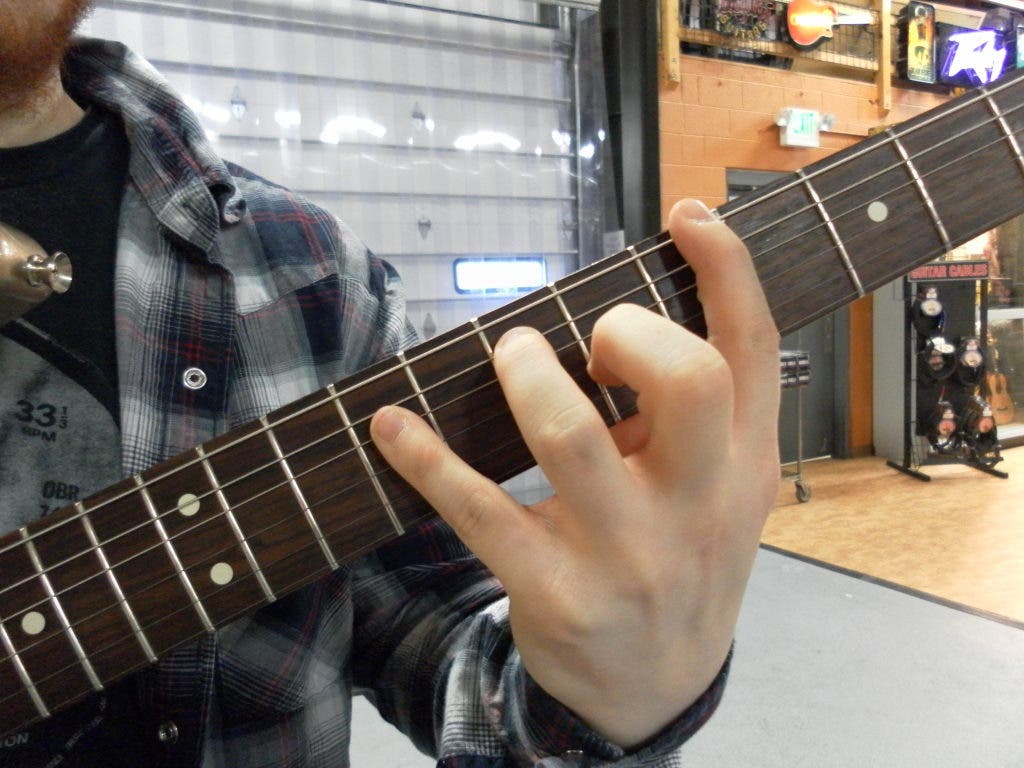
Our first example is an extension on the power chord. If you are playing a power chord on Low E, fret 5, and A, fret 7, you would add D, fret 7 with your pinky. This new note is an octave. In some situations the 5th will be excluded and musicians make chord movements and melodies with octaves alone.
4th
These chords are a great alternative to the overused power chord. If your root is on Low E, fret 5, you would add the A string, fret 5 on top of the root. Fourths are best done by barring; playing two or more strings with one finger. Your first finger should play both strings. If this is too difficult, use your middle finger for the 4th. This chord can also be fuller by adding the octave on D, fret 7 with your pinky.
Root-5th-9th
Considering this chord entirely non-melodic is incorrect. It works similarly to the power chord and 4th because this chord, by itself, contains no melodic intervals (nothing distinguishes it as major or minor). Controversy begins when you combine multiple movements using this chord. The results will sound good but are academically odd. Further conversation about the nature of this chord would be pointless right now. Just know you can move it freely like a power chord and will have good results.
This chord is made by playing a normal power chord. If your chord begins on Low E, fret 5, your 9th would be on D, fret 9 using your pinky. This is an unusually large stretch.
Its called a 9th because it is one position up from the octave in a scale. The octave is the 8th position in an ascending scale. Octave (8th) is the root so the ninth is an octave up from the 2nd interval in a scale.
Tip
Many songs are just 3 or 4 power chords. A simple alternative to this rut is to mix power chords with our 4ths and other chord shapes. Basically, if your first chosen chord is a power chord, try using a 4th for you next chord choice. You can even do a power chord, then turn the same chord into a 4th, all in one measure.