Crime & Safety
Anatomy of Forensics at Baltimore County Police (And a Human Skull, Too)
The Baltimore County Police Department is home to several, but not all, of the bells and whistles that come along with the intriguing fields of forensic art and crime scene investigation.


Wrinkles run perpendicular to your muscles? Really?
I sat back, retooling my outlook on aging (so the more wrinkles, the more muscles, right?), reunited with . We had spent the last two weeks experiencing and in smaller, separate groups. We were back in Towson Tuesday for class, which was on forensic art and CSI.
Det. Eve Grant, whose training includes time at the FBI, presented the first of the two topics. Yes, your wrinkles do run perpendicular to your muscles. In addition, it's a set of 21 universal tissue markers on everyone's faces that allows forensic artists to produce near-identical sketches of people they've never seen, she said.
Find out what's happening in Owings Mills-Reisterstownfor free with the latest updates from Patch.
This session was going to blow my mind.
Forensic Art
Grant came to forensic art through police experience, not formal training.
Find out what's happening in Owings Mills-Reisterstownfor free with the latest updates from Patch.
"Before this, I had never drawn a face in my life," she said, at least not the forensic kind.
It didn't matter. You learn by trade, and more important than one's drawing skills is one interviews a witness, she said.
"I need to take what you're telling me and put it on paper," she said, which is why her skills at drawing caricatures only got her so far. The training pays off. Grant said forensic art has a three times better success rate in catching the bad guy than fingerprints do.
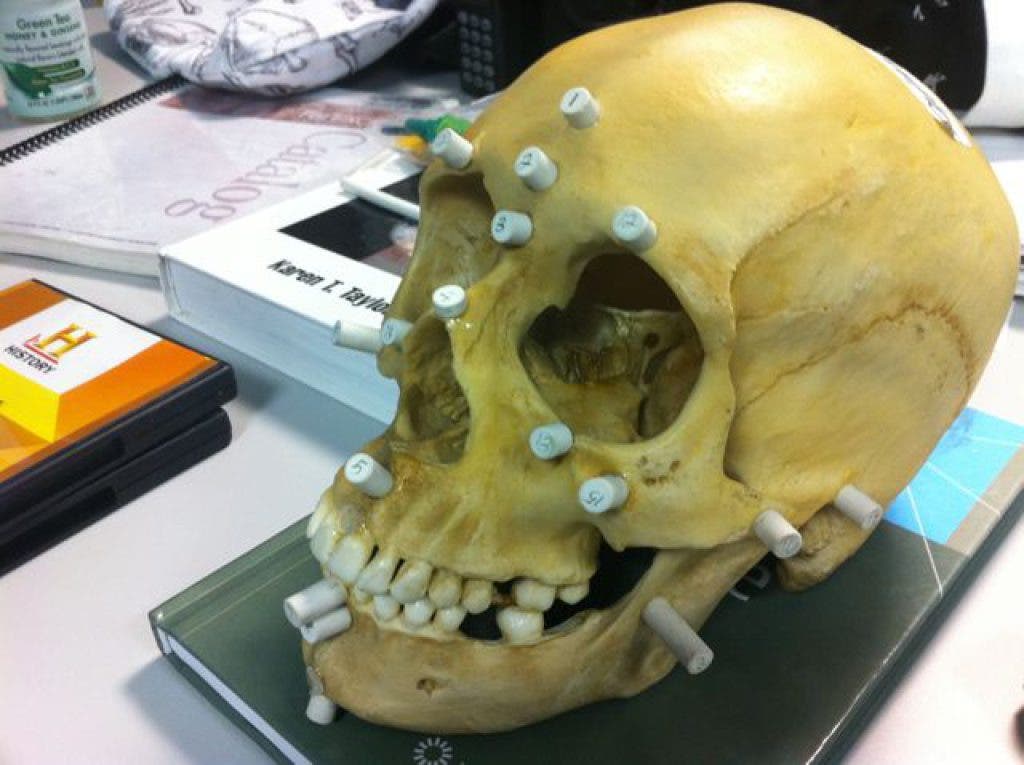
A set of theories and formulas guides the field of forensic art, which is basically the ability to reconstruct someone's face—or skull—when virtually no clues are available. Things like Frankfort Horizontal Plane Positioning and knowing where to place 32 cylinder-shaped erasers during a 3D reconstruction of the head are some complicated tricks that make it a science. (See photo.)
Budgetary constraints have helped Grant maintain an old school repertoire: Rather than using printers to produce sketches in color, Grant said she sticks to black and white, using a pencil, an eraser and a piece of paper.
"Plus, you're not always going to be able to take a computer in with you when you get a call," she said, referring to some sketch technology that allows the user to draw directly onto a computerized screen.
That's especially true when you have a witness lying seriously injured in a hospital that doesn't allow electronic devices, she said.
In short, Grant said the rest of the craft can be found in the "bible," Forensic Art by Karen Taylor, a 608-page volume for less than $100 on Amazon. This reporter checked!
Crime Scene Investigation (CSI)
Det. Irvin Litofsky, director of the forensic services department, quashed my illusions from the start of his two-hour presentation—a photo tour of the department's labs and workstations.
"We don't driver Hummers, wear leather pants or spike heels to a crime scene," he said." It's not quite as sexy as it looks on TV."
Litofsky's department works on facets of an investigation that include firearms identification, latent fingerprints, chemistry, trace evidence, a biology and DNA lab, forensic photography, digital and multimedia evidence and criminalistics.
The most important part of the work is to adhere to practice and policy. After all, CSI examines DNA, the most complex thing ever known, he said. For example, a DNA sample can be lost in a day or two if it's wet. Whether it's from rain, blood or been dumped in the water, if it's not dried and then packaged in paper, evidence that could have lasted 50 to 60 years is garbage, he said.
"If it wasn't recovered properly, whatever value we've added to it is useless," he said.
Stay tuned for the next edition, which will be two weeks from now—we'll have no class on Passover, and then meet Wednesday, April 27, rather than Tuesday. The topics are traffic law, traffic stops, radar, DUI laws and accident investigations.
Get more local news delivered straight to your inbox. Sign up for free Patch newsletters and alerts.