Crime & Safety
Dealing with Drugs, Crises
All over Baltimore County, officers are trained to encounter them.

The presentation in our second-to-last class of by Allison Paladino, LCPW-C, and Det. Jeanne Pilarski-Slattery showed that of 2,503 calls for service in 2010, only 479 ended with trips to jail or the ER.
That small percentage is what are officially called crises, and the way police deal with these types of incidents, such as suicides and people with chronic mental issues, has changed a lot over the past decade.
Lock 'em up and "get touchy-feely" later is how Baltimore County police used to handle such situations, Paladino said. Escorting someone in need of an emergency psychological evaluation could tie patrol officers up for hours. Fixing the situation—and getting those cops back to work—was achieved quickly by taking a problematic person to jail.
Find out what's happening in Owings Mills-Reisterstownfor free with the latest updates from Patch.
But people with disabilities and depression are capable of improving their behavior if communicated with correctly, Paladino said. The team now provides any support needed, from taxi fare to hourly check-ins.
"No one has a reason to say 'no' to mental health treatment," Pilarski-Slattery said. "We make it happen."
Find out what's happening in Owings Mills-Reisterstownfor free with the latest updates from Patch.
Each mobile crisis team operates as a combo—one is a trained police officer and one is a licensed mental health professional.
One challenge that particularly stood out with me are the rights protected by a police officer versus the mental health professional. Cops guard the First Amendment, but medicine adheres to HIPAA, or the Health Insurance Portability and Accountability Act. While on call, the two-person team must stay together at all times.
As a reporter, my instinct is to always want access to information about everything the police do in the public eye. In case the crisis team ever helps me out, I'm glad to know what I say is off the record.
On Drugs
Sgt. Richard Bergin noted what you may already know: Drugs, drugs, drugs he said, are everywhere.
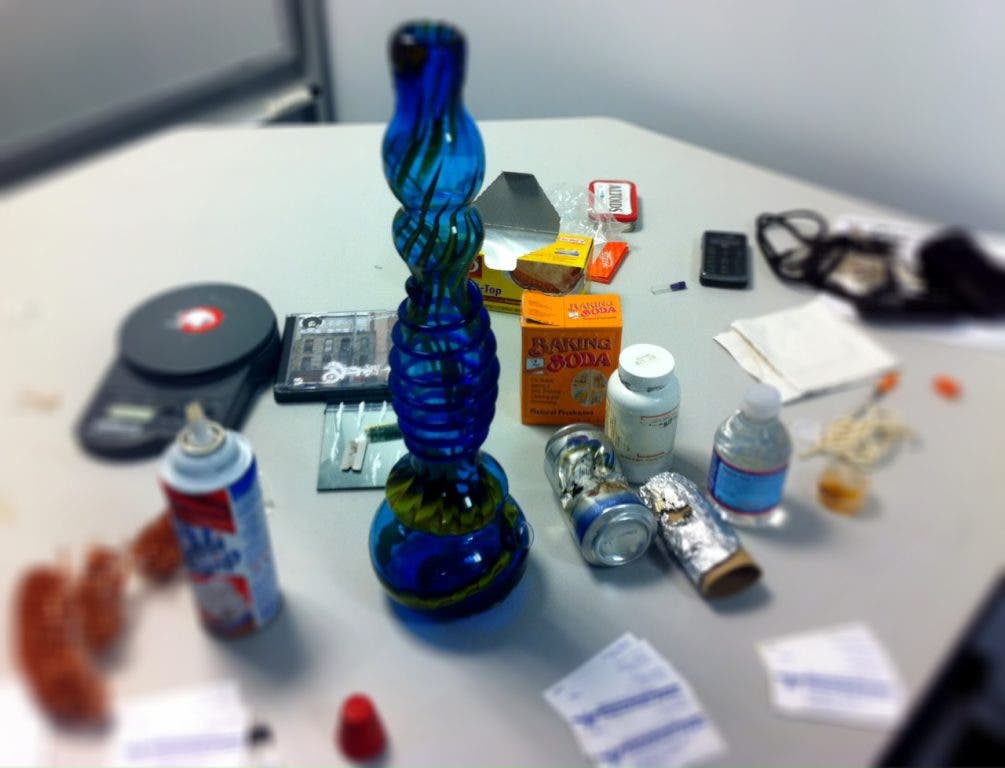
As we passed empty bongs and crack pipes around the room, Bergin provided a bevy of drug trivia. Here are five things I learned:
- Baltimore is known for its widespread heroin problem, Bergin said. Street-grade drugs only have 25 to 60 percent potency because a) drug dealers want to make more money and b) the drug in its pure form is too powerful for consumption and would be lethal. The stakes are high. Millions of dollars can be made off a kilogram of pure heroin, which sells for $100,000.
- Police can use anything they discover—from your trash and GPS devices to good old informants—to collect evidence. Yes, your trash becomes public property when you set it out on the curb.
- Most of the marijuana in the United States is smuggled from Mexico. Dealers use tunnels, one of 20 commercial railroad crossings and whatever gaps they can find along the 1,969 miles of fence on the Mexican-U.S. border. And sinsemilla means "without seeds."
- Crystal meth, or methamphetamine, is a combination of battery acid, rat poison and flammable items that can easily blow up a house. Maryland was the last of the states in the country to report a problem with meth, with two cases in the last year. Missouri had more than 700 cases.
- "Snuffing" means cruising the Internet for herbal drugs, "dexting" (for DXM) means getting drunk off a full bottle of cough syrup, and "robotripping" is more of the same but exclusive to the brand Robitussin.
Get more local news delivered straight to your inbox. Sign up for free Patch newsletters and alerts.