Arts & Entertainment
Reconstructing Lost Faces of the Holocaust
Dr. Nathan Moskowitz's Shoah Forensic Art Institute aims to honor the lost souls who perished during the Holocaust.


As a child of two Holocaust survivors, Dr. Nathan Moskowitz learned of the infamous tragedy at a young age. To say he’s familiar with the sorrow and mourning that goes along with commemorating Kristallnacht—the day when the Nazis began carrying out their "final solution" by attacking Jews and destroying their homes and synagogues—would probably be an understatement.
However, a little less than a decade ago, Moskowitz was inspired to create a new way to honor the lives of those lost. That inspiration came when Yad Vashem, a Jewish center responsible for safeguarding the memory of the Holocaust in Israel, introduced an online database that housed thousands of records of Jewish prisoners names and their vital information.
In searching for his perished relatives, Moskowitz came across his uncle on his father's side, who is one of about 200,000 Holocaust victims to have detailed prison cards written by Nazi officials that document, in meticulous detail, who each person was, where they were from and what they looked like. Moskowitz speculates that this was done for identification purposes in case someone escaped from a prison camp.
Find out what's happening in Owings Mills-Reisterstownfor free with the latest updates from Patch.
Using this information, which included date of birth, height, hair and eye color, body and face structure and more, he painted two pictures of an uncle he had never met and had never even seen.
“When I saw that I said to myself, this is fantastic, I can now recreate him and paint his picture, which is what I did,” Moskowitz said. “This was almost like a posthumous gift; snatching him out of oblivion and bringing him back to life.”
Find out what's happening in Owings Mills-Reisterstownfor free with the latest updates from Patch.
Wednesday night at , as a part of his Shoah Forensics Art Institute, Moskowitz invited others to do the same.
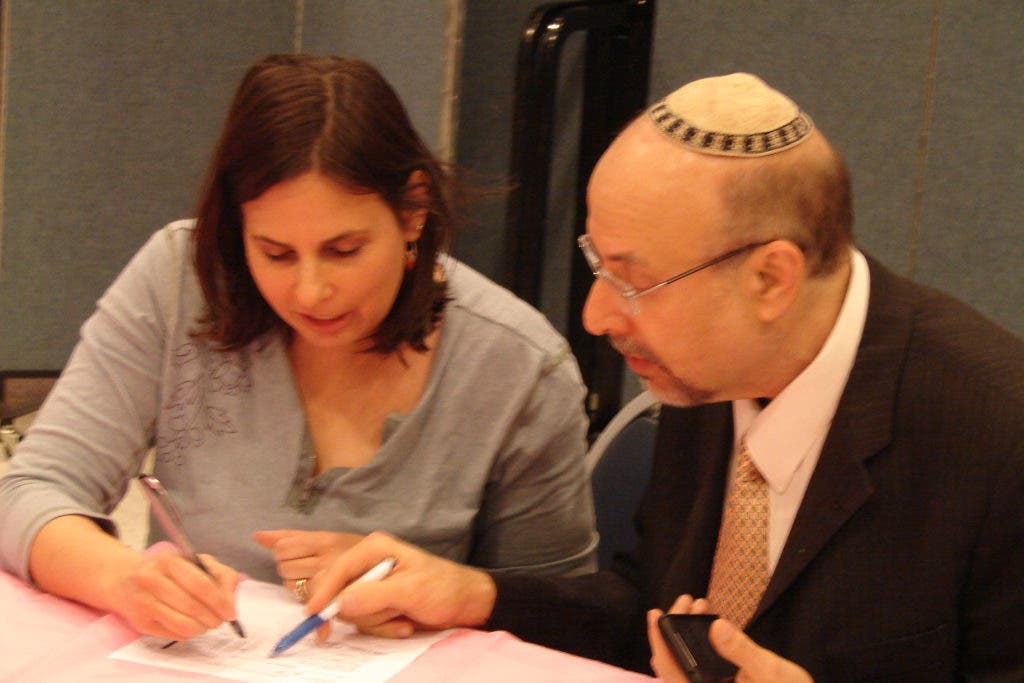
Printing out records of other Holocaust victims, Adat Chaim congregants and other members of the Reisterstown community proved you don’t have to be a practiced artist to create something truly meaningful.
In addition to reclaiming the lives and faces of so many, Moskowitz’s project enables individuals to take a sorrowful and devastating day and turn it into a positive tribute.
Adat Chaim Rabbi David Greenspoon welcomes the notion of taking an upbeat view and celebrating the lives of the deceased rather than mourning a vast loss.
“Ultimately, we’re still here and isn’t that a wonderful thing?” Greenspoon said. “As much as there were individuals, households, families and entire communities who were annihilated during the Shoah, it’s our responsibility to give testimony that they were here too because they can no longer do it for themselves.”
After the project was presented to about 40 people in attendance, children and adults were handed printouts of an individual's information—written in German. They soon got to work with crayons and colored pencils to illuminate the memory of the person who died nearly 70 years ago.
During his presentation, Moskowitz said it is difficult to grasp just how many people were killed in the Holocaust. Human minds are simply wired to understand the death of one, as opposed to millions. However, this project helps personalize some of those millions to others, he said.
“This is really, really exciting because we’re actually learning about an actual person and this person is being thought about,” said Joanie Posner of Pikesville. “Otherwise, who knows? They might not ever be thought about or remembered. So I think you pick up a little connection as you’re trying to decipher some things and actually think about an individual as opposed to a large number of people.”