Sports
Stevenson Looking to Score Big with Football
The new sport looks to change the face of the one-time commuter school when the Mustangs take the field this September.
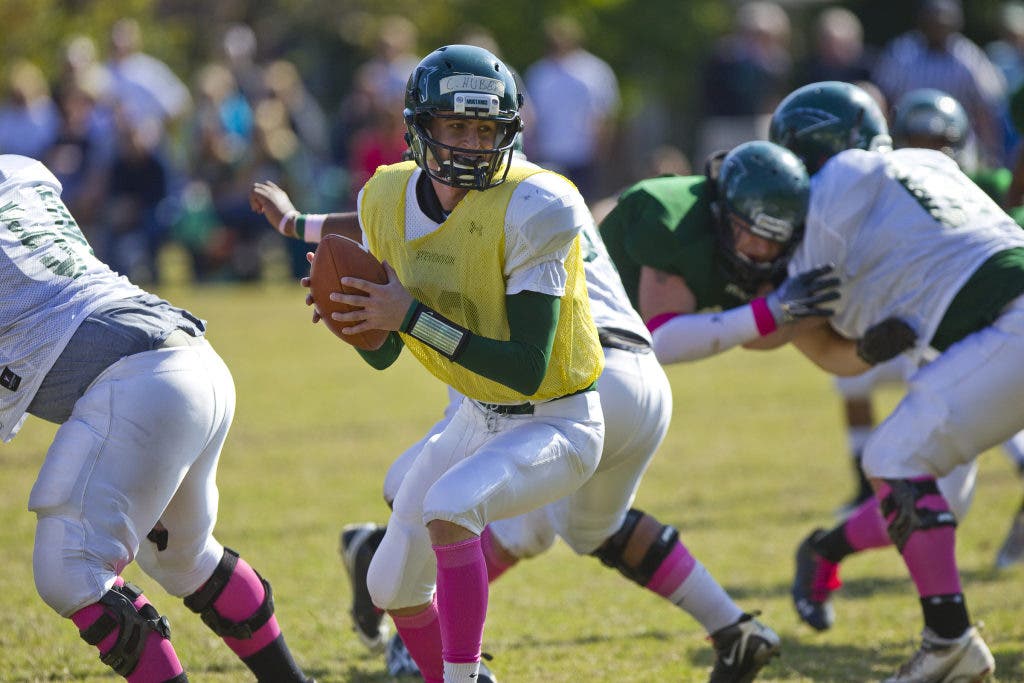

Kevin Manning foresees a crisp, fall night when he'll walk through the crowded Owings Mills campus of , nudging his way past green-and-white-clad students swaying to the strains of the Mustangs fight song as they excitedly make their way toward the big event under the lights.
For Manning, the president of this fast-growing university, football night on Owings Mills Boulevard is anything but a pipe dream. In just under two months, Stevenson's newly minted gridiron team will take the field for the first time, and simultaneously open a new chapter in the history of the one-time commuter school.
"We think this will be a real transformational experience for all of us," said Manning.
Find out what's happening in Owings Mills-Reisterstownfor free with the latest updates from Patch.
It already has been, to some extent. Helped by the buzz of the school's growing athletics program, applications from prospective students reached nearly 6,000 this year, up six-fold from 2000.
Stevenson's total enrollment is 3,900 graduate and undergraduate students.
Find out what's happening in Owings Mills-Reisterstownfor free with the latest updates from Patch.
Perhaps just as important has been the growing sense of pride and identity for a school known until 2008 as Villa Julie College.
"What comes along with football is it brings the school a new type of attitude, and a lot more excitement on campus," said linebacker Donnell Brown. "There's been a real big buzz about what's happening here."
Manning, who has led Stevenson since 2000, said school officials decided several years ago to prioritize athletics as a way to boost enrollment and create a richer culture on campus. That started with the hiring of former Loyola star and longtime Div. I assistant Paul Cantabene to lead the school's men's lacrosse team, now considered one of the top squads at the Div. III level.
Football was a logical next step.
"Football is the largest sport at the high school level, and obviously football and universities kind of go hand in hand," said Manning, who spent time as a grad student at football powerhouse Ohio State. "I think when anyone thinks about a typical university in the fall, they usually think about the first football game and homecoming."
The Making of a Team
The centerpiece will be a $7 million, 3,500-seat stadium, being erected on the site of the former training complex of the Baltimore Colts and Ravens. The stadium is expected to be ready in time for the home opener on Sept. 10.
But that's just the tip of the iceberg. There are uniforms, equipment, a coaching staff and around 100 new student athletes.
Head football coach Ed Hottle, who previously rebuilt the program at Gallaudet, said he's so far had nothing but cooperation from school administrators.
"It's very important to have the university fully committed to what you're doing. … Anything short of that just makes it more difficult," said Hottle. "I've seen schools do this, and some of them not doing it very well. They struggle, and they struggle for a long time to really kind of get it going. Everybody here is all in, from the custodians to the president."
From a financial perspective, Manning said the program—which, like all programs on the Div. III level does not award scholarships—is a win-win. All of the associated costs, he said, are covered by the tuition and fees of the players themselves.
"And because football and enrollment expansion go hand in hand," said Manning, "we actually have more money now to spend on the other things, separate from athletics, than we did five years ago."
Writing the Fight Song
One of the beneficiaries will be , led by former Westminster High School band director Mark Lortz. Hired in April, Lortz will be busy this summer attempting to recruit musicians, secure instruments and arrange a new school fight song, composed by music department chair Bob Suggs.
Following 15 years at Westminster, Lortz said the opportunity to get in at the ground level was simply too much to pass up.
"The whole idea of not following in anyone's footsteps, but starting the tradition myself is really what I'm excited about," he said. "We can get all the kids involved with the university and start the different rituals we'll do before games, performances and things like that.
"My philosophy for the band has been that we're the largest musical PR vehicle for the school."
Lortz is hoping to attract around 30 band members—each of whom will receive a $500 grant and course credit—for the inaugural season.
The band, cheerleaders and dance team all will contribute to what school officials are hoping will be a memorable game day experience for fans.
Finding Rivalries and Reasons for Pep Rallies
Rising sophomore Tim Campbell only hopes the atmosphere can match what he experienced as a player at , which ended each football season with a rivalry game against Gilman.
"We spent all week decorating the school and had a huge pep rally the night before," said Campbell. "Obviously our team now is brand new, and we don't have a rival. But hopefully in the future we'll have a consistent team that we get excited to play each year."
Players can't wait to get started building traditions from scratch. The team, which went through a developmental season in 2010, has a digital clock on the wall of its locker room counting down the number of days, hours and minutes until its first game.
Hottle already has a particular tradition in mind he'd like to see from the outset.
"The tradition of winning, that's for sure," he said. "Our job No. 1 is to make sure these guys do well academically. And job No. 2. is to win a national championship. We want the tradition of hardworking, blue-collar type kids here—guys that are lunch-pail, hard-hat kinds of guys that understand hard work, understand discipline and understand that they're here to do a job."
And that job will be critical to the future success of a school attempting to distinguish itself on the collegiate map.
"A lot of these elements we're putting in place are not only practical from the standpoint of making a richer culture, but also symbolic of what we're trying to do at Stevenson," said Manning. "We've noticed just in the short time we've had [football] that more people are aware of Stevenson than ever before."
Editors Note: This is the first in a series examining Stevenson's new football program.