Politics & Government
Could Cash-For-Phone Kiosks be Banned by State?
Maryland lawmakers are worried that businesses like ecoATM, which recycle used cell phones, are encouraging thefts.


By MIKE DENISON
The premise seems simple: drop off an unwanted phone at a recycling kiosk, receive instant cash and keep precious metals out of landfills. Consumers and the environment both win.
Find out what's happening in Perryvillefor free with the latest updates from Patch.
But, according to some politicians, so do phone thieves. This fear has led some Maryland lawmakers to push for tighter restrictions or even outright bans on these machines.
This fall, Baltimore prohibited cash-for-phone kiosks in the city. Baltimore City Councilman Bill Henry, who initiated the measure, said the kiosks’ tendency to attract stolen phones outweighed the good done by businesses like San Francisco-based ecoATM, which has 10 kiosks in Maryland.
Find out what's happening in Perryvillefor free with the latest updates from Patch.
The issue is set to expand, as Delegate Mary Washington, D-Baltimore, is authoring legislation to increase restrictions on ecoATMs and similar kiosks statewide. Her bill would require the kiosk operator to submit records of all transactions to law enforcement officials within 48 hours and to withhold payment for 48 hours.
However, Ryan Kuder, ecoATM’s director of marketing, argues that the kiosks are designed for maximum security.
“There’s a lot of misperceptions about the way that the machine works,” said Kuder. “It doesn’t make any sense why the company who does more than anyone else would be targeted.”
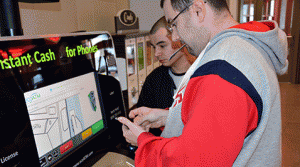
The process of selling a phone at an ecoATM is simple; a machine scans a customer’s driver’s license, analyzes the model and condition of the phone, and offers a price. If the customer accepts, the phone is eventually recycled.
Many recycled phones are sold again. Others are harvested for usable parts, keeping materials within the phones - including precious metals and toxic chemicals - out of landfills, according to Kuder.
He added that ecoATM has many security measures in place, including requiring customers to scan a valid driver’s license. With the help of cameras on each kiosk, every transaction is personally monitored by ecoATM staff.
“A fraction of a percent” of phones recycled at ecoATMs are later subject to police inquiries, Kuder said.
In fact, he said that these cameras are often helpful for police. If a phone is reported stolen, the cameras on and around an ecoATM can offer high-resolution pictures of suspects. Additionally, ecoATM holds all phones for 30 days, or longer if state law requires; Maryland requires secondhand-goods dealers, such as pawn shops, to hold purchased items for a minimum of 18 days and a maximum of 75 days.
Henry agreed that ecoATM has a sterling track record of cooperating with police, but he believes a more proactive approach is necessary.
“Nobody has said anything but [that] they are 100 percent cooperative,” said Henry. “While that’s nice behavior on their part, regulated secondhand-goods dealers are required to report to the police every day every single item that they’ve purchased.”
For some lawmakers, the most blatant problem with ecoATM and its competitors is the promise of instant cash. Henry says that considering ecoATM’s identification requirements, the kiosks should have enough information to mail the seller a check. Washington’s bill would require providers to pay sellers with a check.
“The ability of individuals to collect phones...and receive cash without any information being collected, that is what the public safety problem is,” said Washington. “There are all kinds of ways for the value of these cell phones to be provided to the seller without cash.”
However, Kuder says that the promise of cash is a huge incentive to customers and “a critical component” of his company’s business model.
The consumer response to ecoATM in Baltimore County was “fantastic,” according to Kuder. He said that over 20,000 phones and devices have been recycled there so far. When Baltimore city allowed ecoATMs, “there were people lined up to use the machine.”
EcoATM has at least one kiosk in the following locations: Westfield Annapolis Mall, the Marley Station Mall and Centre in Glen Burnie, Security Square Mall in Woodlawn, TownMall of Westminster, St. Charles Towne Center in Waldorf and Harford Mall in Bel Air.
Understandably, some Marylanders are opposed to the idea of a ban.
“I think it would be a bad idea, because [ecoATM is] keeping a lot of waste out,” said Shaneice Crowdy, a retail worker in Annapolis.
Henry said that he would support putting ecoATM’s technology in the hands of pawn shops and other secondhand-goods dealers. This would allow for the convenience of the kiosk while facilitating human reporting and monitoring.
Get more local news delivered straight to your inbox. Sign up for free Patch newsletters and alerts.