Politics & Government
ICE Contracts Boost Revenue For Maryland Counties, Universities
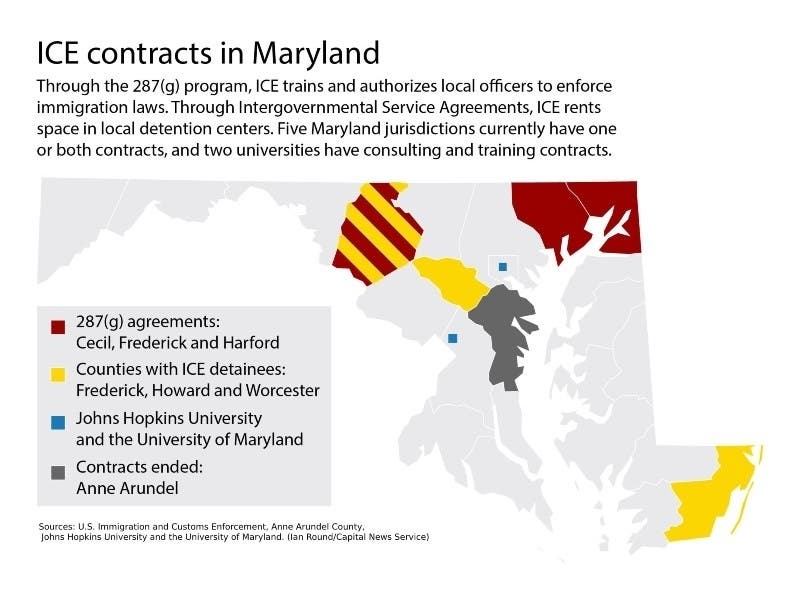
Cecil, Frederick, Harford, Howard and Worcester counties have programs in partnership with ICE, while some other areas have ended theirs.


By Ian Round, CAPITAL NEWS SERVICE
ANNAPOLIS, MD — As Maryland counties and universities face increasing pressure to end their partnerships with U.S. Immigration and Customs Enforcement, Cecil County’s is recently “operational,” according to an ICE spokeswoman.
Cecil is one of three Maryland counties — with Frederick and Harford — that currently have what are known as 287(g) agreements with the federal agency. Through these agreements, ICE trains and authorizes police officers at local detention centers to screen inmates for breaking immigration laws.
Find out what's happening in Perryvillefor free with the latest updates from Patch.
Two Cecil County officers completed a four-week training in September, ICE spokeswoman Kate Pote said.Though the 287(g) training programs do not come with federal funds, other programs with the immigration agency — to house inmates, and train ICE employees — have brought in millions in revenue to a few Maryland localities and universities.
Three counties — Frederick, Howard and Worcester — have Intergovernmental Service Agreements with ICE, through which they rent out jail space for immigrant detention.
Find out what's happening in Perryvillefor free with the latest updates from Patch.
While activists across the state are seeking to end these agreements, officials say the revenue is worth it.
"I do empathize with the concerns of people, but if what you’re trying to change is how the president decides policy, and you think this is gonna have some impact on that, I just don’t see it," said Jack Kavanagh, who runs the Howard County Department of Corrections.
"You haven’t changed the policy just because you’ve ended the contract in Howard County … That’s money for police, schools, where’s that gonna come from?" Tim Rothermel, who lives in Elkton, in Cecil County, and works in pharmaceutical sales, has protested ICE across Maryland, and he wants the county to end this contract.
Rothermel said these agreements are easily misused and create fear in the immigrant community.
"We’re creating more work for our officers, we’re exposing ourselves for liability and lawsuits, just to do something ICE already has the ability to do anyway," he said. "Creating fear for no reason is costing tax dollars and making us less safe."
ICE pays for 287(g) training, but after that, this immigration work becomes part of the officers’ jobs. Rothermel argues it takes away from time they could be spending on more important police work.Rothermel marched against ICE with the activist group Jews United for Justice at the Artscape festival in Baltimore in July. And with a few hundred allies, he obstructed the Howard County detention center in August in protest of that county’s detention agreement.
On Aug. 15, Rothermel sent an inquiry to the office of Cecil County Executive Alan McCarthy in which he asked why the county had signed the contract. Sheriff Scott Adams, who signed the contract for the county in February, replied in a letter provided by Rothermel to Capital News Service.
"The reason I decided to enter into this program is simple," Adams wrote. "The 287g program is not about hunting down illegal residence (sic) who may be living in our county but it is about removing illegal persons from our county who have committed crimes here."
A few major highways run through Cecil County. While its immigrant population is small, Adams wrote that drug traffickers, many of them immigrants, often stop there while driving between cities.
"We have noticed recent trends where those bad actors are setting up shop in our county and starting drug organizations because it is safer here for them than in other areas," Adams, a Republican, stated.
(Adams’s and McCarthy’s offices did not return multiple phone calls from Capital News Service.)
Howard, Frederick, Worcester Counties Get ICE Payouts
Howard County has brought in nearly $20 million through its Intergovernmental Service Agreement since it was signed in 2013, Kavanagh said, and Frederick County makes about $1.3 million per year, according to Sheriff Chuck Jenkins.
"All that money is turned over to the county coffers," Jenkins said.
ICE pays Worcester County $87.11 per inmate, per day, according to a contract amendment.
Rothermel said his problem is that those suspected of immigration violations can be turned over to ICE after being arrested and charged with a crime, but before facing a trial.
Rothermel said when he found out about the Cecil contract, he reached out to various progressive groups in search of “sympathetic ears.”
Danielle Contreras, the president of the Cecil County chapter of the League of United Latin American Citizens, said she worries officers will use their immigration enforcement authority outside of the detention center. She noted the example of a Salvadoran woman who won a lawsuit against Frederick County after officers profiled and wrongfully arrested her in 2008.
In an email, Pote noted the “stringent internal controls and protocols” on officers’ conduct, and said that officers trained under 287(g) were not the ones accused. The “287(g) trained officers are only authorized to utilize their authority at the detention center," Pote added.
“If they’re using it in jail, that’s fine,” Contreras said. If not, “That’s gonna be an issue.”
That said, opponents are only in the awareness-raising stage. Rothermel is “not ready to link arms and lay down on Route 40 or anything like that,” he said.
Recent Pushback Against ICE
Frederick County began in November an independent audit of the sheriff’s office’s spending through the 287(g) agreement, according to Jenkins. The audit is expected to take a few months.
Sergio España, of the ACLU of Maryland, said he was glad for the audit, but he wants more accountability.
“We think that barely scratches the surface,” he said. The 287(g) program is “denying Maryland residents due process and breaking up families and breaking up public trust.”
Johns Hopkins University announced in September that it would not renew a contract with ICE, under which it provided emergency medical training. Students at the university, which according to USAspending.gov has earned more than $7 million through its contracts with ICE since 2008, protested and engaged in sit-ins in April against the contracts, and the creation of an independent university police force.
Kim Hoppe, a spokeswoman, said faculty leaders at the Department of Emergency Medicine were the ones who decided to end the contract. She said the university is “working with the Department of Homeland Security to determine an appropriate transition period for this work, which we anticipate will be completed by spring 2020.”
Immigrants’ rights advocates have demanded Maryland governments and institutions end their contracts with ICE in recent years, with varying levels of success.
“These contracts were no longer tenable in the general atmosphere,” said Conor Bean, a graduate student in political science who organized with the Hopkins Coalition Against ICE.
The University of Maryland has one active contract with ICE, through which it has provided terrorism-related trainings since 2017. ICE has paid $250,000 of the $625,000 contract, which is set to expire in 2022, according to USAspending.gov. The university has not said it will end the contract, despite demands from student activists. The contract is with the ICE division of Homeland Security Investigations, not Enforcement and Removal Operations, the office responsible for detention, arrests and removal.
Through the agreement, the university’s National Consortium for the Study of Terrorism and Responses to Terrorism provides research “on the human causes and consequences of terrorism,” according to the university’s Undocumented Student Program, which cited the university’s Office of Strategic Communications. The office stated the university’s police department does not ask about citizenship, and that the goal of the contract is to provide “science-based, non-partisan, non-politicized understandings about human behaviors.”
Last December, Anne Arundel County Executive Steuart Pittman ended the county’s 287(g) agreement, arguing it stretched staff too thin and hurt police outreach efforts in Latino communities, according to a December 2018 report. But he kept the detention agreement in place, saying the county’s facility could treat detainees more humanely than others. He vowed to use the revenue from ICE for immigrant legal defense. But in January, ICE ended the detention agreement.
The county had the detention agreement in place between 2017 and early 2019, and according to that report took in $118 per inmate per day and more than $4 million in the first 13 months of the agreement.
Kavanagh also said his facilities provided better conditions for detainees than those at the southern border. He said revenue from the agreement has offset the detention center’s costs, and that protesters’ anger is misplaced.
“I understand the activist point of view, but you have the wrong battlefield,” he said. “You’re upset about the policy of a president and the conditions of some of the facilities on the border.”
In deciding to enter the agreement to house ICE detainees, “We said look: Our mission is public safety, so if you give us criminally involved individuals, that is within our mission.”
Kavanagh said his facility houses convicted felons, criminal gang members, those who have reentered the United States after being deported, and those charged but not yet convicted of jailable offenses.
He said ICE pays Howard County $110 per inmate per day. The average stay is about 90 days, he said, and the facility has 95 beds, of which around 65 were full Dec. 3. All detainees are men, he said.
Molly Amster, the Baltimore director of Jews United for Justice, said the revenue isn’t worth it. She said she thinks the political headwinds are in the activists’ favor in the majority-Democratic Howard County.
“Where you have Democratic leadership, you have less collaboration and that’s part of what’s so shocking about Howard County,” she said. “What immigrant rights advocates across the country are saying is if you have more beds, they detain more people.
Get more local news delivered straight to your inbox. Sign up for free Patch newsletters and alerts.