Arts & Entertainment
‘And Then What Happens?’ (Part I)
Follow the journeys of 10 storytellers as they hone their craft onstage at Timonium's joke house.
Storytelling has been around since the first guy said to another guy as they sat around a fire, “Hey I just killed a saber-toothed tiger, wanna hear about it?”
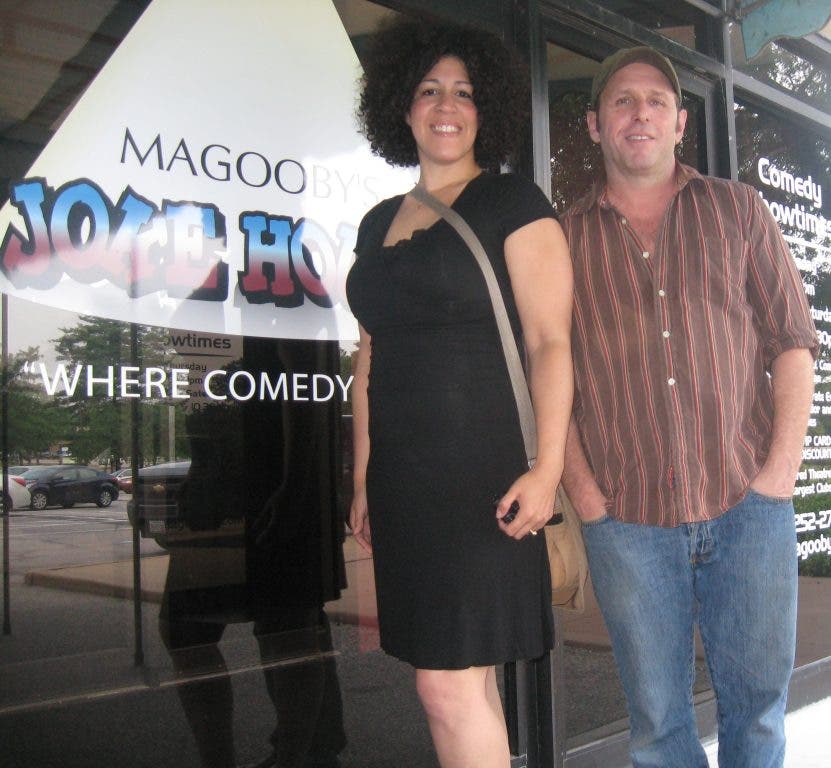
That’s how Marc Unger put it, at in Timonium, where the nationally headlined comedian is teaching a five-week seminar called “The Art of Comedic Storytelling.”
“One of the things you learn how to do in effective storytelling is, and then what happens, and then what happens, and then what happens," said Unger, describing how to hold an audience.
Find out what's happening in Lutherville-Timoniumfor free with the latest updates from Patch.
Approaching the eons-old craft with the intensity of that long-ago hunter, Unger went for the soul of the students almost immediately. In an opening exercise, he challenged them to improvise a short speech using whatever emotion he shot at them.
“Give me anger,” Unger demanded. “Give me macho, over-confidence, cockiness. Give me painfully depressed. I mean, you know, suicidal. Give me disingenuous—phony. Give it to us again, with complete disinterest. Instead of happy, let’s say silly. Be silly. Now, let’s go with delusional. Heartbreak. Show me heartbreak.”
Find out what's happening in Lutherville-Timoniumfor free with the latest updates from Patch.
One by one, the students plumbed their depths and tried to project these emotions. Raw and amateur, most of the students were profoundly uncomfortable and a lot of embarrassed laughter filled their time on stage.
Rain Pryor, who is teaching the seminar with Unger, is the softer foil to Unger’s edginess.
The daughter of legendary stand-up comedian Richard Pryor and a singer and an actress in her own right, Pryor is free-flowing, thoughtful, quick with a laugh and spontaneous. In class, she’s the counter-balance to Unger who is structured and disciplined with an economy of movement, communicating volumes with a single look, or word.
The two admit that Unger has the writer’s eye and Pryor has the director’s eye.
“It’s not necessarily just the lines you’ll be speaking, but how you present that story, and how you relate that story,” Pryor said.
Performing her own solo show, several years ago, about the racism she experienced as a child, Pryor was surprised to learn a lesson herself about the connection between drama and comedy.
“In my solo show, when I first created it, I thought I created a dramatic piece,” Pryor said. “I kid you not, when I performed it, people laughed. I thought, my pain is funny? But out of tragedy comes comedy.”
That’s what she told the class, stressing that the stories they bring to the seminar can be serious. They can be painful, dramatic or heartbreaking – and still be funny.
Unger added, "Your story can be about something that’s very, very serious. But, we’re looking for the comedy. It doesn’t mean that the audience has to be rolling on the floor laughing. This isn’t stand-up.”
In the opening exercise, the students were learning how to embody an emotion in order to inject a believable character into their stories.
“Let’s go with devious,” Unger instructed Danielle Baird, an event-planner from Baltimore who hopes the class will help her overcome a fear of performing in front of people. Baird appeared dispirited for a moment.
“We want to see the twirling moustache,” said Unger, painting the picture for Baird. “You might have an anecdote, as part of your story, and one of your characters could be a Dastardly Dan kind of guy. I want to see him a little bit.”
Baird gamely put on a sly, smarmy smile and showed none of the nerves she admitted to later.
“My knees were shaking!” she laughed.
She got applause from the class.
Vera Gabriel, another Baltimore resident, whose day job is performing as a party clown, is no stranger to the stage or to comedy, but her emotion was trepidation.
Unger was more impressed with the result.
“If you were doing a character in your story,” he said to Gabriel, “that performance was a fully-realized character that I would buy, as an audience member. So that was really good.”
The class is going to start telling their stories next week, during the second class, and they listened hard to Unger's words when he summed up why their stories have to come from the heart.
“The audience will smell if you’re trying to manipulate them,” he said.
The students will not use microphones, on stage – not even during their final performances. Unger wants to keep the intimacy of true storytelling, which started so long ago, when storytelling was how people stayed close, around a fire.
Join us next week to read about the second class, meet some more of the students, and see how they begin to craft their stories for a final performance in August.
Editor's Note: You can read Part II .