Community Corner
Lo and Behold, A New Breed of Buddleia
As summer days fall off the calendar which of your plants will survive the chilling weather? Leigh Barnes knows.
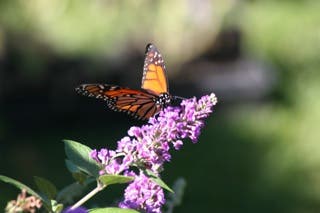


It is a gorgeous, bright mid-September day. There is a gentle breeze rustling the leaves of crape myrtles, maples, a lovely young pendulous ginko that will glow yellow in a few weeks and two sad, old oaks in the yard behind mine. I watch clusters of bumblebees in search of food–up, down and around tall stalks of salvia blooms. The weatherman says the temperatures will be in the 40s tonight. I realize the summer is coming to an end.
These are precious days.
Nowhere in my garden is there more winged activity than around the three dwarf 'Blue Chip' butterfly bushes I planted two years ago in the early spring. One is growing with yellow companion plants in a large container on my terrace. The other two have formed a 3-foot-tall, 6-foot-wide mass of violet blue blooms in the front of one garden bed.
Find out what's happening in Lutherville-Timoniumfor free with the latest updates from Patch.
'Blue Chip' is one of two color introductions (the other is a ruby red) in a series of new, dwarf Buddleias with the trade name 'Low and Behold'.
As the name implies, these deciduous shrubs are a low-growing form of the old fashion Butterfly Bush. What makes them so special is not only their diminutive size, but they are almost completely sterile. This means they will not set seed and will remain in continuous bloom from mid June until killing frost. And these flowers provide an abundant food source for a large number of insects. It is hard to write about this lovely plant without mentioning all the insects it attracts
Find out what's happening in Lutherville-Timoniumfor free with the latest updates from Patch.
The air traffic around these plants can rival anything O'Hare airport can produce in a day.
I count at least 25 large black and yellow bumblebees working their way across the blossoms, oblivious to my presence. Pairs of 2-inch, pale celery colored butterflies with a single black dot on the upper wings flutter and land, feed, then flit off again within seconds. Clusters of inch-long yellowish brown butterflies land on a flower and share the bounty. A praying mantis has just appeared on a flower stem inches from the laptop resting on my knees.
To my horror, I am witnessing another garden murder.
The mantis has just snatched one of the little brown guys, held him in one claw-like front leg and devoured him in less than a minute. She (maybe he?) is cleaning off the remains of her prey from her left leg and is now poised for the next strike. Her alien-like eyes glow shiny, translucent green.
But I digress.
Because blues and purples are recessive colors that fade in the distance rather than stand out in a garden bed, I have found that it is best to combine 'Blue Chip' with bright yellows such as a barberry called 'Bonanza Gold' or possibly Spirea 'Ogon'. In my garden I have them with the yellow Barberry on one side and a large, yellow striped Yucca 'Bright Edge' on the other. As an under-planting in front of the shrubs, I have used a coral bells called Heuchera 'Citronelle'- a lovely bright yellow/green.
So here is an easy care, drought tolerant, woody perennial plant that will bloom most of the summer and fall, will provide a food source for a large number of insect and will be a beautiful addition to any garden.
Happy Gardening