
I have never liked the idea of using pesticides. For years I maintained a large vegetable garden that was chemical free and often vegetable free as well.
My green beans provided a feast for Mexican Bean Beetles. The strawberries, at the point of perfect ripeness, would be eaten hollow on the underside by stealth slugs who always beat me to them. But, knowing that pesticides were unhealthy for beneficial insects and humans alike, I was willing to sacrifice abundance and give the insects their due.
What a dumb idea!
Find out what's happening in Lutherville-Timoniumfor free with the latest updates from Patch.
It was a huge amount of work for minimal return and maximum frustration. I plowed the garden under and drove to the local Farmers' Markets.
But this year, a friend dropped off six fancy tomato plants he had grown from seed and I felt it would be an insult not to plant them. So, I prepared the far end of one of the garden beds and planted the roots deep into the soil.
Find out what's happening in Lutherville-Timoniumfor free with the latest updates from Patch.
That was a month and a half ago. The plants are rising to amazing heights – all that good manure I added - and I can see many fruits forming. What I did not notice was the presence of a Tomato Hornworm that had been feasting on the upper leaves of several plants.
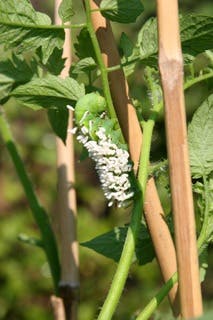
I saw the stripped stems and then discovered the culprit – lined up in perfect green camouflage along the stem on which he had been feeding. He was not moving; his entire body was covered in tiny, white rice-like structures. I knew this creature had been parasitized by a beneficial wasp, but couldn't remember any of the details. I did take the time to grab my camera and capture this wonderful act of nature in the moment and then I went to my computer.
I Googled 'natural predators of Tomato Hornworms' and all the information I needed popped up on the screen. You can do the same, but here is a quick account. There is a fascinating insect called a Hawk Moth – also known as a Sphinx Moth or Hummingbird moth.
It has a wing span of 5 to 8 inches and can hover, like a hummingbird, over a plant to collect nectar in its incredibly long straw-like proboscis which rolls up when not in use. The caterpillar stage of this moth is the dreaded Hornworm (so called because of a black, harmless hook-like horn at the tip of its tail), which can do a lot of damage to agricultural crops.
The good news is that these destructive caterpillars have a natural predator, the braconid wasp. This is a good wasp -- yes, I said 'good' because, where there are hornworms on tobacco or tomato plants, more than likely these natural killers will be present.
The females lay their eggs under the skin of the hornworm. When the larvae develop, they eat the viscera of the worm. I know, it is gross. One website refers to this process as 'meals on wheels' for wasps. They then emerge through its skin and spin tiny cocoons from which the adult stage wasps emerge.
The female wasps will then find new hornworms and repeat the cycle.
If you find a parasitized hornworm in your garden, do not throw it away. The resulting generation of new wasps will protect your tomato crop. Nature takes care of its own and we do not have to do a thing to aid in the process. No chemicals, no sprays, no cost and minimal damage to the plants. That's hard to beat.
Happy gardening…