

We see them under our porches, sometimes, their eyes glowing in the dark. We set out the saucer of milk, and then the dish of tuna. We gain their trust and the bond begins to grow. And then we make that first fateful trip to the store for Meow Mix or Fancy Feast or Friskies. That’s when it happens—we now have a new cat. We didn’t choose this cat.
It’s the stray cat that chose us.
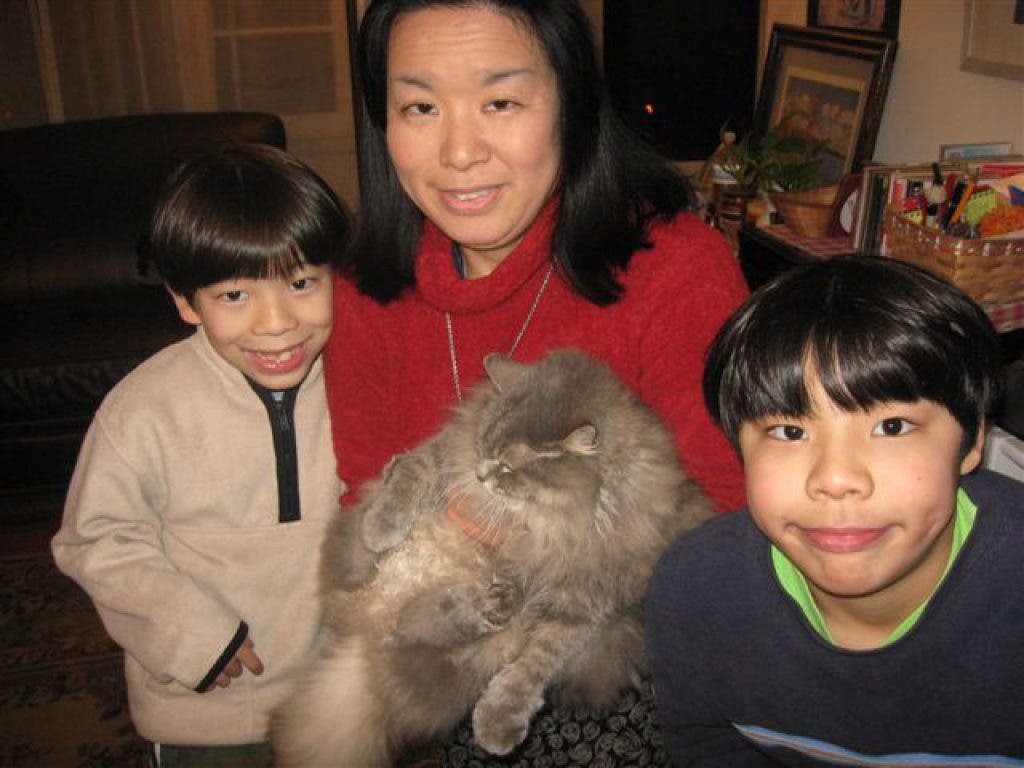
Yoko Sasaki, a Lutherville resident, was smitten when a beautiful gray long-haired stray cat walked down her street and made itself at home on her porch.
Find out what's happening in Lutherville-Timoniumfor free with the latest updates from Patch.
“She came out of nowhere,” Sasaki said. “Somehow she got very comfortable in here. Then, we looked at the electric pole, and there was a poster of a lost cat. The picture was exactly her.”
Sasaki called the owners, a couple who lived just a few blocks away, and learned the cat had been lost for six months. The owners had already adopted two new kittens.
Find out what's happening in Lutherville-Timoniumfor free with the latest updates from Patch.
“So they said we can keep her,” Sasaki said. She was thrilled, as were her sons. “We had just talked about getting a pet—it was perfect timing.”
Some cats that roam our neighborhoods are not strays, however. They are ferals.
A feral cat, as defined by Alley Cat Allies, a Bethesda advocacy organization, is a wild animal. According to their website, “Not all cats are socialized to live with people. Feral cats are fearful and generally avoid humans. Feral cats cannot be adopted into homes. Feral cats live healthy, natural lives on their own, content in their outdoor homes.”
Feral cats, born and living in the wild, might be considered akin to raccoons or squirrels. Their stomping grounds might be our own backyards or office parking lots, but they are not domesticated animals. Unless you find a very young kitten, you will rarely be able to socialize a feral cat. Alley Cat Allies website states, “If the kittens are eight weeks or younger, usually just about anyone can socialize them.”
Jillian Bartholomew, a teacher at Lutherville Laboratory Elementary, got lucky. Her husband found a scrawny feral kitten scavenging behind a dumpster at a movie theater, where it lived off of old popcorn. “She had a big scar on her neck, so I am guessing her life was a bit rough fighting for popcorn,” Bartholomew said.
The kitten was more than happy to go with the Bartholomews. “She snuggled up to me almost permanently after that,” Bartholomew said. “She was not skittish at all.”
A more typical story of trying to domesticate feral kittens comes from Kristen Neall of Woodbridge, VA. “Against my better judgment, we took in two feral kittens who had been living under the modular building in which I worked,” said Neall. Neall was rewarded for her good deed by battling an aggressive form of ringworm that spread from the feral kittens to all four of her family members and both dogs.
Of course, the kittens were named Ring and Worm.
They continue to be extremely skittish with humans and antagonistic toward the rest of the family’s pets.
While there are plenty of Baltimore-area neighborhoods that have feral cat populations, so far Lutherville-Timonium does not seem to be one of them. According to Mark Clark at Baltimore County’s Department of Health, there have been no reports of feral cats in Lutherville-Timonium.
For now, if you see a wandering cat in our area, chances are high it’s a stray looking for a home, and not a feral. Open your door, uncap your milk, and unzip a pouch of tuna. You might have a new friend.