Schools
Protecting Maryland's Polling Places, TU
Faculty duo training election judges to identify, address election threats

By Cody Boteler on October 22, 2020
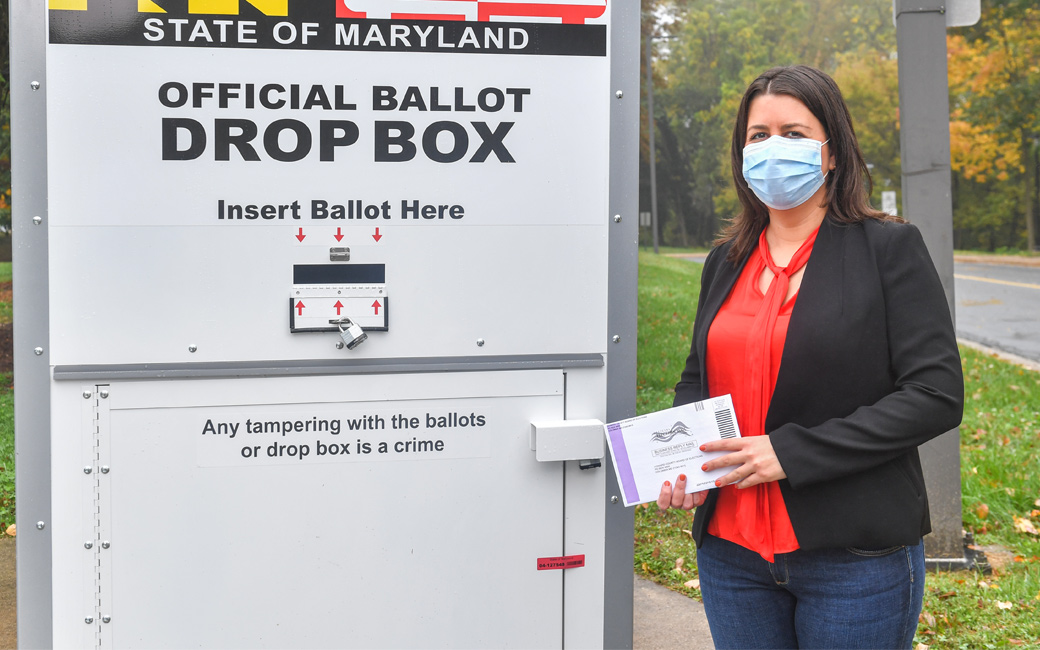 Associate Professor Natalie M. Scala standing at the ballot drop box on the Towson
University campus about two weeks before the 2020 General Election.
Find out what's happening in Towsonfor free with the latest updates from Patch.
Between physical distancing measures leading to long lines to vote in person, mail-in
or absentee ballots taking longer to be counted and the threat of foreign interference,
there are plenty of factors making tensions rise ahead of November’s general election.
But Towson University’s Natalie M. Scala and Josh Dehlinger have stepped up to train Maryland’s poll workers on identifying and addressing election
security threats.
Find out what's happening in Towsonfor free with the latest updates from Patch.
For the last three years, Scala, an associate professor in the Department of Business
Analytics and Technology Management, and Dehlinger, a professor in the Department
of Computer & Information Sciences, have partnered with local election boards to train
election judges.
“The poll worker is the first line of defense,” Scala says. “We’ve shown with statistical
significance that poll workers do learn about threats by taking a training. If they
learn about those threats, they are able to respond to those threats.”
Read more: TU one of just 9 institutions in U.S. with 85% student voter registration
Scala and Dehlinger study how best to respond to and prevent cyber, physical and insider
threats to elections and use that research to create training modules. The faculty
duo is continuing work originated by Megan Price ’18 and Scala as part of an Honors College research project.
Cyber threats are the kind that many people are familiar with—hacks or phishing scams—but
physical threats, like a voting machine being broken, or insider threats, like an
election worker making a mistake that leads to ballots being miscounted, are just
as important.
“When we first looked at the election judge training manual, there was no piece on
how to look out for cybersecurity,” Dehlinger says. “This is how to fill in that gap.”
Scala says the team at TU is the only academic group in the country looking at the
security of polling places. Most research is being done at securing the overall state-level
systems, she says.
“But the public interacts at the polling place,” Scala says. “In order to increase
and maintain confidence in the integrity of the elections, the public needs to understand
that there are protections in place, right where their vote is being cast.”
The team’s research looked at three groups: Towson University students, volunteers
from the Osher Lifelong Learning Institute and poll workers from Harford County at
TUNE. All three groups showed, with statistical significance, that the training modules
increased their knowledge of election security, Scala says.
Their research was recently recognized in the annual BTU Partnership Awards, for the partnership between TU and the Harford County Board of Elections and the
Anne Arundel County Board of Elections—both of which have used the training modules.
David Garreis, deputy director of the Anne Arundel County Board of Elections, says
it’s a huge challenge for local precincts and wards to train poll workers.
Read more: 'Unity flag' by TU artists exhibited alongside final presidential debate
But, he says, “the partnership with Towson University has allowed us to leverage our
online resources to reach election judges and teach them about an important aspect
of this process, namely voter security in an era where elections are heavily scrutinized.”
Scala and Dehlinger say their goal now is to expand the training as much as possible
in time for the 2022 midterm and gubernatorial elections in Maryland.
As for individual voters, Scala says research has shown that mail-based voting is
safe and secure and that attacking a distributed voting system, like the mail, is
very difficult for an adversary to do.
“[This project] will help voters to know that their elections are secure. That the
integrity of the election results has been maintained,” Garreis says.
This story is one of several related to President Kim Schatzel’s priorities for Towson University: TU Matters to Maryland and BTU-Partnerships at Work for Greater Baltimore.
This press release was produced by Towson University. The views expressed here are the author’s own.