Community Corner
Women and the Civil Air Patrol: 75 Years of History
During Women's History Month, we remember the trailblazers of the past, including the women who have and are serving in the CAP.
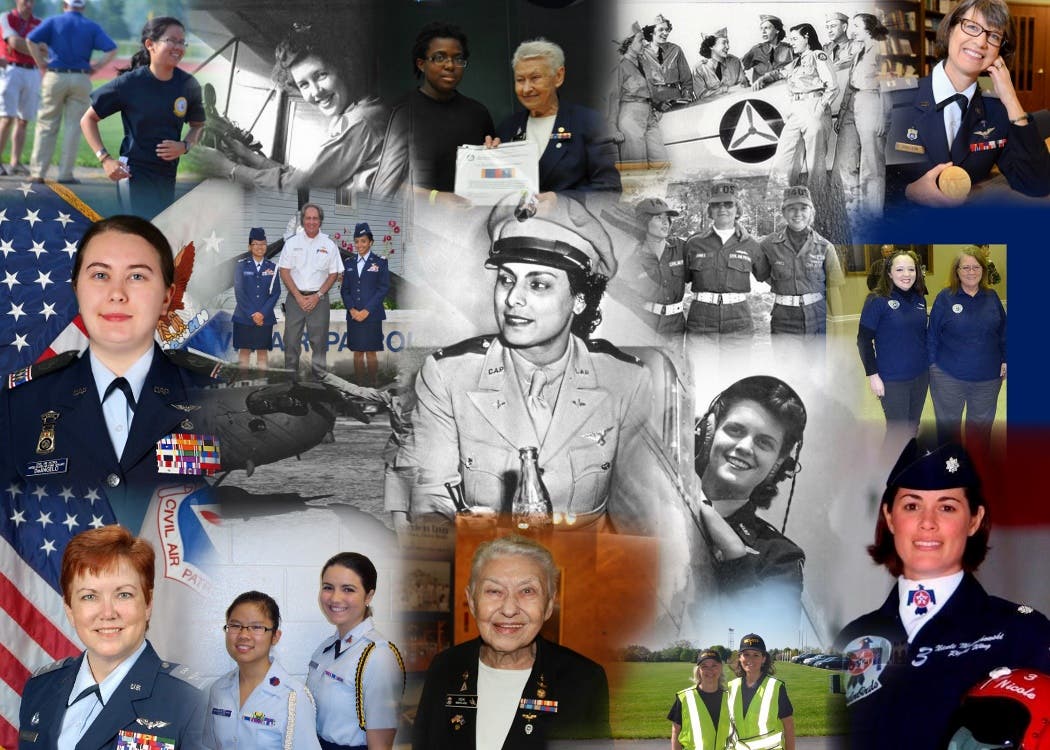

The National Women’s History Month theme for March 2016 honors women who have shaped America’s history and its future through their public service and government leadership. As such, we are provided an opportunity to acknowledge that women have and are serving as volunteer members of the Civil Air Patrol (CAP). Civil Air Patrol, the U. S. Air Force Auxiliary, has built the nation's finest force of citizen volunteers. Since its inception in 1941 through today, women continue the legacy of CAP service as pilots, emergency services personnel, technicians, mentors and as cadets who contribute thousands of volunteer hours for the sake of their communities and nation. Effective 2016, the Civil Air Patrol is celebrating 75 years of service and commitment to America. Women have and remain part of our legacy and future.
“During Women's History Month, we remember the trailblazers of the past, including the women who are not recorded in our history books and we honor their legacies by carrying forward the valuable lessons learned from the powerful examples they set.” President Barack Obama, 2016 Women’s’ History Month Presidential proclamation.
CAP from its inception has been an equal-rights organization, open to citizens of all genders, races and backgrounds. At the start of World War II, only three and one-half percent of licensed pilots in the U.S. were women, many of whom joined CAP. By 1945, women constituted 20 percent of CAP’s senior and cadet membership. Over half of all the Women Airforce Service Pilots (WASP) were former CAP members, with 70 percent of the last class of WASPs having served in CAP. Other former CAP members joined the Women’s Army Corps (WACs) or the Women Accepted for Volunteer Emergency Service (WAVES). CAP’s legacy of service before self is a commitment made by its membership of men and women, girls and boys throughout its history. It is the membership that makes CAP a premiere volunteer organization.
Find out what's happening in Westminsterfor free with the latest updates from Patch.
Throughout its organizational history, CAP has offered professional and community service opportunities to its members. All CAP senior members’/officers’ professional development specialty tracks are available to women and range from chaplain to pilots, from public affairs to air operations officers and from emergency services to cadet program officers. Rank and assignments are attained based on performance and expertise gained through training and opportunities provided by CAP and its partners. CAP supports a variety of missions that require adults from all walks of life and work experiences. Doctors, nurses, paramedics or other medical professionals, business professionals, executives, mechanics, cooks, teachers, police officers, clergy, parents all have a place in the Civil Air Patrol. Any career or background can be useful to and found in the ranks of the CAP adult membership
To fulfill its goal of developing young people into responsible citizens and aerospace leaders, the CAP Cadet Program for youth ages 12 to 18 is organized around four program elements; leadership, aerospace education, fitness and character development. Through their experiences as CAP cadets, young men and women develop into responsible citizens and become tomorrow's aerospace leaders. CAP treats cadets as young adults, not children. The Cadet Program instills a sense of personal responsibility, respect for others and self-discipline.
Find out what's happening in Westminsterfor free with the latest updates from Patch.
Equality in access is an essential component of the CAP ladder of professional and mission success. Senior and cadet members work together to perform CAP’s three congressionally assigned key missions: emergency services, which includes search and rescue (by air and ground) and disaster relief operations; aerospace education for youth and the general public; and cadet programs for teenage youth. In addition, CAP has been tasked with homeland security and courier service missions. CAP also performs non-auxiliary missions for various governmental and private agencies, such as local law enforcement and the American Red Cross. View more information about the Civil Air Patrol at www.gocivilairpatrol.com/
The purpose for the establishment of the CAP remains as a backbone concept for its existence today—aid to others. In 2014, CAP contributed $158 million in man-hours by serving the disaster relief, emergency services and civic needs of communities, states and the U.S. CAP members make a difference in their communities and help save lives. Their contributions continue to support CAP’s Mission for America.
Today, CAP, also known as the U. S. Air Force Auxiliary, continues its ‘Mission for America’ as a volunteer organization comprised of men and women from all backgrounds, lifestyles and occupations working together with common values of Integrity, Volunteer Service, Excellence and Respect. CAP is a group of dedicated, disciplined volunteer civilians both women and men, helping the Air Force fulfill its emergency services responsibilities in the most efficient, cost-effective manner possible. It is a group of responsible adults helping to develop the aerospace-oriented leadership of tomorrow from the youth of today. It is a group of citizens of altruistic motives, in step with the Air Force, asking to serve without hesitation and with an unwavering commitment to America and its citizens.
Group II is one of three major subordinate groups of the Maryland Wing of the Civil Air Patrol, the official auxiliary of the United States Air Force. Group II is comprised of eight (8) Maryland squadrons located in Baltimore, Carroll, Harford, Talbot and Wicomico counties. Follow Group II on Facebook at www.facebook.com/mdgroup2 or on Twitter at https://twitter.com/mdgroup2_cap.
Nearly 1,600 CAP members serve in Maryland. Last year wing members flew 13 search and rescue missions. The wing was credited with four finds. Maryland Wing flew 32 missions for the State of Maryland. Members flew 2,245 hours in all mission categories. Volunteers contributed services estimated at 4.6 million dollars. For more information, contact the Maryland Wing at www.mdcap.org, like us on Facebook at www.facebook.com/MarylandWingCivilAirPatrol and follow us on Twitter at www.twitter.com/MDWGCAP.
Civil Air Patrol, the longtime all-volunteer U.S. Air Force auxiliary, is the newest member of the Air Force’s Total Force, which consists of regular Air Force, Air National Guard and Air Force Reserve, along with Air Force retired military and civilian employees. CAP, in its Total Force role, operates a fleet of 550 aircraft and performs about 90 percent of continental U.S. inland search and rescue missions as tasked by the Air Force Rescue Coordination Center and is credited by the AFRCC with saving an average of 78 lives annually. Civil Air Patrol’s 56,000 members nationwide also perform homeland security, disaster relief and drug interdiction missions at the request of federal, state and local agencies. Its members additionally play a leading role in aerospace education and serve as mentors to more than 24,000 young people currently participating in the CAP cadet program. Performing missions for America for the past 75 years, CAP received the Congressional Gold Medal in 2014 in honor of the heroic efforts of its World War II veterans. CAP also participates in Wreaths Across America, an initiative to remember, honor and teach about the sacrifices of U.S. military veterans. Visit www.capvolunteernow.com for more information.
By Alice Raatjes, Captain, Public Affairs Officer, Group II, Maryland Wing, Civil Air Patrol.