Politics & Government
Vibrant Village Centers Envisioned for Acton
Citizens of Acton were asked how they wanted to see Acton develop in the next fifteen to twenty years at a public workshop sponsored by the Acton 2020 Committee called "Choose Your Own Acton."
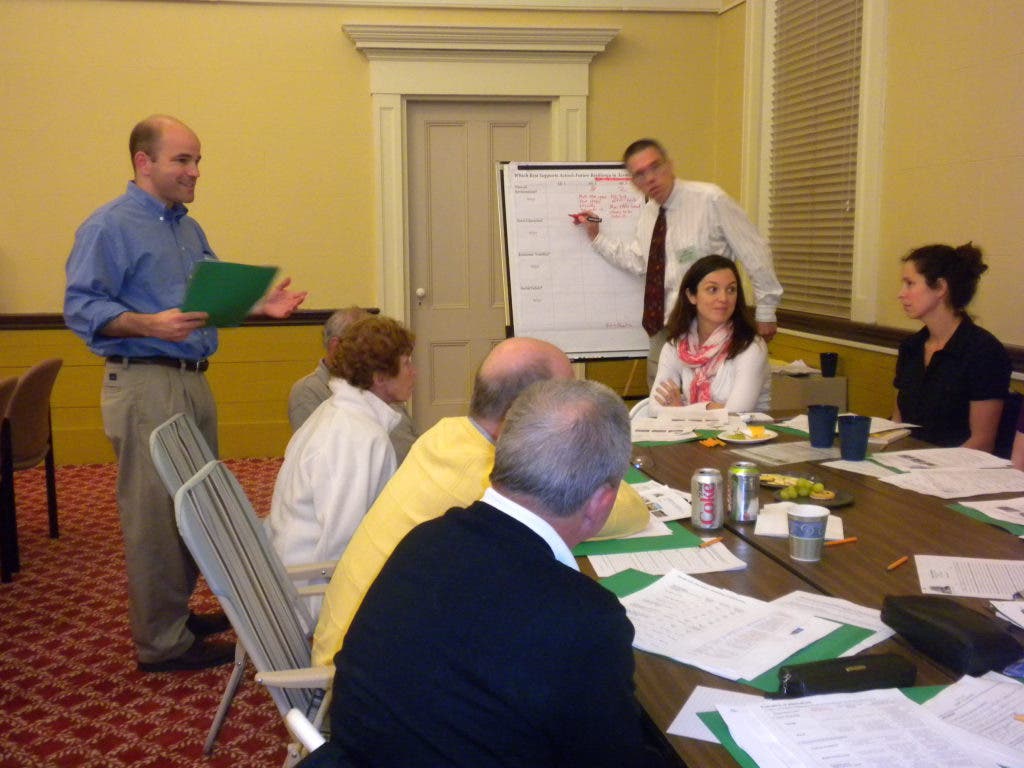


On June 23 the majority of residents at the workshop chose an option for concentrated development around village centers such as Kelly’s Corner, West Acton and South Acton.
According to Acton 2020 Chair, Margaret Woolley Busse, the goal of the workshop was to reach a consensus from residents on the direction for planning and development of Acton so that the committee can direct their energies in developing a new Master Plan.
“We are here because we really want to choose Acton’s future,” said Woolley Busse. “We are interested in what you have to say.”
Find out what's happening in Actonfor free with the latest updates from Patch.
The “Choose Your Own Acton” workshop was a continuation of the planning process which began in October of 2010 when citizens provided input on goals and objectives for the town.
Woolley Busse said that the committee took the “feedback from a broad swath of Acton residents” and developed seven goals including objectives like preserving the town character, sustainability, and providing opportunities for community gathering and recreation. The three development alternatives integrated those seven goals to a lesser or greater degree in each option.
Find out what's happening in Actonfor free with the latest updates from Patch.
In an upcoming community forum in October 2011, the Acton 2020 Committee, charged with overseeing the development of a comprehensive community plan, will present an implementation plan based on input gathered at the June 23 workshop.
After three development alternatives were introduced, residents were broken into nine groups of twelve to dig deeper into each option, which included continuing present planning, moving toward limited growth or encouraging development around village centers. Two facilitators gathered feedback from each group.
Eight of the nine break-out groups preferred concentrating growth around key town centers, which would emphasize walking, biking and public transportation; transform existing commercial development to fit the village character; encourage mixed-use residential development around the town centers and away from open land; and encourage multi-generational and multi-cultural community development by providing smaller housing units.
This type of development can be encouraged by using incentives called Transfer of Development Rights (TDR) in which property owners of open space transfer development rights to the denser village centers.
Although landowners are not required to participate in a TDR, it allows property owners to retain their equity by selling development rights while protecting open space.
The majority of residents in the audience felt that Kelly’s Corner at the intersection of Route 27 and Route 111 should be the first village center to be developed. Participants cited reasons such as the central location, the existing commercial development, the need to make it look nicer and the accessibility of walkers from both the schools and surrounding residential areas.
Other village centers also received votes for initial development such as South Acton because of its proximity to the trains and bike trails.
Mike Gowing, Chairman of the Board of Selectmen, thought new village centers could be developed. Gowing said that the Nagog area already has commercial development, low cost housing and “a gorgeous view of Nagog Pond.”
The least favorite of the three proposed alternatives was continuing with the current mode of development. The second most popular option included limited residential growth while encouraging employment-oriented commercial development.
Several citizens wanted to combine the commercial elements of the limited growth scenario with the development of the village centers into a fourth option.
One gentleman said, “I’ve taken what I thought was the best of one, two, and three and rolled it into Alternative 4.”
Daphne Politis of Community Circle, a consultant to the Acton 2020 Committee, said that the gentleman was “modeling what we’re going to do [which is] come up with some hybrid.”
An Acton mother with young children voiced a strong opinion about providing recreational and community space for her family and wanted to build a town pool and a park with trees.
She takes her children to Long Lake in Littleton rather than NARA park because of the lack of shade trees, a soggy playground and a “bacteria infested” swimming pond.
“Independent of which alternative is selected that needs to happen in this town,” she said. “We need to relate more and be together.”
Politis said that the committee will include items not specifically addressed in any particular alternative including recreational opportunities, a possible senior center or community center and facilities for the arts.
Jamie Watt, who starred as Acton’s Guardian Angel in a video highlighting the need for community participation in planning for the future of Acton, considered the workshop a job well done.
“I’m feeling reasonably optimistic that this is a good use of everyone’s time,” said Watt.
The Acton 2020 committee will look carefully at the written comments from the workshop and extended the deadline to turn in comments to the planning office by Friday, July 1.
The results from the workshop will be posted on their website and residents were encouraged to comment on their blog.
SIDEBAR(S):
Alternatives For Acton:
- Disperse Growth: continue with present planning policies – 4 votes
- Limit Growth: limit residential growth; encourage employment-oriented commercial development; acquire open space – 22 votes
- Concentrate Growth: guide residential and commercial growth to key town centers – 51 votes
- Hybrid Option: combine preferred elements from all three alternatives with the emphasis on concentrating growth around town centers
Goals and Objectives:
1. Preserve Town character
2. Ensure environmental sustainability
3. Improve connections
4. Provide more opportunities for community gathering and recreation
5. Support inclusion and diversity
6. Preserve and enhance town-owned assets
7. Maintain and improve financial well-being of the town