Neighbor News
MCC Offers Hybrid Courses for Students to Finish Lab Requirements
MCC is allowing faculty and students on campus in limited numbers while following strict health and safety protocols to finish labs


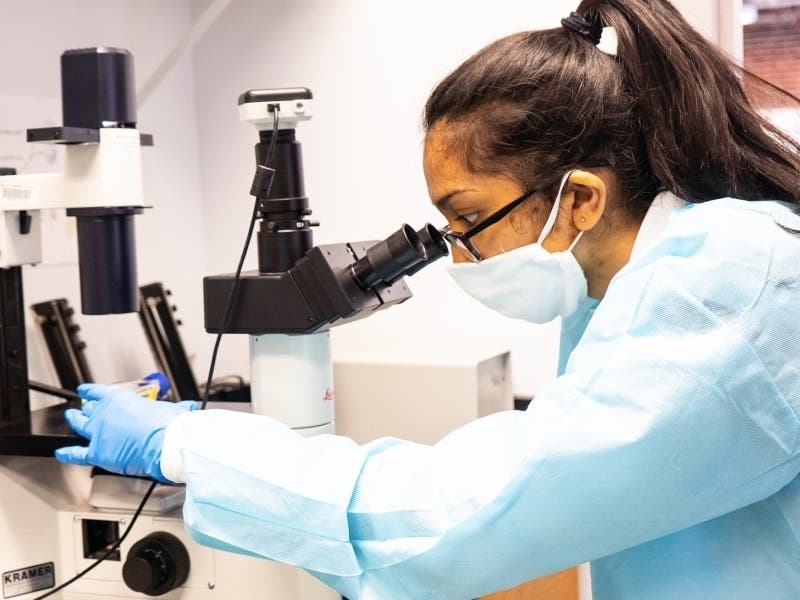
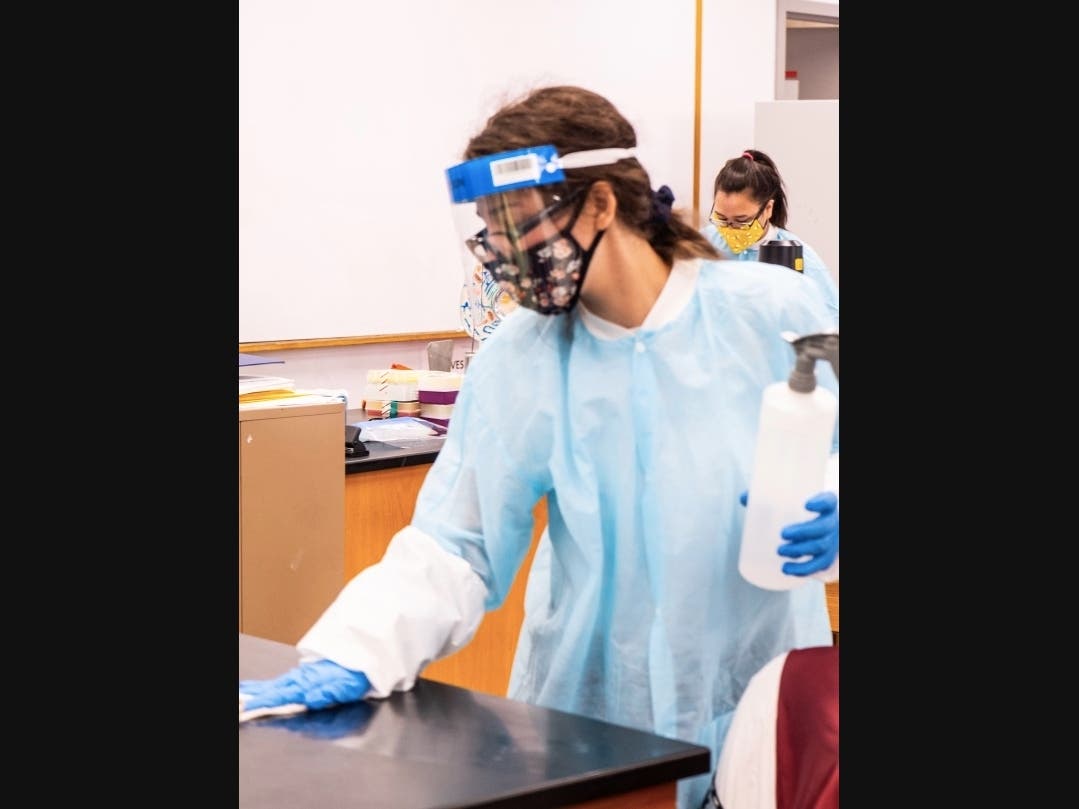
A leader in providing high-quality and affordable education, Middlesex Community College is transitioning 95 percent of courses to run online for the Fall semester. Middlesex understands some courses require in-person experiences, including select science labs. To ensure students gain all of the practical experiences they need to be successful, MCC is allowing faculty and students on campus in limited numbers while following strict health and safety protocols.
The blended hybrid course format is one of the college’s four learning modalities that will be offered in the fall. Hybrid courses allow students to watch lectures and complete coursework online, while going to campus in-person to work on experiments in the lab.
Students are provided with MCC safety guidelines and a self-checklist before coming to campus. While in the lab environment, students and faculty wear appropriate personal protective equipment (PPE), sanitize all equipment and workspaces, and stay six feet apart from others. The PPE include masks, gloves, lab coats and face shields. Protocols also include a list of articles and videos that feature precautionary measures that need to be taken in order to return to campus.
Find out what's happening in Bedfordfor free with the latest updates from Patch.
A Biology major from Oregon who now lives in Boston, Rachel Peinkofer hopes to transfer to Boston University in the fall of 2021 to receive a bachelor’s degree and then go onto medical school. Peinkofer enjoyed taking a hybrid course this summer. She believes working in the labs helped her to better understand the content she learned in online lectures.
“The take away for me has been the integration of the information from the online lecture into the tangible, hands-on aspect of the labs,” she said. “I absolutely love the online learning platform and chose MCC to continue my education for that reason. The time saved by not commuting is essential for me to take on a heavy course load, however I was shocked how much I enjoyed the hybrid course.”
Find out what's happening in Bedfordfor free with the latest updates from Patch.
Laura Ferguson – a nursing student from Arlington – has found that keeping in touch with her professors helps her succeed in hybrid classes. She also enjoys the flexibility she has in creating her own schedule.
“What I have found is you can study and complete assignments at any time, which allows for some freedom you wouldn't necessarily have in a regular class,” she said. “I find I can compose any questions I may have more concisely to either email or speak to the professor in-person on the lab day. [Doing labs in-person] truly shows you if you are on track or where you need to better concentrate your efforts.”
Reed Konsler, a Chemist who works as a Laboratory Technician for MCC, also believes hybrid courses are beneficial because students can learn the content on their own time in their own environment, while taking a practical approach to experiments in the lab. According to Konsler – former high school chemistry teacher who worked in academic research – it is also important for students to hold themselves accountable in doing their work.
“The hybrid model is most beneficial for people who are motivated and interested in doing things efficiently,” he said. “If you are present in the lab, your objective is to learn the experimental techniques and to observe substances and reactions between them that you probably wouldn’t have the opportunity to do otherwise.”
Konsler keeps the lab organized, checks equipment and materials, ensures experiments will run as expected, and suggests any changes to experiments as needed. It is important to run efficient labs – especially throughout the pandemic – and Konsler makes that happen.
All of the experiments have been able to run, although some parts have to be changed because students need to remain apart. Konsler spends more time setting up materials and cleaning them himself to make sure everything is properly sanitized. The goal is to prevent students from having to move around too much or gather in small spaces.
The use of fume hoods in the labs adds another safety precaution in the labs. They remove a large volume of air, which means there is less of a chance of aerosols accumulating over time.
MCC’s Biotechnology program also reopened labs for this summer’s courses as many students needed to complete requirements for classes starting in the fall. Classes ran at half capacity – about 12 students per section – in order to adhere to social distancing guidelines
Mariluci Bladon, MCC’s Professor & Director of the Biotech Program, taught four sections of a biotech course on MCC’s Lowell campus this summer. The course involved five hours of hands-on lab work and is required for students to be able to find a job in the industry.
“Hands-on labs are necessary and efficient for this subject, and this class has shown that it is possible to have in-person classes when necessary,” she said. “It was very successful thanks to all the students who followed directions and CDC guidelines.”
While many of MCC’s science courses use virtual labs to simulate experiments in a valuable and meaningful way, Eva Leiman, MCC’s Biology Laboratory Technician, believes in-person labs are necessary for many of the college’s biotech and biology courses.
The lab experiments students are performing in these classes require materials that can only be found in the labs and cannot be replicated online or at home, according to Leiman. Handling materials and working through steps offers a better understanding of these concepts. She said working in a lab “is about producing something tangible and learning visually.”
Although wearing additional PPE at all times and following all of the protocols is an adjustment, Leiman believes everyone did a great job of keeping themselves safe and their spaces clean.
“Slowly coming back to work is a better plan until the pandemic is over,” she said. “We are learning to live with this current situation while trying to stay safe. We have learned to be more innovative in distanced working and classes.”
Ralph Sherwood, an MCC science faculty member, also taught a hybrid course this summer in Bedford. He compares the importance of hands-on lab work to how a person effectively learns an instrument – “one must physically pick it up and do the required physical practice.”
“Working in the laboratory is a skill for not only applying the academics of various scientific disciplines, but also for involving the physical manipulation of tools which coordinate both hand and eye to adequately research and understand those disciplines,” he said.
In addition to the hybrid model, MCC will run most classes fully online in two formats – asynchronous and synchronous. In asynchronous online classes, students work independently while meeting deadlines, engage with materials and other students on their own schedules, and have on-going access to online resources, pre-recorded lessons and tutorials. In synchronous online classes, students attend classes at specific dates and times while professors and students engage in live classes using a camera and microphone via a remote setting.
Some classes may also run fully in-person. Every student, faculty and staff member who come to campus are required to follow MCC’s strict health and safety guidelines.
This Fall, MCC is running over 50 science courses – featuring both in-person and virtual lab opportunities – with flexible formats including accelerated eight-week classes, hybrid and online options. MCC offers personalized financial aid counseling, payment plans, flexible course formats and a supportive community to help keep students on track with their goals.
For more information, contact Kathleen Sweeney, MCC’s Dean of STEM, at 781-280-3609 or sweeneyk@middlesex.mass.edu.
MCC is offering incentives to help students continue their education. One incentive offers 50 percent off a first class to students who were laid-off due to COVID-19. The college is also offering 50 percent off one course to new students in celebration of the college’s 50th anniversary. Qualifying students must register by September 10.
Visit www.middlesex.mass.edu/save for participation rules.
To learn more about the classes and opportunities MCC offers – and to register for Fall classes – visit www.middlesex.mass.edu/registration/ or call 1-800-818-3434.
Discover your path at Middlesex Community College. As one of the largest, most comprehensive community colleges in Massachusetts, MCC has been a proven leader in online education for more than 20 years. We educate, engage and empower a diverse community of learners, offering more than 80 degree and certificate programs – plus hundreds of noncredit courses. Middlesex Community College: Student success starts here!