Community Corner
Hawks Increasingly Call Belmont Home
While Cambridge's birds are media stars, Belmont's quietly move in.
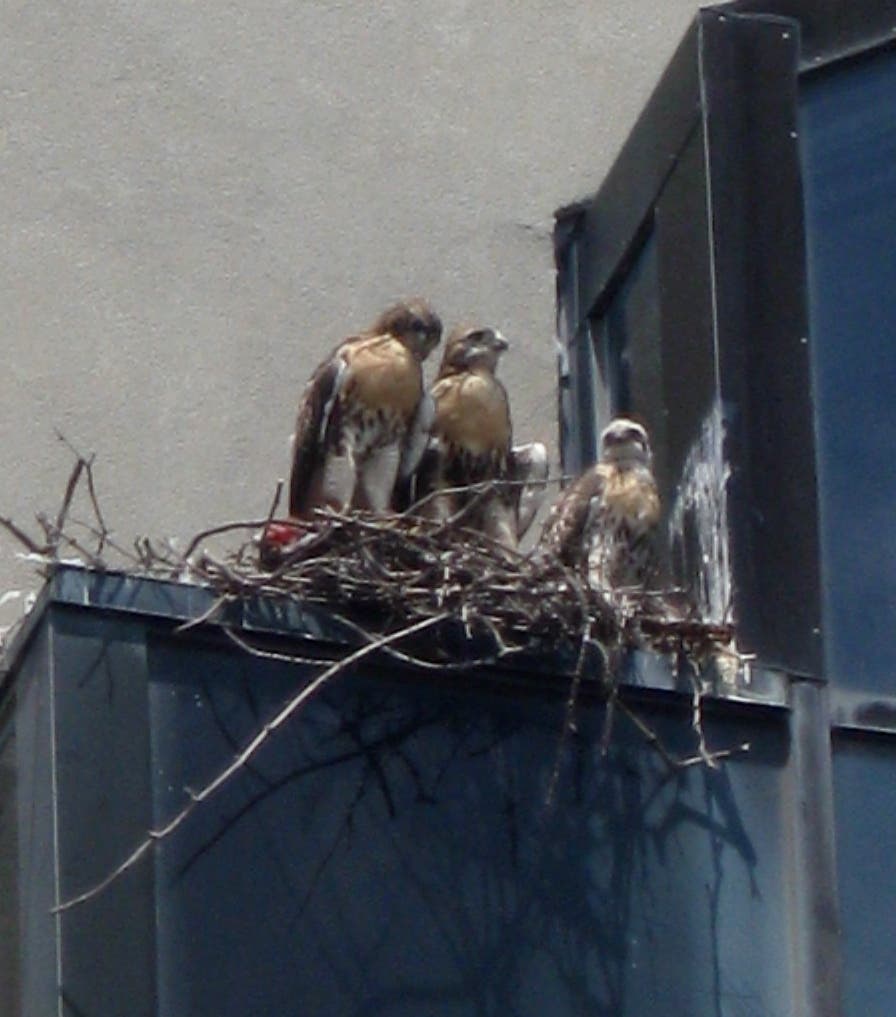
Since the beginning of spring, a gaggle of spectators have lined on both sides of Alewife Brook Parkway across from the entrance to the Fresh Pond Mall, looking skyward.
They are the excited onlookers of the red-tailed hawk family, perched in an untypical nesting site on the ledge of an office building at 185 Alewife Brook Parkway.
Hundreds of cars rush by speeding to their destinations but the dedicated bird watchers chatted amongst themselves and waited patiently.
Find out what's happening in Belmontfor free with the latest updates from Patch.
Belmont's Rob Bryant from Marion Road is part of a group of a dozen people with cameras and binoculars poised at the ready. Hundreds of cars rushed by speeding to their destinations but the dedicated bird watchers chatted amongst themselves and waited patiently.
For three months now, Buzz and Ruby, the parents, had been incubating their eggs and are now feeding their chicks, Larry, Lucy and Lucky, preparing them for their first time flights.
Find out what's happening in Belmontfor free with the latest updates from Patch.
Enthusiastic onlookers don't have to wait long for the chicks to take their maiden flights. Larry finally took the leap of faith on May 31 to the excitement of many of the waiting crowd.
Yet what is happening under the constant public glare in Cambridge occurs everyday in Belmont.
"Belmont has plenty of red-tails," said John Maguranis, Belmont's Animal Control Officer. Areas include the Alewife Brook Reservation, Rock Meadow Park, The Habitat and Beaver Brook Reservation.
People do feel an affinity for the bird, said Maguranis, adding, "red-tailed hawks got me started with my interest in wildlife."
The red-tailed hawk is the largest and most common of the hawk family, nests throughout urban Boston including at Fenway Park where an aggressive couple resides.
Maguranis said they aren't normally aggressive birds but in the past two decades years are increasingly more common in urban areas.
Marge Marjrines, a naturalist with the Massachusetts Audobon Society which runs the Habitat on Belmont Hill, has noticed that, "in the past 20 years, red-tailed hawks have much more commonly come to use human structures for building their nests."
Maguranis recounts a story of a red-tailed hawk family in Belmont a few years ago that was nesting in the old town cemetery on Grove Street.
One of the birds had an accident and had suffered a broken leg, hip and wing. Maguranis received a call that there was a hurt duck on Grove Street that ended up to be the father of the family. He took it to the Tufts Veterinary Hospital where the father spent six weeks recuperating.
During the father convalescence, cemetery custodians fell in love with the birds and took it upon themselves to supply the mother with fresh, road-killed squirrel in the father hawk's absence. As the mother had to work doubly hard by staying on top of the eggs and finding something to eat, she needed some help.
One of the tasks for the state's Division of Fisheries and Wildlife Department is to help "have birds and people co-exist." In order to do that, it might be necessary to "manipulate urban breeds more than in country settings" including suburbs such as Belmont," explained Tom French, assistant director of the Division of Fisheries and Wildlife.
An example of this might be disbanding the hawk's nest if the site owner doesn't want them to come back next year. There is no law forbidding breaking up a nest as long as the inhabitants are no longer there. But the hawks can be persistent and it's sometimes necessary to keep breaking up their nest for up to two weeks if the hawks come back the following year.
Maguranis hasn't had to break up any nests in Belmont but noted that they do "tend to nest in the same area every year, and sometimes in the same nest."