Health & Fitness
MA Nonprofits Team Up to Save African Elephants
Two Mass. nonprofits, The School for Field Studies and the International Fund for Animal Welfare, have partnered to study and protect African elephants in Kenya's Amboseli National Park.
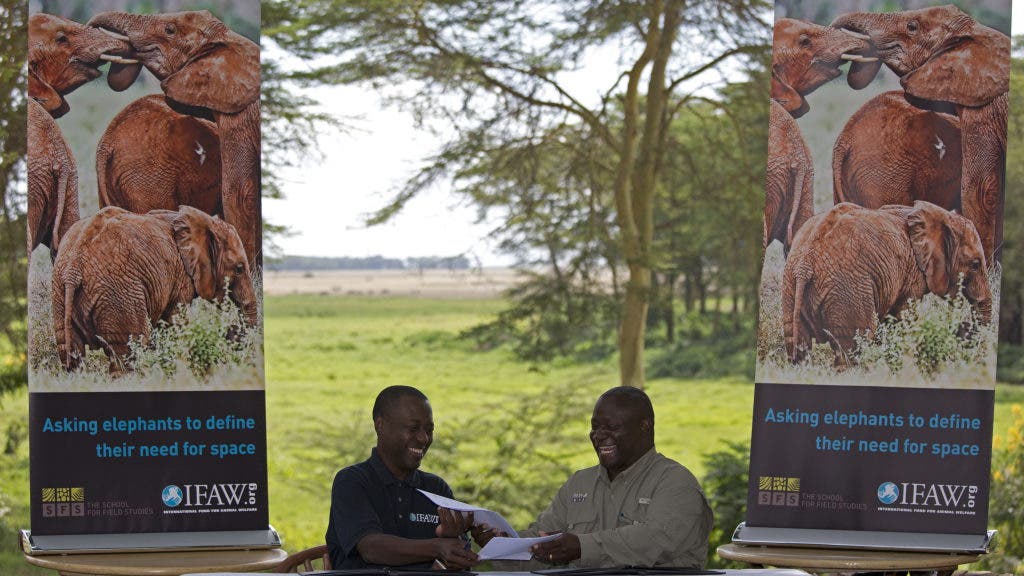
Science is taking the lead to secure habitat for elephants and other wildlife in Kenya’s Amboseli National Park. In the next five years, a partnership between the International Fund for Animal Welfare (IFAW – www.ifaw.org), The School for Field Studies (SFS - www.fieldstudies.org) and Kenya Wildlife Services (KWS), will see scientists, researchers, and veterinarians tracking elephant populations around the park to determine their needs for space and resources, and ultimately help prevent human-elephant conflict.
"It is a fact that Amboseli's 1,400 elephants spend up to 80 percent of their time outside the national park. They roam in the surrounding Maasai group ranches, and are known to cross over into Tsavo West National Park in Kenya, and wander south over the border into Tanzania – as far as Kilimanjaro National Park. But how far do they go? Where exactly do they go? Why do they go there? What are the threats and challenges they face? These are all questions that this important research will be able to answer," said James Isiche, Director of IFAW East Africa, at a ceremony held in Amboseli last Thursday to mark the IFAW-SFS partnership.
Entitled "African elephant space needs and associated relationships in southern Kenya; a landscape study approach to secure range for wildlife," the project is being led by Dr. Moses Makonjio Okello, Senior Director of The SFS Center for Wildlife Management Studies in Kenya and Tanzania.
Find out what's happening in Beverlyfor free with the latest updates from Patch.
"Elephants need space and resources in order to be free, viable and to fulfill the flagship role they play in East Africa," said Dr. Okello. "The IFAW-SFS partnership brings together our organizations' shared passion, vision, research, and management resources to help enhance the population, range and viability of the charismatic Amboseli elephant."
The first step of the project began two months ago with the radio collaring of six elephants (four male and two female), to be monitored for at least the next two years to provide critical information on elephant movement patterns within and outside of Amboseli.
Find out what's happening in Beverlyfor free with the latest updates from Patch.
With this information scientists will be able to establish the elephants’ preferred habitats and why certain areas are chosen above others, and the threats that the elephants face. This information will enable the team to make clear recommendations that will be used to safeguard elephant herds for the long term.
"Seen in human terms, the information we gather will give us an elephant’s eye view of optimum lifestyle standards for these giant creatures," said Isiche. "We will be able to make a case for the connection of their favoured habitats by securing critical corridors and securing the areas Amboseli that are essential for sustaining Amboseli’s rich wildlife heritage, especially the elephants."
The IFAW-SFS study is part of IFAW’s Amboseli Project, which includes enhancing KWS’ law enforcement capabilities, leasing critical corridors and dispersal areas in community land, creating conservation awareness and local capacity for ecotourism ventures, and mitigating human-elephant conflict. The study is also a component of the SFS Center for Wildlife Management Studies Five Year Research Plan, or roadmap, which examines how land use and resource availability in the Amboseli ecosystem can be managed to foster the well-being of local communities as well as safeguarding biodiversity conservation.
IFAW North America Regional Director, Jeff Flocken, is an alum of the SFS program. He saw his first wild elephant while doing research on giraffes as a student on an SFS program in Kenya, and since then has devoted his professional life to conserving wildlife globally.