Community Corner
Honoring Reuben Kennison, Revolutionary War Hero
Richard Henderson, a direct descendant of Reuben Kennison shared on his ancestor Revolutionary War hero of Beverly MA



Revolutionary Minuteman Reuben Kennison (1751-1775) is among the distinguished names associated with Ryal Side, a section of Beverly Massachusetts. Kennison’s origin and early life was “humble and obscure.” He was the son of Richard Kennison and Mary Johnson Tucker in Newmarket, New Hampshire.
Kennison moved to Beverly where he married Apphia Batchelder, daughter of Joshua Batchelder and Mary Dismore on May 3 1774. The couple lived on the family homestead of Apphia’s father who was a prosperous farmer. Joshua Batchelder died in 1763 and left his estate to Apphia and her siblings. Reuben worked the farm at 12 Cressy Street assisting his brother-in-law. Although the couples time was short, it is evident through many sources noted in the family papers they were very much in love.
During the long winter evenings before the war Apphia “held the mold while Reuben ran the bullets he intended to use in the first revolt.” Beverly had been preparing for the onset of war several years in advance as the annuals reveal a powder house was erected on the south side of the common (1765).
Find out what's happening in Beverlyfor free with the latest updates from Patch.
On February 27 1775 a town meeting records : “To see if the town will have a watch kept for the preservation of the town, and come into such measures relative thereto as may then be thought best; and there was a warrant issued out to the several constables to warn the same as follows: viz; to Samuel Woodberry 3d, to warn Farms and Bald Hill districts; to Joseph Woodberry to warn Royal Side and Bass River districts, and to William Elliott to warn the Ferry district.”
On April 19, 1775 Reuben was seeding the field when the alarm summoned him to Lexington and Concord. --it was the ringing of church bells from the old Danvers meeting house across the river. Apphia knew it was time and when Reuben came up through the field, she was holding his old flintlock which she “took from over the fireplace and with her own hand hung the powder-horn over his shoulder and went with him to the brow of the hill and watched him to the turn of the road; and, as he looked back, she held up her bare arm in the April sunshine and bade him a long, long farewell.” Kennison proceeded immediately to New Mills, now Danversport, where he, along with other Beverly men, joined the company of Capt. Israel Hutchinson.
Find out what's happening in Beverlyfor free with the latest updates from Patch.
When Reuben’s body was brought back to Apphia the very next evening from the battlefield she preserved her beloved husband by cutting off “a piece of the shirt he wore, which she spun and wove for him.”
Reuben fought that day surrounded by the old Beverly families whose ancestors were part of the early settlement. The captains of the local militia---Joseph Rea and Caleb Dodge and fellow Minutemen Nathaniel Cleaves, Samuel Woodbury and William Dodge were present when Reuben was killed in the yard of Jason Russell, in Menotomy, now Arlington. All three men were wounded, but would return home alive. Reuben was struck in one place by ”a British bullet which pierced his breast, and was repeatedly, savagely bayoneted by the angry troops ..and there his life blood ebbed away.” His body was brought home on an ox cart and he was buried in “the old Leach lot on Brown’s Folly Lot,” or “the old Putnam estate.”
Douglas L. Henderson noted the events from the moment the Reuben left for battle to his death in an article “The story of Reuben Kennison, a Beverly Minuteman, April 19, 1775.” The following is a portion of Henderson’s work:
“The start was made at about 10 am, their goal being to arrive at Cambridge in time to assist in interrupting the British troops upon their retreat to Boston. If statements that they arrived at 2 pm are correct, they could have only accomplished covering some 20 miles by a most determined effort and by a straight cross-country route. It is said that these Minutemen ran most of the way. Arriving at Cambridge, they continued on to Menotomy, now Arlington.
In back of the house, the land rises and in the yard there were many bundles of shingles, looking as though the owner was about to shingle his house. A barricade was made with these shingles and here a number of Minutemen stationed themselves and attacked the British soldiers. The Minutemen were surprised by a flank guard which came through the fields and were driven to the house, being hemmed in between the flank guard and the main column. A savage fight at close quarters followed, and in the house and yard, twelve Americans including Reuben Kennison were killed. This occurred about half past four in the afternoon after the British column was reinforced. Reuben Kennison became the first Beverly man to give his life for his Country. In responding to service in the cause which he manfully upheld, Reuben Kennison gave his all. Jason Russell’s house stood and still stands today about a quarter mile from the center of Arlington, a short distance from the Concord road.”
In 1894 the Beverly Historical Society erected a votive memorial stone over his grave. It may have been an article posted April 26, 1890 in the Beverly Citizen that prompted the memorial for Reuben as he was the only soldier from Beverly who “marched farthest to Gage’s revolt--and the only Beverly soldier to die in the Lexington and Concord battle as well as the first citizen to sacrifice his life in the Revolution in that city.”
According to the Batchelder family papers Apphia did remarry to a Hollis N H Uriah Wright, a widower married first Eunice Jewett. Wright fought at Bunker Hill in Col. Prescott’s regiment June 17,1775. Apphia retained in her possession the shirt cloth of her first love till her death, Oct. 22, 1842. Mrs. Elizabeth Tucker, a grand niece left the cloth to the Beverly Historical Society where it was on display for many years.
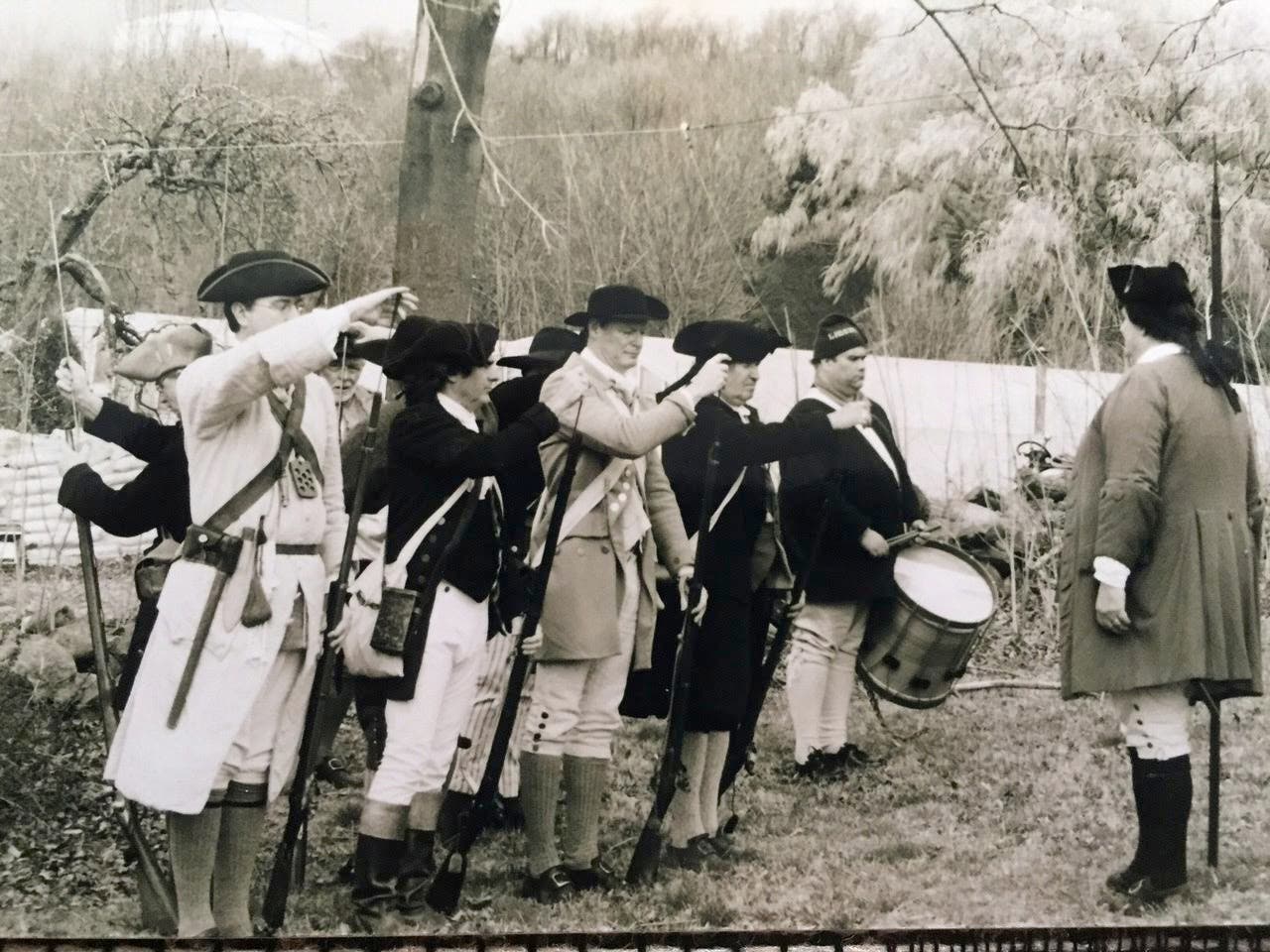
Photos added here are of Reuben Kennison grave site and medal forged to commensurate the 200th anniversary of our country in 1976. Also Douglas L. Henderson and the Danvers Minutemen at Reuben Kennison ceremony provided by his son Richard Henderson of Newburyport. The March of the Militia to Reuben’s grave site was one of the events hosted in the celebration. Leach Street Burial Ground.
Also from Journeys of a Constant Genealogist blog ca. 1745 by Jason Russell (1717-1775), the third generation to live on the property. On April 19, 1775, the house and property was the site of the severest fighting on that historic day. As the British Regulars retreated from Concord to Boston through Arlington, known then as Menotomy, they savagely attacked homes and citizens along the road through Arlington. Minutemen companies had established a defense breastwork near the Jason Russell House and were surprised by British Regulars who swarmed the house from two sides. Jason Russell and several Minutemen ran for shelter in the house, but were overpowered by the British Regulars who shot and bayoneted Russell and the Minutemen. Jason Russell died inside the doorway of his house. After the savage attack, twelve men, including Jason Russell, were laid out on the kitchen floor in ankle-deep blood. Twenty-five men died in Arlington that day. Twelve of the twenty-five men are buried in the Old Burying Ground nearby. Their names are: Jason Russell, Jason Winship, and Jabez Wyman of Arlington; Elias Haven of Dedham; William Flint, Thomas Hadley, Abednego Ramsdell of Lynn; John Bacon, Nathaniel Chamberlin, Amos Mills, and Jonathan Parker of Needham; and Benjamin Peirce of Salem. At least thirteen others were killed, including Reuben Kennison of Beverly; Samuel Cook, Benjamin Deland, Jr., Ebenezer Goldthwait, Henry Jacobs, Perley Putnam, George Southwick, and Jotham Webb of Danvers; Daniel Townsend of Lynn; William Polly and Henry Putnam of Medford; Elisha Mills of Needham; and Jacob Coolidge of Watertown.1 The seven Minutemen from Danvers were killed at or near the house, and their bodies were returned to Danvers for burial after the fight.2 Their names are memorialized on a Revolutionary War monument on Washington Street in Peabody, which was known as South Danvers in 1775.
Thank you to Richard Henderson!
Sources to consult:
History of Essex County, Massachusetts: With Biographical Sketches of Many of Its Pioneers and Prominent Men, Volume 1
Ryal Side from Early Days of Salem Colony Calvin P Pierce
The world turned upside down : Essex County during America’s turbulent years, 1763-1790 Ronald N Tagney
American Rebels John Harris
Batchelder, Batcheller Genealogy: Descendants of Rev. Stephen Bachiler, of England, a Leading Non-conformist, who Settled the Town of New Hampton, N.H., and Joseph, Henry, Joshua, and John Batcheller of Essex Co., Massachusetts
Beneath Old Roof Trees By Abram English Brown
Beverly and the American Revolution by Askew
Beverly Revisited Beverly Historical Society