Politics & Government
Democrats Wu, Essaibi George To Vie For Boston Mayor
Whoever wins on Nov. 2 will make history in a city that has never elected a woman or person of color.

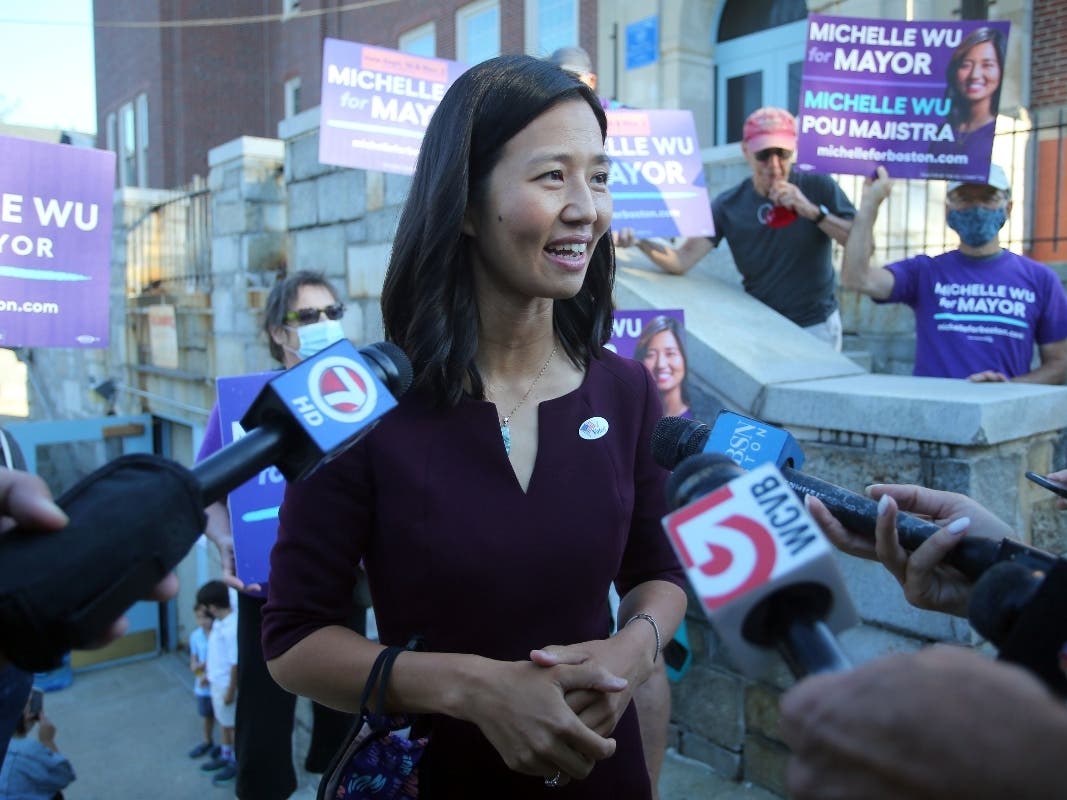

BOSTON (AP) — Boston voters have for the first time narrowed the field of mayoral candidates to two women of color who will face off against each other in November.
City Councilors Michelle Wu and Annissa Essaibi George topped the five-person race in Tuesday's preliminary runoff. They bested acting Mayor Kim Janey, City Councilor Andrea Campbell and John Barros, the city's former economic development chief.
Wu's parents immigrated to the U.S. from Taiwan. Essaibi George describes herself as a first generation Arab Polish-American.
Find out what's happening in Bostonfor free with the latest updates from Patch.
Janey is the first Black Bostonian to occupy the office, replacing former Mayor Marty Walsh, who resigned this year to become President Joe Biden's labor secretary.
Whoever wins on Nov. 2 will make history in a city that has never elected a woman or person of color. For the past 200 years, the office has been held exclusively by white men.
Find out what's happening in Bostonfor free with the latest updates from Patch.
Wu, a city councilor, easily won Tuesday's preliminary balloting. But three other candidates — acting mayor Kim Janey and fellow councilors Essaibi George and Andrea Campbell — were in a tight race for the No. 2 slot. Essaibi George declared victory late Tuesday night, and both Janey and Campbell conceded defeat.
All four are candidates of color, as is John Barros, Boston's former economic development chief and the only man in contention. Barros trailed well behind the four women.
"I'm overjoyed that we are confident we've made the top two and are moving on to the final election," Wu told her supporters earlier in the evening. "I just want to take a moment to honor and thank this historic field of candidates, an amazing moment for the City of Boston."
Essaibi George said she'd won enough support to challenge Wu in November.
"I am so grateful to you showing up not just tonight but showing up for the last eight months," she told supporters, adding that while every vote needed to be counted, "it doesn't mean we can't celebrate."
Earlier this year, Janey became the first Black woman to occupy the city's top office in an acting capacity.
"I want to congratulate Michelle Wu and Annissa Essaibi George on their victories this evening," she said in a statement. "This was a spirited and historic race, and I wish them both luck in the final election."
There had been an effort among some leaders in the Black community to rally around a single candidate to ensure that at least one Black mayoral hopeful could claim one of the two top slots.
All the candidates are Democrats. Mayoral races in Boston do not include party primaries.
Wu was elected to the Boston City Council in 2013 at age 28, becoming the first Asian-American woman to serve on the council. In 2016, she was elected city council president by her colleagues in a unanimous vote, becoming the first woman of color to serve as president.
Essaibi George won a series of key endorsements during the race including from unions representing firefighters, nurses and emergency medical technicians. She also won the backing of former Boston Police Commissioner William Gross.
Essaibi George grew up in the city's Dorchester neighborhood and taught in the Boston Public Schools. She was elected to the city council in 2015. Her father immigrated to the United States from Tunisia in 1972. Her mother was born in a displaced persons' camp in Germany of Polish parents.
The November contest could also be a test of whether voters in a city long dominated by parochial neighborhood and ethnic politics are ready to tap someone like Wu, who grew up in Chicago.
Wu moved to Boston to attend Harvard University and Harvard Law School and studied under U.S. Sen. Elizabeth Warren, then a law professor. She's the only candidate not born in Boston.
Boston has changed radically since the 1970s, when the city found itself in the national spotlight over the turmoil brought on by school desegregation, and in the late 1980s, when the case of Charles Stuart again inflamed simmering racial tensions.
Stuart is believed to have shot and killed his pregnant wife in 1989 while trying to blame the killing on an unknown Black man, prompting police to search Black neighborhoods in vain for a suspect. Stuart later jumped to his death from a bridge.
The latest U.S. Census statistics show residents who identify as white make up 44.6% of the population compared to Black residents (19.1%), Latino residents (18.7%) and residents of Asian descent (11.2%).
Among the challenges facing the city are those brought on by gentrification, which has forced out many long-term residents, including those in historically Black neighborhoods.
Added to that are a host of other challenges that will face the new mayor, from transportation woes, racial injustice and policing to schools and the ongoing response to the COVID-19 pandemic.