Arts & Entertainment
Arrival VR: Susan Shares Her Family's Immigration Story
Watch the newest interview from Arrival VR, a project highlighting immigration stories from around Boston/Brookline.
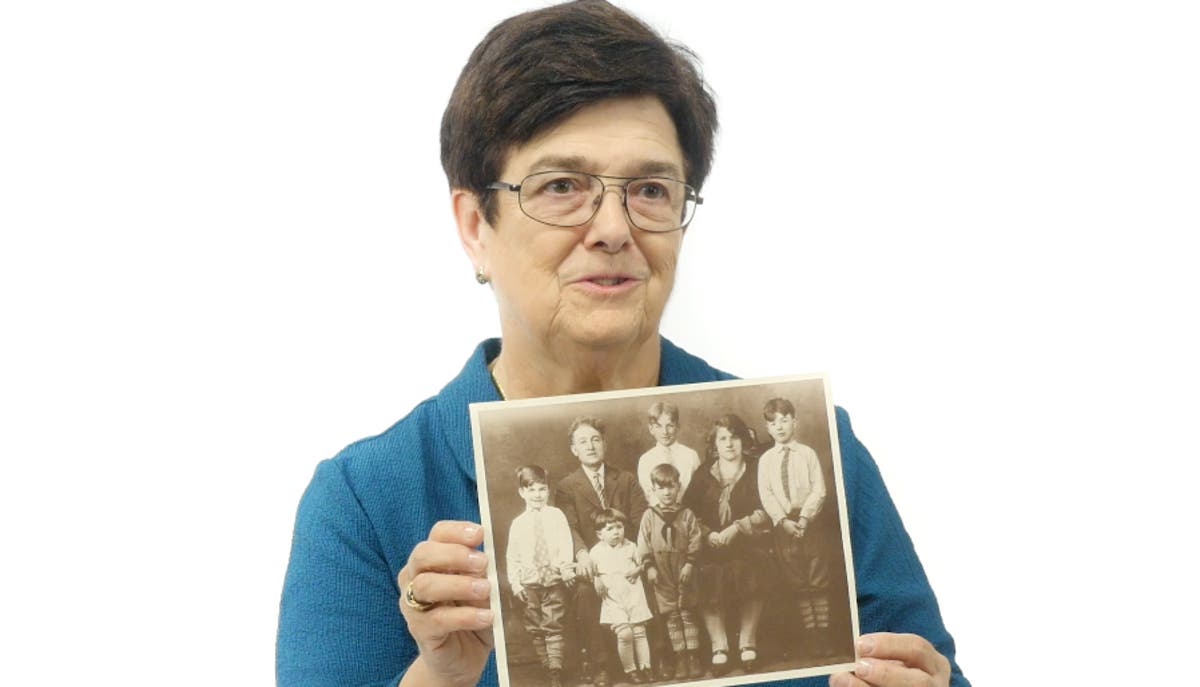
Brookline Interactive Group (BIG) and its project, the Public VR Lab, are proud to present the latest interview from Arrival VR. This co-created immersive storytelling project is the first national virtual reality (VR) filmmaking collaborative project curating immigration stories of Americans from pre-1620 through 2018 and incorporating them into a visual XR/VR timeline. The Brookline Community Foundation has awarded a generous grant to BIG to support their efforts to record immigration stories from the Brookline community to contribute to this project.
Members of the public are invited to participate in this project and share their family's immigration stories at BIG's studio in Brookline. We'll be holding the next interviews on December 3. To learn more, please visit http://immigrationvr.com.
-----------
Find out what's happening in Brooklinefor free with the latest updates from Patch.
Can you start by introducing yourself, and telling us where your family migrated from?
“My name is Susan O'Connor. All four of my grandparents came from Ireland. Three of them came from the Dingle Peninsula in Ireland, which is the westernmost part; it was one of the parts that preserved the Irish language. And the fourth grandparent came from County Cork. All of them came to the United States between 1901 and 1913.”
Find out what's happening in Brooklinefor free with the latest updates from Patch.
There is a story behind every decision to migrate. What do you know about your family's story?
“One of my grandfathers was educated and he was supposed to become a priest. Well, that fell apart. But because he was so educated, and could read and write, he was the postmaster in Ireland. He was the last one to come in 1913, and he really didn't want to come to the United States. But because he had been working for the post office he was considered as having worked for the Brits, therefore he could have been killed or maimed in the Irish rebellion, and he knew about that, so he came. All three of the others came for economic reasons. They were the middle children of large families and my [grandfather] was not going to inherit land, and there wasn't a lot of prospects for the women. And so coming to the United States was their really only option.”
Can you go into detail about what members of your family came with them? Who was left behind, and who stayed back in Ireland?
“In the case of my grandfather Bowler, which was the postmaster, three of his brothers came… to the United States and most of the women, and only one of his sisters came, but the rest of them stayed behind. In the case of my grandmother who married him, I really don't know. She's kind of the black hole of what I don't really know. But she came, and again for economic reasons. My grandmother Manning, only the eldest son who inherited the land stayed, and all the rest of the children immigrated to the United States. The O'Connor grandfather came to the United States with two of his brothers, and all of them who were really from Dingle all came to Western Massachusetts.
"The story goes, you don't immigrate by yourself, you immigrate with your family to a family, and that's where all of their support systems would have been once they immigrated. In the case of my grandmother from County Cork, she ended up in… the Boston area. She was a domestic servant, meaning she just did housework [for] wealthy families and she ended up in a place called Abington, Massachusetts.”
What was the most difficult thing about your family’s arrival to the U.S.?
“Both of my grandmothers got married fairly soon after they arrived in the United States. All of the grandparents who were from Dingle really knew each other. So [when] my grandfather O'Connor and my grandmother Manning… came here, they would have faced the same kind of problems that everybody did during the Depression. My grandfather was a steam fitter and a plumber. He built his own house. One of the things that struck me is that the people who came from Ireland... all knew each other and they all took care of each other.
"In the early 1920’s [when my grandfather] built his house, somebody sold him the land for a dollar and it was worth a whole lot more than that, absolutely. But life wasn't necessarily easy for him. He raised chickens in his backyard, he had a huge garden, he put in fruit trees that we still use to get pears and stuff off of, and that was really the only way that he fed his family through the Depression. Two of his children died young, one of which was killed in a car accident and happened to be his namesake. That probably was a defining moment in his life, and from that point on he was pretty miserable to live with from what everybody tells me.”
What do you think your family has been most proud of having accomplished?
“From my immediate family and my grandparents, I think the fact that everybody is a contributing member of society. They made it a point that their children were going to go to college, that their children were going to have opportunities that they never had. My grandparents, for the most part, came here for economic opportunity and survival, and all of their children and grandchildren have basically flourished.”
Are there any cultural traditions from your family's home country that you still share at home?
“My three grandparents who are from Dingle all spoke both Irish and English, but they were so insistent that their children become assimilated that the only time that they spoke it was when they wanted to say something that they didn't want the kids to understand. So I can say like five or six phrases in Irish, but that's the end of it...
“As far as traditions are concerned, every Christmas Eve my grandmother would make mutton pies… and I still make them. My sister and I bake Irish soda bread at St. Patrick's Day. We send all of the soda bread and cookies off to our cousins, and that's kind of their St. Patrick's Day card.”
Do you see any connections between your family story and that of today's immigrants?
“I think that there's a lot of parallels in terms of why people are coming to the United States. Mine came for economic reasons… My grandfather Buller would have came because he knew he would have been persecuted and possibly killed, and I think that that's a lot of the same situation that immigrants today face. I think [my grandparents] had an easier time of it than people who are currently coming to the United States. They went into places where there wasn't as great a population. There were plenty of low entry-level jobs that people could partake in. If you could read and write in the early 1900's that was a big deal. All my grandparents could do that, some of them, and were bilingual. They wanted to assimilate and that is very different than, I think, with some of the current immigrants; they want to preserve, they don't want to have their heritage lost...
"In some instances, there was an expectation of forgetting what was left behind, because none of my grandparents went back to Ireland. It was way too difficult for them to have to go back, say goodbye again to their families, and then realize how much better they had it than the people who were left.”
Have you gone back to Ireland made any connections with your family who remain there?
“Yes. I'm fortunate in that I know the little tiny townlands in Ireland where all of my grandparents came from. I've been there four or five times. Some of my cousins I've met who are there, and there are others that I don't know. I know where all the little townlands are; I've seen them, I’ve been to them. I've tried to learn how to speak Irish and failed miserably, I can't get my tongue around half the syllables. I have done a lot of tracing back from where people came, and I'm also kind of interested in the history of what made them tick and what did they have to survive.”
------
About Arrival VR
Led by Brookline Interactive Group, and its project the Public VR Lab, Arrival VR is a nationwide collaborative curating immigration stories of Americans from pre-1620 through 2018 in a visual XR timeline. The project has fifteen partners across the United States, and will be shared online, in virtual reality, at film festivals and at arts and cultural organizations nationwide with a curriculum for engaging community dialogue about immigration. The project ponders a shared experience and visual timeline of the commonalities and complexities of American immigration throughout history using XR as a platform for a field-building strategy for emerging media.
About the Public VR Lab
The Public VR Lab is growing a field for Community XR that promotes accessibility, digital inclusion, and diversity. The Lab is disrupting traditional media communications in community-based civic media, journalism and arts, cultural and educational organizations by providing XR Toolkits, equipment, training, cohorts, artists residencies, fellowships and content in the public interest. The Lab is a project of Brookline Interactive Group, a next generation public access community media arts center. www.publicvrlab.com