Politics & Government
Preservation Commission Delays Demolition of 155-year-old Home
At Tuesday night's Preservation Commission hearing, a pre-Civil War home at 11 Chestnut Place received an 18-month reprieve from destruction despite the owner's insistence that structural weakness does not allow for renovation.
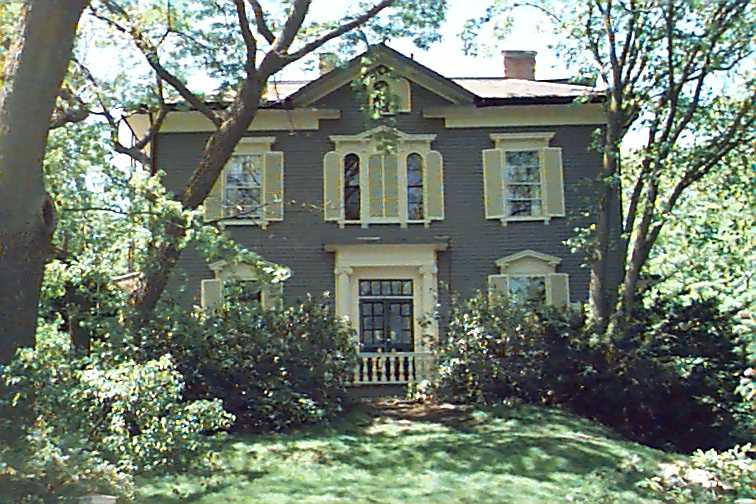
A pre-Civil War home in Brookline's historic center has dodged the wrecking ball, temporarily, thanks to a demolition stay issued by the Preservation Commission on Tuesday night.
The commission voted 7 to 0 at its July 13 meeting to give the federally-recognized building at 11 Chestnut Place an 18-month reprieve from demolition because of its historical and architectural significance.
The property's owner, Fred Destin, originally planned to give the building a so-called "green" renovation and keep intact its historic structure, but the cost to transform it into a LEED Platinum Certified Building – a classification for especially environmentally-friendly buildings that include features like geothermal heating systems – was deemed prohibitive.
Find out what's happening in Brooklinefor free with the latest updates from Patch.
It was "much more economically viable" to tear down the old building and start from scratch, said architect Jeffrey Klug, who represented the absent owner along with contruction manager Marc Truant.
Built in 1855 near Brookline's Old Burying Ground, the home has had several prominent owners, including Boston businessman Abraham L. Cutler and Henry Richardson Shepley, whose firm Shepley Bulfinch designed such landmarks as Massachusetts General Hospital and the Woods Hole Oceanographic Institute.
Find out what's happening in Brooklinefor free with the latest updates from Patch.
"It's really disturbing, the idea to rip down this building to create a LEED Platinum building," commission Vice-Chair David King said. "It just doesn't make any sense to me."
Member Linda Leary concurred, calling 11 Chestnut Place a "very unique" property.
Tom Urmy, whose address at 29 Chestnut Place provides him with a more personal view, spoke out strongly at the hearing against the proposed demolition.
Calling the house "the soul of the neighborhood," Urmy recalled how dissapointed he and his wife were when they learned that the current owner had gutted the inside of the home, destroying many of the 28 years of memories they had built with their neighbors. A slide show of the property showed what remains of the inside – only bare wood floors and beams, no plaster or paint in sight.
If the home is eventually demolished, Urmy said he'd like to see something built that suits the historic sensitivity of the area.
"I hope it's worthy of the site and its place as a focal point of this neighborhood," he said.
Brookline's town preservation planners, in a report drafted for the commission, determined that the 155-year-old Italianate-style house and its garage met three requirements needed to avoid demolition. First, the building is listed on or is within an area listed on the National Register of Historic Places. Second, it is associated with one or more significant historic persons, and third, the building itself is historically or architecturally significant in terms of its period, style or method of building construction.
The next step for the owner is to meet with a subcomittee of the commission to examine alternatives to demolition, preservation planner Greer Hardwicke said.
In an effort to give opponents of the demolition a more permanent solution, Town Meeting member Dennis DeWitt suggested at the hearing that if enough neighborhood residents agree, the area could be voted a Local Historic District. That would save the building altogether, avoiding what DeWitt called an "appalling" proposal to destroy it, though he cautioned such an historic designation could be difficult to obtain.
Commission member Judith Selwyn asked the owner's representatives, Klug and Truant, to consider constructing a new building at a different location on the property, while preserving the history of the site.
"We've seen too many demolition applications in this neighborhood," Selwyn said.