Politics & Government
Public Hearing Attendees Split On Police In Brookline Schools
Some lauded the school officer as a trusted adult for students, while others questioned why a social service worker couldn't fill that role.


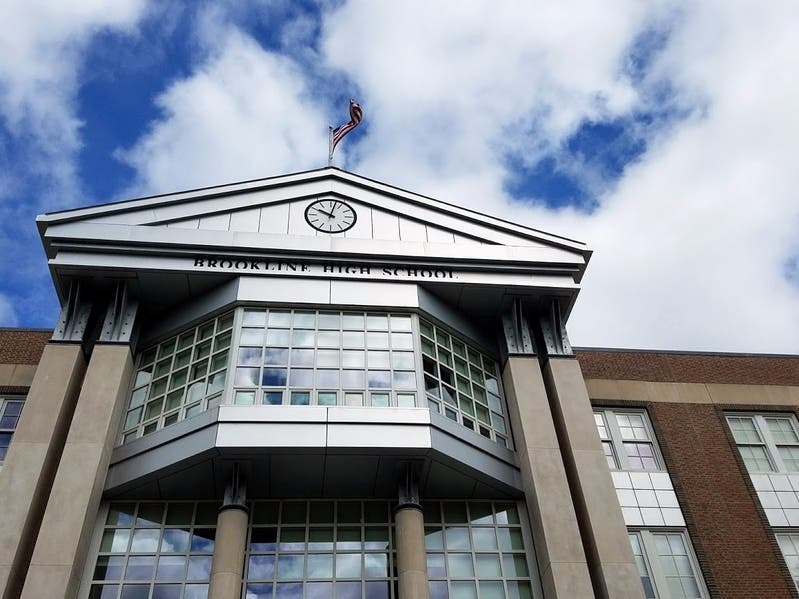
BROOKLINE, MA — Public opinion on the presence of police officers in Brookline schools was split at a hearing Tuesday afternoon, as some educators touted the benefits of student-officer relationships, while residents questioned why social services couldn’t be delivered by someone outside of law enforcement.
The hearing was to discuss the recommendation from the Subcommittee on School Resource Officers — one of five subcommittees of the Task Force to Reimagine Policing in Brookline — which suggests a reauthorization process for school resource officers, designed to measure the effectiveness of having them in schools and community need, with a special focus on racial equity. The task force and subcommittees were formed in July 2020 and are holding public hearings this week to discuss their research and findings over the past six months.
School resource officers — often known as SROs — in Brookline don’t act as disciplinarians, said Lisa Redding, dean at Brookline High School. That’s the responsibility of her office—if there’s a physical fight they still don’t bring in the school officer typically, unless it’s a large altercation that would require them to call the police.
Find out what's happening in Brooklinefor free with the latest updates from Patch.
“The goal of that role is to build relationships with students,” said Redding. “It is very much to intervene and to educate students, and it does have a restorative component.”
Marcie Miller teaches a legal studies class at BHS where the Officer Kaitlin Conneely, the high school's officer, will often come in to talk with the students. Miller said the Conneely’s presence benefits the 78 students in the program, as well as the students who consider her someone they can trust and confide in.
Find out what's happening in Brooklinefor free with the latest updates from Patch.
“The SRO doesn't need to mean a person with a gun in a uniform,” said Miller. “As police in general reform and reimagine their work this could be an area of change without eliminating the position.”
Others at the hearing disagreed and questioned why this social support needs to come from law enforcement.
“What purpose are they serving in the school?” asked Benjamin Buster. “Could that purpose be better served by somebody in a different occupation? And what abuses of power are possible? Not likely, but possible?”
Abby Erdmann, who taught at BHS for 45 years, said she worked to solve problems within the school building when she was an educator, and didn’t understand the need for police involvement in school. Erdmann questioned why the officer had to be the person building trust with students.
“I don’t see what makes an officer on the police dept particularly suited to that function,” Erdmann said.
Some people who spoke acknowledged that it sounded like the officer in the high school is a good person and a real resource for students, but questioned what would happen when she leaves and has to be replaced.
“We can’t think about it as a person,” said Deborah Brown, a town meeting member. “We have to think about it as a system.”
Miller, the BHS teacher, addressed that concern listed in the report at the beginning of the meeting.
“Why can’t this be a committee decision with students, teachers, parents, that is super transparent?” she asked.
The committee acknowledged in its report that some members of the community have supported the school officer program, while issuing a list of steps to reevaluate their role in schools.
“We believe that an authentic reauthorization process — one using the mechanisms of discussion, data collection, and identified accountability — is the correct path for the Town because it will allow us to achieve a better balance between the recently updated regulations, the perspectives of those who support school-police partnerships, and those who have important concerns about the partnerships,” the recommendation reads.
The steps include an audit of where school officers work; meeting with parents, students, school counselors, and advocacy groups; creating an evaluation for school officers’ performance; increasing the participation faculty and staff at schools; and the School Committee and superintendent’s commitment to focus one summer session to share findings of school-police partnerships and get community input.
The group is recommending that some of the steps—such as recruiting student and parental input—be taken in the spring of this year, to avoid low participation that would be expected in the summer.
If the district finds that it wants to continue employing school officers, the subcommittee recommends that it create and follow a memorandum of understanding that identifies six points:
- Why police officers can best serve this role instead of a social service worker
- The cost to the town and implications for the budget
- What data will be collected to evaluate the school officers' performance
- What data will be needed to measure the effects on students, and discover who is affected the most
- How the BPD will examine the data, particularly through the lens of racial equity
- A plan to share finding with parents and the Brookline community
Part of the subcommittee’s responsibility in submitting a recommendation was to research the history of the school resource officer program in Brookline—it found that the first police officer program in the schools was in 1986, when an officer came into the high school to teach a legal studies class. The district started the DARE program for middle schoolers and ninth graders in 1992, before discontinuing it in 2008. An MOA was signed in 2018, creating the formal position of the "school resource officer" in Brookline High School.
“This history leads this committee to challenge the need and even the titling of SROs according to the MOU,” the recommendation says. “What caused the BDP and PSB to place an SRO in BHS after 175 years of existence?”
The subcommittee is expected to present a revised draft — edited with the public comments in mind — to the Select Board on March 2.
Get more local news delivered straight to your inbox. Sign up for free Patch newsletters and alerts.