Politics & Government
Rudnick Ramps Up Senate Campaign With 'Town Hall' Telephone Conference
Challenger questions Sen. Creem's commitment, lays out positions on health care, education, taxes and donations
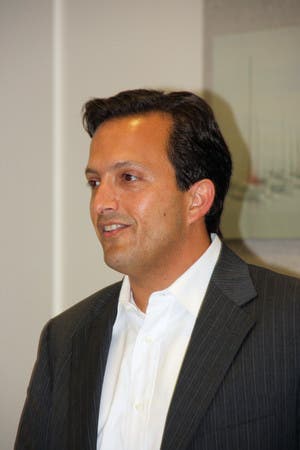
In an effort to ramp up his challenge to Sen. Cynthia Creem, Newton's Charles Rudnick brought his campaign directly to voters in Brookline, Newton and Wellesley on Monday night with what was billed as a "Town Hall"-style telephone conference call.
Rudnick used the question-and-answer format of the call to hammer home his four-point platform and to continue his assault on his opponent for maintaining her law practice while serving in the state Senate. The challenger is pushing a platform built around control of health care costs, "smart" economic growth, encouraging innovation in public education and rejecting campaign donations from special interests.
Another plank in Rudnick's platform is his commitment to only receiving campaign contributions from individual donors, and not political action committees or lobbyists. Creem, Rudnick says, has provided "too many conflicts of interest and not enough results," for the district.
Find out what's happening in Brooklinefor free with the latest updates from Patch.
Rudnick has accused Creem of being distant from her duties as a senator because she has maintained a law practice while in office. On almost every issue brought up during the town hall, Rudnick mentioned that his work on Beacon Hill would benefit from his being a "full-time senator" free of conflicts from campaign contributors and other special interests.
Creem supports have repeatedly rejected the claim that the senator has not served her constituents well during her 12 years in the senate.
Find out what's happening in Brooklinefor free with the latest updates from Patch.
"The thing that matters is effectiveness and Sen. Creem has just been incredibly effective for Brookline, Newton and Wellesley," said Creem campaign spokesman Michael Sherry. Sherry added that Creem has a 99.1 percent attendance record in the Senate and is "always there, always working."
Creem's "work on the side for her family's law practice ... just gives her a better connection to regular people," and the small business issues she deal with in the Legislature, Sherry said.
Health care cost control was an issue of concern for callers as well as Rudnick.
"The reason I think this is such a critical importance is that it impacts people across the board in our state. It's impacting municipal budgets, it's impacting small businesses who can't grow or are aren't even coming to Massachusetts because of these costs," Rudnick said.
Though he could not offer a specific policy recommendation that he thinks would help lower health care costs, Rudnick said he would work with experts to develop solutions.
Responding to a question on the gas tax, Rudnick said that there are several benefits to raising prices at the pump.
"I think the gas tax is worth taking a hard look at," he said, adding that the tax could provide a steady revenue stream to help rebuild the state's transportation infrastructure after a "woeful lack of investment," in the past.
When asked by a caller how he would represent constituents who favor fiscal conservatism, Rudnick said that Beacon Hill is "not treating tax dollars with the respect they deserve," and that waste should be eliminated from the state budget. However, he does not support the ballot initiatives to lower the sales tax or remove the tax on alcohol, saying that it is not the time to eliminate those sources of revenue for the state.
When a caller asked the candidate about the on-going debate over increased gambling and destination casinos, Rudnick said that increasing gambling in Massachusetts would increase gambling addiction, substance abuse, domestic violence and other social problems and would not solve the state's fiscal woes with added revenue.
"I don't think that casino gambling is smart economic development policy and I don't think it's smart social policy," Rudnick said.
Small businesses in the areas surrounding destination casinos would also suffer, according to Rudnick.
"What you would see in all likelihood is business going to some of the local restaurants or local entertainment venues being sucked away into the destination resort casinos," Rudnick said."
A caller identified as "Adam from Auburndale" asked Rudnick how, as a freshman senator, he would compensate for the loss of seniority and power enjoyed by a 12-year veteran like Creem. Rudnick admitted that there are benefits to seniority, such as influence over major legislation and the chance to chair important committees.
But Rudnick accused Creem, the Senate chair of the Legislature's Judiciary committee, of failing to use her position to benefit the district, citing what he called failed efforts to reform the state probation department and to pass a gun control bill through her committee.
Creem formed a task force earlier this year when reports surfaced of corruption within the probation department. Rudnick said that he had not heard of any action taken by that task force and that it went on recess along with the rest of the legislature at the end of July.
Rudnick also accused Creem of a lack of leadership on alimony reform, saying that that too had been relegated to a task force.
Rudnick told listeners that as senator, he would host more town halls and open houses in order to better reach out to constituents, mentioning that while knocking on doors around the neighborhood, he has been surprised to find so many residents who could not name their state senator.
The Creem campaign is continuing to call and canvas around the district, appearing at the Coolidge Corner MBTA station last month with former governor, presidential candidate and Brookline resident Michael Dukakis. According to her campaign, Creem is also scheduled to attend the Brookline Farmers' Market this Thursday.
Finance reports released by both campaigns late last month show Rudnick trailing far behind Creem in fund raising, forcing him to loan his campaign $15,000 of his own money in late May.