Neighbor News
Nontraditional students find success at Southeastern
Students in vocational programs that are not traditional for their gender are doing well in their classes and Co-op jobs.

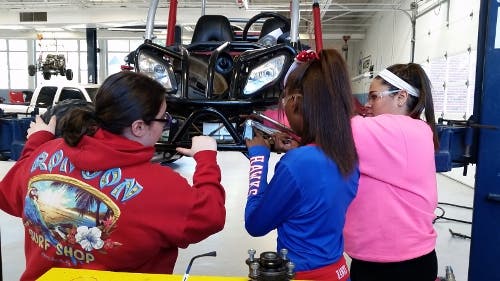
When Kaitlyn Hart, of Norton, started freshmen exploratory classes at Southeastern, she expected that she’d enroll in a vocational program that had an even number of boys and girls. Now, two years later, she is taking a much different route. Kaitlyn is one of just four junior girls enrolled in the Electrical program, which is not only one of the school’s most challenging shops, but one that is traditionally male-dominated.
“When I explored this shop, I found I was really good at it. I think it’s because I’ve always enjoyed hands-on projects at home,” she said.
Though Kaitlyn thought it might be intimidating at first, she quickly gained confidence. She found she could hold her own with male peers, and in fact did really well at problem solving skills, which is an extremely important skill for electricians.
Find out what's happening in Eastonfor free with the latest updates from Patch.
“Kaitlyn is doing very well, and so are the other girls,” said her teacher, Joseph McGuire. “All of them are at the top of their class, and I think that’s because they push themselves harder,” he said.
Ryan McFarland, also from Norton, planned to study a curriculum that involved engineering when he came to Southeastern, but after exploring different shops, he decided he liked Medical Assisting the best. The program, which started two years ago, had 100 percent girls in its first year, and some people asked why he chose to be in a female-dominated field.
Find out what's happening in Eastonfor free with the latest updates from Patch.
Ryan, however, said he loved the program right from the beginning. He said he loves working with hands-on skills, including checking blood pressure and finger pricking, and he plans to get his EMT (Emergency Medical Technician) license this summer.
“I love the thought of helping people in different ways. Some people outside the school have questioned me about it, but this is definitely what I want to do, so I’m not going to let anyone get in the way of that,” he said.
Kaitlyn and Ryan are just two examples of dozens of students at Southeastern who are enrolled in shops that are not traditional for their gender. There are just one or two handful of girls in most shops that involve construction or cars, including Electrical; Plumbing; HVAC and Refrigeration; Metal Fabrication; Collision Repair and Restoration; and Carpentry. Moreover, there are just a few boys in shops that involve health services, personal care, and education, including Medical Assisting; Health Services; Cosmetology; and Early Childhood Education.
Despite the challenges they may face, Southeastern administrators and teachers are encouraging students to choose nontraditional shops if that’s where their interests lie. Vocational Director Leslie Weckesser said nontraditional students are in constant demand.
“There are in general better opportunities for students who are nontraditional to their field. They are often positions with multiple career advancement opportunities and generally pay more than jobs that are traditional for their gender,” she said.
Altogether, the school has 212 students (not counting freshmen) that are considered to be nontraditional, but the numbers are deceiving because they include workplace employment as well as education. For instance, Legal and Protective Services and Culinary Arts are considered to be nontraditional for girls, even though there are more girls than boys enrolled in the programs. That’s because fewer than 25 percent of the fields’ employees are women, a criteria set by federal legislation through the Carl D. Perkins Vocational and Technical Education Act.
In fact, one of Southeastern’s instructors, Pam Foster, who teaches Legal and Protective Services, is considered to be nontraditional because she is a woman in a field that is dominated by men. She and Guidance Counselor David Joseph are the school’s nontraditional advisors, and part of their job involves participating in SEEL (Southeastern Equity Leaders), a regional collaborative that supports nontraditional students in career and vocational education.
Last year, SEEL took nontraditional students from several school districts to Otis Air National Guard Base, in Buzzards Bay, so they could participate in team building skills. The students were able to talk about their unique school experiences, and they also worked together in team-building activities, including a rope course.
“The message was, no matter who you are, you have to work together,” Mr. Joseph sad.
SEEL representative Jeff Perrotti, a consultant with the Massachusetts Department of Education, said the key to attracting and supporting nontraditional students is to help them believe in themselves. He said students need support in school, during the transitional period of getting a job, and in the workplace. He also said it is often harder for boys to fit in with nontraditional programs because they may experience more peer pressure. If they stick with their programs, however, they have a better chance of staying in their fields, and actually being more successful than females.
“Boys tend to get more jobs, and then work their way up to more powerful positions, such as the salon owners,” he said.
Cosmetology teacher Mary Kobey agrees that boys in her program have bright prospects, but she is concerned that some may not pursue the field because of peer or parental pressure. She said many men hair stylists in the area have been very successful, including Southeastern alumni Paul Joseph, who owns his own business (Paul Joseph’s Salon in North Easton).
Currently, her program has only one boy, and she is hoping those numbers increase. Her male student, Jake Ruskin of Norton, said he is very comfortable with the program, and he enjoys the creative element of cosmetology, such as exotic hair coloring.
“People are encouraging me to own my own salon, and it’s something I’ll think about. But right now, I want to take my time learning what I need to know,” he said.
Girls on the other hand have an easier time in school, but face more challenges once they are out in the workplace. Mr. Perrotti said one of the best ways to ensure that girls continue with a nontraditional trade is by placing them in the school’s Cooperative Education program, in which students work at a paid job in their trade during school hours. He said that Southeastern has been a leader in the program, placing girls in nontraditional jobs such as plumbing, auto technology and electricity.
Amber Goodwin, a senior from Brockton, is working at John Hoadley Plumbing and Heating, Inc., in Rockland, and she said she loves the work. In her opinion, girls are just as good as boys in her vocation, as long as they get the proper training.
“I like that I’m proving my abilities to everyone at my job,” she said.
Samantha Cronin, from Stoughton, is also working at a plumbing job, and in fact, often works with her mother, who manages a plumbing company, Angelos Plumbing, Heating and Cooling, in Stoughton. She said some of the customers were skeptical that she could do the work, but were very impressed with the finished results. Other customers were really happy to see a female at their door.
“Some of my customers have said that we need more women in the trade,” she said.
Southeastern freshmen will be placed in their majors on January 19, after having spent the first part of the year experiencing different vocational programs. Mrs. Weckesser said she and the teachers have encouraged all students to explore the nontraditional fields, and have provided them with information about job opportunities and pathways.
Once placed, teachers and advisors will continue their work to make sure that the students feel comfortable with their choices. Ms. Foster and Mr. Joseph will invite the nontraditional students to attend SEEL meetings, and they also plan to participate in another field trip to continue to build confidence.
“The most important message is that the students should be able to do what they want. If they love that program, that’s what they should be doing,” Mr. Joseph said.