Neighbor News
Birds, Environment Focus of London-Based Artist
ATM will give a Zoom talk for Falmouth Art Center on Thursday, April 14, at 4pm.


People who live on Daubeney Road in London may never have seen a sparrowhawk because the use of pesticides in the 1950s almost wiped out the birds in the region. That’s why the artist known as ATM painted a giant sparrowhawk on the side of a building on that street.
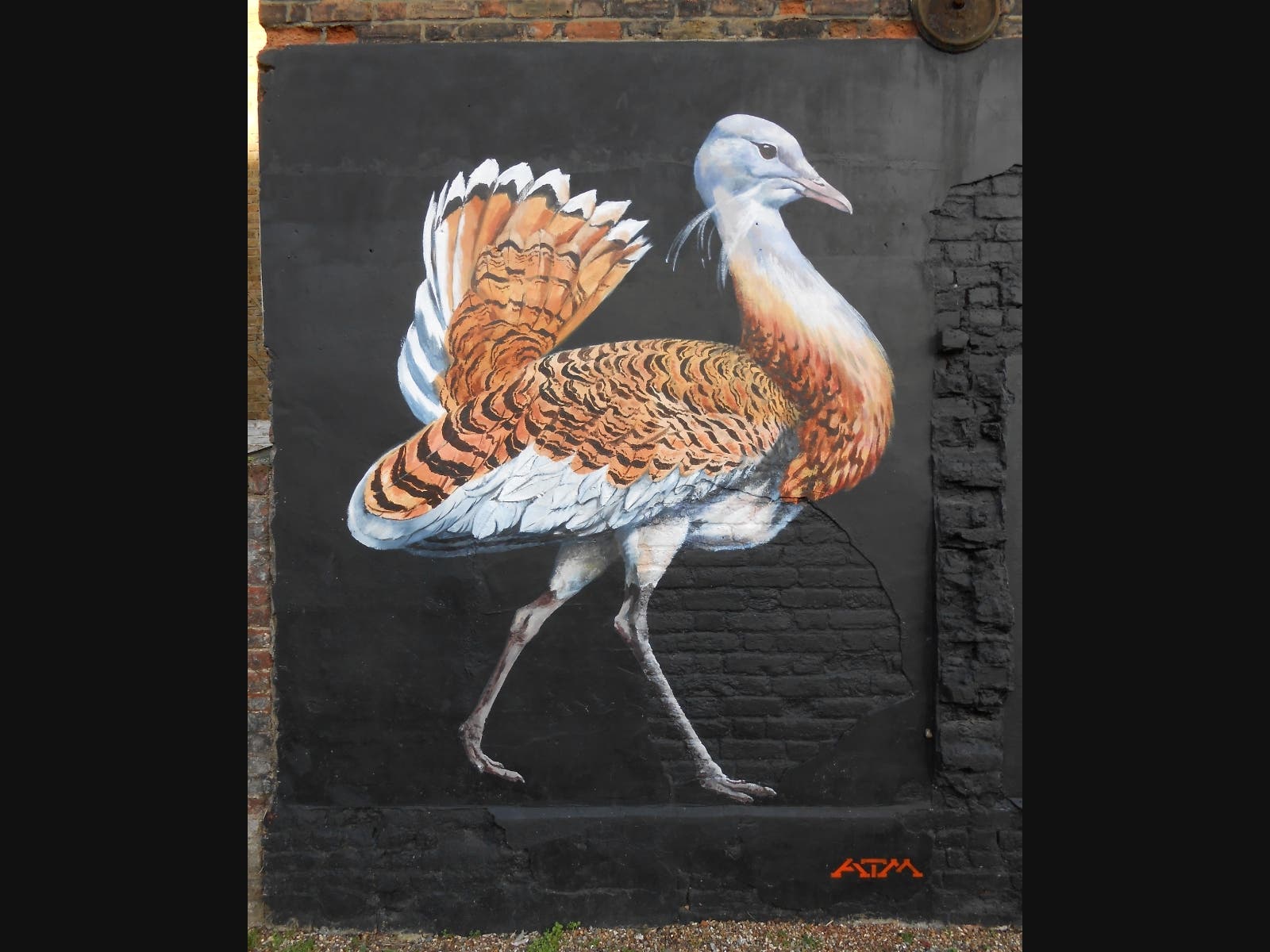
As for the type of raptor called a great bustard, the large ground-nesting bird became extinct in Great Britain when the last bird was shot in 1832. ATM’s mural of the colorful bird brings attention to the efforts to reintroduce it to the area.
By showing the beauty and significance of these creatures, the artist hopes to inspire interest, curiosity and a desire to protect them and the habitats they depend upon.
Find out what's happening in Falmouthfor free with the latest updates from Patch.
ATM will give a Zoom talk for Falmouth Art Center on Thursday, April 14, at 4pm. The talk is one of four in the Speaking of Art series of virtual talks, a spring fundraiser for Falmouth Art Center.
ATM was born Mark Anthony in an old mill town called Rochdale, in the North West of England. “I had an early love of birds and painting and exploring the steep-sided river valleys and the moors, the combination of the old industrial landscape and nature,” he said.
Find out what's happening in Falmouthfor free with the latest updates from Patch.
When he attended art college, he became more aware of different styles and approaches to painting. “I was told I was an anachronism at college for loving Renaissance techniques and trying to emulate them. I was told painting was dead, most definitely representational painting, and the future lay in conceptualism and new techniques like video,” he said.
After college, he was struggling to survive and painting as much as possible. He started making community and public art with two colleagues. “We came more and more to see art as having a vital role to play in social and political concerns, rather than being ironic and detached and about the inner workings of the artist as was the fashion at the time,” he said.
He and his friends started doing graffiti in protest of the commercialism and also to protest wars around the world.
Bringing art into the public domain, out of the galleries and accessible to all, his aim has been to reclaim some civic space from the ubiquitous advertising billboards, which, he said, sell an ideal of individual consumption as a route to happiness.
“I eventually found my true niche when I began making big wall paintings of birds, which brought together my love of nature, painting on a large scale, and feeling that art should play a part in the most important issues of our time.”
His wall murals offer “an alternative of active participation in collective environmental protection and improvement. We need to move away from a culture of tidiness and control of nature with our lawns and over-use of pesticides and herbicides, towards one of rewilding and restoration, a return to natural abundance, where nature’s processes are allowed to go their own way, even in parts of our urban environment,” he said.
ATM believes street art can play a valuable role in this cultural shift.
Tickets to hear ATM’s talk and other talks in the Speaking of Art series, can be purchased on Falmouth Art Center’s website at FalmouthArt.org or by calling the Art Center at 508-540-3304. Tickets are $50 per talk or all four talks for $150, a tax deductible donation. Those who purchase all four talks get a gift bag with a handmade piece of pottery and a handmade woven square made by Falmouth Art Center instructors and advanced students.