Neighbor News
Falmouth Alternative Approach Onshore Turbine Cables
Alternative Planned Approach Minimizes Overall Risks and Costs

Massachusetts plans to contract 5600 megawatts of offshore wind power by 2027. Each group of 800 megawatts of power equals 2 high voltage direct current cables to come on shore at some location. The 5600 megawatts of power means the need for 14 onshore cables to land somewhere.
The object of the offshore wind companies is to get the power from the ocean to Boston and urban locations where the power will be used.
Right now offshore wind contractors in Falmouth are using the “generator lead line” approach where each individual wind company develops its own cable route to the mainland. In this case, the offshore wind contractors bring their power to a power substation and electric ratepayers have to rebuild the grid from Falmouth to an off Cape location to move the power to Boston.
Find out what's happening in Falmouthfor free with the latest updates from Patch.
The "alternative planned” approach is a transmission system developed independently from the generation by the building of an ocean wind turbine grid using all ocean submarine cables to the large cities. This type of system minimizes overall risks and costs of achieving the state’s offshore wind and clean energy goals without electric ratepayers rebuilding the state's electric infrastructure.
Using all ocean submarine cables is very expensive for ocean wind contractors but the current method requires electric ratepayers to finance rebuilding the land-based grid.
Find out what's happening in Falmouthfor free with the latest updates from Patch.
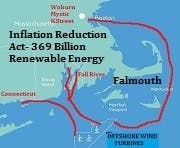
There is another win-win alternative for wind companies and ratepayers called the newly passed Inflation Reduction Act. The act sets aside 369 billion for renewable energy. The federal government would build the submarine cable infrastructure by sea to major coastal cities. The wind companies would then pay a fee to hook up to the infrastructure out in the ocean. This saves multiple wind companies to provide hundreds of miles of submarine cables and electric ratepayers don't need to pay to rebuild the old grid.
Think tank groups in Boston have already provided an independent economic analysis of the impact of developing an entire offshore wind industry in the United States using the "alternative planned" approach. This eliminates the need for a massive onshore power plant in Falmouth and speeds up the future growth of renewable energy.
The federal government and US taxpayers have already set aside 369 billion for renewable energy. It's time to run the ocean submarine cables directly to their destinations such as Boston and large cities in Connecticut.
There is no need to spend two years burying cables through a vacation destination like Falmouth.