Neighbor News
Falmouth HVDC Converter Plant Vs Drinking Water
Onshore Wind High Voltage Direct Current Converter Plant Environmental Issues

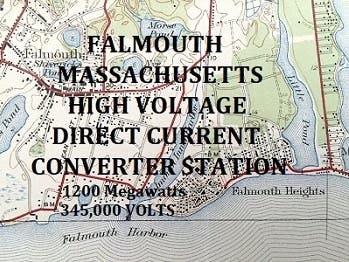
Offshore wind companies are planning two six-acre 1200 megawatt high-voltage direct current converter stations. These converter stations will change offshore high-voltage direct current (HVDC) to high-voltage alternating current (HVAC) between 220,000 to 345,000 volts.
The first HVDC converter station is Brayton Point near Fall River, Massachusetts the site of a former industrial 300-acre coal-burning plant now a brownfield site. The plant burned 10,000 pounds of coal a day from a nine-acre storage area.
The second proposed 6-plus acre HVDC converter station is in Falmouth, Massachusetts. Falmouth comprises a residential community, multiple distinct villages, boating, and the Cape's most popular vacation destination.
Find out what's happening in Falmouthfor free with the latest updates from Patch.
The Town of Falmouth gets 50 percent of its water from a reservoir and 50 percent from wells. The high voltage direct current converter station is proposed within the Cape Cod Aquifer which provides 100 percent of the Cape's drinking water. The Environmental Protection Agency under the Safe Drinking Water Act has designated the Cape water supply as a Sole Source Aquifer.
The proposed onshore wind-buried cable route will extend from Falmouth Heights Beach through residential neighborhoods to the HVDC converter substation at either 396 Gifford Street or 486 Thomas B Landers Road.
Find out what's happening in Falmouthfor free with the latest updates from Patch.
These high-voltage converter stations are new to the United States. The station will produce acoustic noise and serious levels of radio frequency interference. In Massachusetts, a noise nuisance is defined as: "a substantial and unreasonable interference with the use and enjoyment of someone else's property."
The town-owned wind turbines were deemed a noise nuisance by the courts and removed. Wind turbines generate two types of frequencies called regulatory noise and human annoyance noise aka infrasound.
During lightning strikes, accidents, mechanical failures, and overloads concrete containment is required for the HVDC converter station to prevent contaminating the Cape Cod aquifer in case of a spill. Overheating of transformer cooling fluids presents a major hazard and risk of fires and explosions.
(Note# Robots inspect HVDC converter stations )
In 2010 and 2012 there was a lot of political pressure to build megawatt wind turbines promising a revenue stream for 25 years. The Falmouth assistant town manager and wind turbine manager said: “We took on a huge risk and I think we were successful but we’re a large community and I think we can take on that risk.”
Today again there is a lot of political pressure to reach the Massachusetts renewable energy goal by 2025. Offshore wind contractors want to partner with the town providing around only 1 (one) percent of the annual budget for twenty years.
Falmouth on January 9, 2024, is redefining the wind energy system bylaws.
Can Cape Cod and Falmouth afford to risk the drinking water?
Massachusetts
.jpeg)
Map/ picture credit Frank Haggerty
Falmouth proposed locations of HVDC electric substations near reservoir and wells